
AI GTM Engineer Skills in 2026: The Complete Career Roadmap
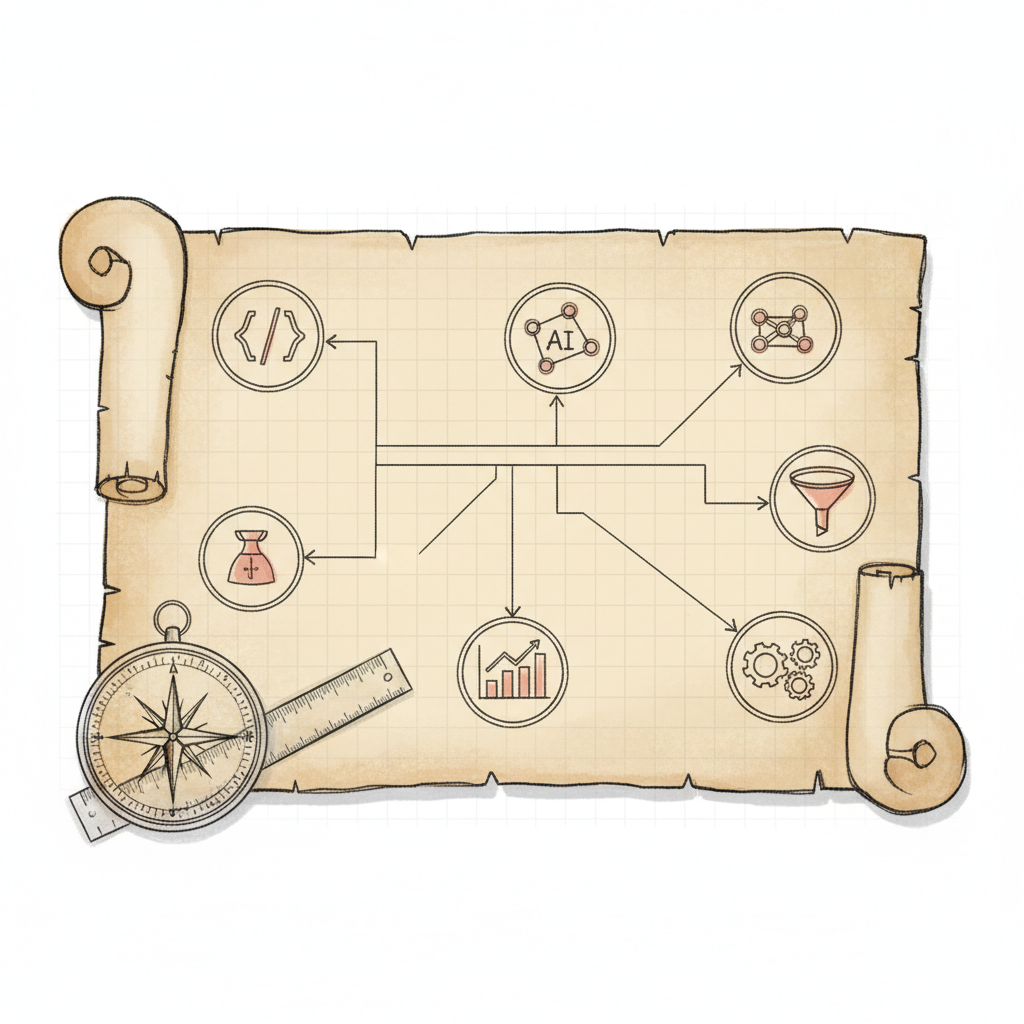
GTM engineer job postings grew 205% last year. The skills list everyone publishes is incomplete — here is what 2026 actually requires.
Most articles on GTM engineering cover one thing: Clay and cold outbound. That is half the job at most. In 2026 the role split into two distinct tracks — sales-side and marketing-side — and AI fundamentally rewrote the required skill set for both. This roadmap covers the full picture.
What Is an AI GTM Engineer in 2026?
An AI GTM engineer is a builder who sits between go-to-market strategy and technical execution. They automate the systems that generate pipeline, not just the tasks inside those systems.
The role went from a niche title to a mainstream career path between 2023 and 2026. Job postings grew 205% year-over-year, according to reporting from Apollo.io and industry aggregators tracking the category. Compensation on the sales-side track now ranges from $120K to $250K. The marketing-side track is emerging at $90K to $160K — and growing faster.
What separates a GTM engineer from a marketing ops hire?
A marketing ops hire configures tools. A GTM engineer designs systems. The distinction is scale: a GTM engineer builds something that runs without them. They think in workflows, data flows, and API calls — not dashboards and reports.
AI changed the skills list significantly from what it looked like in 2024. A year ago, the job was mostly Clay tables and Apollo sequences. In 2026, LLM integration, prompt engineering at scale, and AI-powered content pipelines are core requirements — not advanced specializations.
The two tracks diverge at the tool layer but share a common foundation. Sales-side GTM engineers focus on outbound automation, enrichment, and intent routing. Marketing-side GTM engineers focus on content pipelines, topical authority, and AEO (answer engine optimization). Both tracks require the same five core skills before specializing.
The 5 Core Skills Every AI GTM Engineer Needs
These five skills are non-negotiable in 2026. They apply to both tracks. Master these before picking a specialization.
1. Systems Thinking
Systems thinking means designing for scale, not one-offs. Every process you build should run 1,000 times without you touching it.
Practically, this means mapping inputs, outputs, failure states, and edge cases before writing a single automation step. GTM engineers who skip this step build Rube Goldberg machines that break on Monday morning. The skill is not technical — it is architectural. You learn it by building and watching things break, then rebuilding with better error handling.
2. API and Webhook Fluency
API fluency means connecting tools without needing an engineering team on call. You do not need to build APIs. You need to read documentation, authenticate requests, parse JSON responses, and chain webhooks across systems.
This is the skill that makes GTM engineers 10x faster than their non-technical counterparts. When a new enrichment tool launches, you can evaluate and integrate it in hours. When a competitor changes their data format, you fix the pipeline yourself.
3. Data Analysis
SQL basics are now a baseline requirement, not a bonus. GTM engineers pull their own data, validate ICP fit, and build propensity scores without waiting for an analyst.
The specific skills: writing SELECT queries with JOINs, understanding data normalization, and reading enrichment data well enough to spot quality issues. Bonus: familiarity with tools like Hex or Metabase for lightweight dashboards.
4. AI Prompt Engineering at Scale
Prompt engineering for GTM is not the same as prompting ChatGPT for personal use. You need consistent, structured output from LLMs running across thousands of records.
This means writing system prompts with explicit output schemas, building validation loops that catch hallucinations, and structuring AI columns in tools like Clay that process rows in bulk. In 2026, this skill separates GTM engineers who use AI from those who build with it.
5. Workflow Automation
n8n, Zapier, and Make are the primary tools. n8n is the most powerful for complex logic and self-hosted setups. Zapier is the fastest for simple integrations. Make sits in the middle.
Pick one and go deep before learning the others. The underlying logic transfers — triggers, actions, conditionals, error paths — but the syntax does not. Mastery of one tool is worth more than surface-level familiarity with three.
Sales-Side AI GTM Engineer Skills
Sales-side GTM engineering is the more established track. The tooling is mature, the community is active, and the comp ceiling is higher.
Clay mastery is the primary differentiator on this track. Clay is a data enrichment and workflow tool that connects dozens of data sources and runs AI logic across enriched records. Specific skills: waterfall enrichment (chaining multiple data providers to maximize match rates), AI columns (running GPT-4 prompts on enriched data to qualify or personalize at scale), and table automations that trigger sequences when conditions are met.
Clay's documentation and community are the best starting points. The platform ships new features weekly in 2026 — staying current is part of the job.
Email deliverability is a non-negotiable skill that most job descriptions bury in the fine print. Domain rotation, warm-up protocols, and sending limits are the mechanics that keep outbound campaigns out of spam folders. Specifically: setting up multiple sending domains, using warm-up tools like Mailreach or Smartlead, and monitoring bounce rates and spam complaints at the domain level.
Multi-channel outbound sequences combine email, LinkedIn, and cold calling into coordinated touchpoints. The skill is sequencing logic — who gets what message, at what time, triggered by what behavior. Tools like Smartlead, Outreach, and Salesloft handle the execution. The GTM engineer designs the logic.
Intent signal routing is where this track gets sophisticated. G2 buyer intent, Bombora surge data, and hiring signals (new VP of Sales at a target account) trigger sequences automatically. The GTM engineer builds the routing rules that connect signal to action — no manual review required.
Marketing-Side AI GTM Engineer Skills
This is the underserved track. Almost no one is teaching it. That is the opportunity.
Marketing-side GTM engineering applies the same systems thinking and automation skills to content, SEO, and distribution. The output is pipeline generated through inbound — organic search, AI citations, and content distribution — instead of outbound.
Topical authority strategy is the foundational skill. This means understanding keyword clustering, pillar-hub-spoke content architecture, and how to build a topic cluster that ranks for an entire subject area rather than individual keywords. The GTM engineer designs the content map, not just individual articles. Tools: Ahrefs, Semrush, and custom keyword clustering scripts.
AEO optimization is the 2026 skill that barely existed in 2024. AEO stands for answer engine optimization — structuring content so that AI systems like ChatGPT, Perplexity, and Google's AI Overviews cite your brand in their answers. This requires understanding how LLMs consume and weight structured content: short definitive answers, schema markup, high E-E-A-T signals, and entity clarity across your content portfolio.
Content pipeline design is the automation layer. A marketing-side GTM engineer builds the system that takes a keyword input and produces a published article — research, brief, draft, edit, publish — with minimal human intervention. The pipeline integrates tools like Perplexity for research, Claude or GPT-4 for drafting, and WordPress or Webflow for publishing via API.
Distribution automation closes the loop. One piece of content becomes a LinkedIn post, a Twitter thread, a newsletter excerpt, and a Skool community update — automatically. The GTM engineer builds the workflow that handles format conversion and scheduling. One input, all channels, no manual copying.
This is the track AI Topia builds tooling for. The platform automates the marketing-side content pipeline from keyword to published article to distributed social content.
How to Build Your AI GTM Engineering Skills in 90 Days
90 days is enough time to go from zero to a working system if you follow a sequential skill build. Here is the roadmap.
Month 1: Systems Thinking and One Automation Tool
Do not pick your track yet. Build the foundation.
Week 1-2: Study systems thinking. Read "Thinking in Systems" by Donella Meadows. Map three existing processes in your current role — even simple ones — as input/output/failure-state diagrams.
Week 3-4: Pick n8n and build five automations. Start simple: a webhook that sends a Slack message when a form is submitted. Progress to multi-step workflows with conditional logic. The goal is fluency with trigger-action-error logic, not complexity.
By day 30 you should be able to look at any manual GTM process and immediately see where automation fits.
Month 2: Pick Your Track and Master the Core Tool
Choose sales-side or marketing-side based on your current role and target comp.
Sales-side: Spend month 2 inside Clay. Build a complete enrichment table for your ICP. Layer in AI columns for qualification scoring. Connect it to a sending tool and run a small campaign. The goal is one end-to-end outbound system, however small.
Marketing-side: Spend month 2 building a content pipeline. Start with keyword research and a topic cluster map. Build a brief template. Connect an AI writing tool via API. Publish three articles using the pipeline. The goal is one end-to-end content system, however small.
Month 3: Build One Complete System and Document It
Month 3 is portfolio month. Take what you built in month 2 and make it production-grade.
Add error handling. Add monitoring. Write documentation as if you are handing it off to someone else. Record a Loom walkthrough. Post the case study on LinkedIn.
This case study is your proof of work. It gets you hired, gets you clients, or gets you promoted — depending on your goal.
For marketing-side GTM engineering, the AI Topia community is the best place to build alongside practitioners doing this work in 2026. The community covers content pipelines, AEO strategy, and distribution automation — the exact skills this track requires. Join at getaitopia.io.
FAQ
Do AI GTM engineers need to know how to code?
No. GTM engineers need API fluency — the ability to read documentation, authenticate requests, and parse responses — but not the ability to write production code. Most GTM automation runs on no-code and low-code tools. Basic JavaScript or Python helps with custom logic in tools like n8n or Clay, but it is not a hard requirement to start.
What is the difference between a GTM engineer and a growth engineer?
A growth engineer typically works inside a product engineering team, running A/B tests and optimizing conversion funnels at the code level. A GTM engineer works at the go-to-market layer — outbound, content, distribution — and operates primarily with no-code and low-code tools. The roles overlap in growth strategy but diverge sharply in technical depth and team placement.
How long does it take to become an AI GTM engineer?
90 days to a working system. 6 months to a portfolio worth showing. 12 months to be competitive for senior roles paying $150K+. The fastest path: build real systems in your current role, document them publicly, and apply what you learn immediately. Reading and courses alone will not get you there.
Which track pays more: sales-side or marketing-side GTM engineering?
Sales-side currently pays more. The range for experienced sales-side GTM engineers is $120K to $250K depending on the company and scope. Marketing-side is emerging at $90K to $160K, with the ceiling rising as the role becomes more defined. The marketing-side track has a first-mover advantage right now — the people building expertise in 2026 will set the market rate in 2027.
Is Clay certification worth it for GTM engineers?
Yes, for the sales-side track. Clay certification signals hands-on platform knowledge to hiring managers and clients who use Clay heavily. It is not a substitute for a portfolio of real work, but it accelerates credibility in the first 30 seconds of a job interview or sales conversation. For marketing-side GTM engineers, Clay is less central — invest that time in building content pipeline case studies instead.
Learn marketing-side GTM engineering inside the AI Topia community — getaitopia.io
Ready to Automate Your Business?
Book a 30-minute call to discuss how AI can transform your Marketing, Sales, or Operations.
Book a Call