
AI-Native vs AI-Assisted: Why One Gets Free Upgrades and the Other Doesn't
Anthropic shipped Claude Opus 4.8. Parallel subagents. 10x lower overconfidence. A measurable improvement in reliability at scale.
Two types of teams woke up the next morning in different positions.
AI-native teams: their platform got sharper overnight. No changes required. The model improved; every workflow built on it improved with it.
AI-assisted teams: they saw the announcement, added "evaluate Opus 4.8 for our stack" to the backlog, and went back to their current toolset.
This is not about which tools you use. It's about how deeply the infrastructure is built.
Defining the Terms
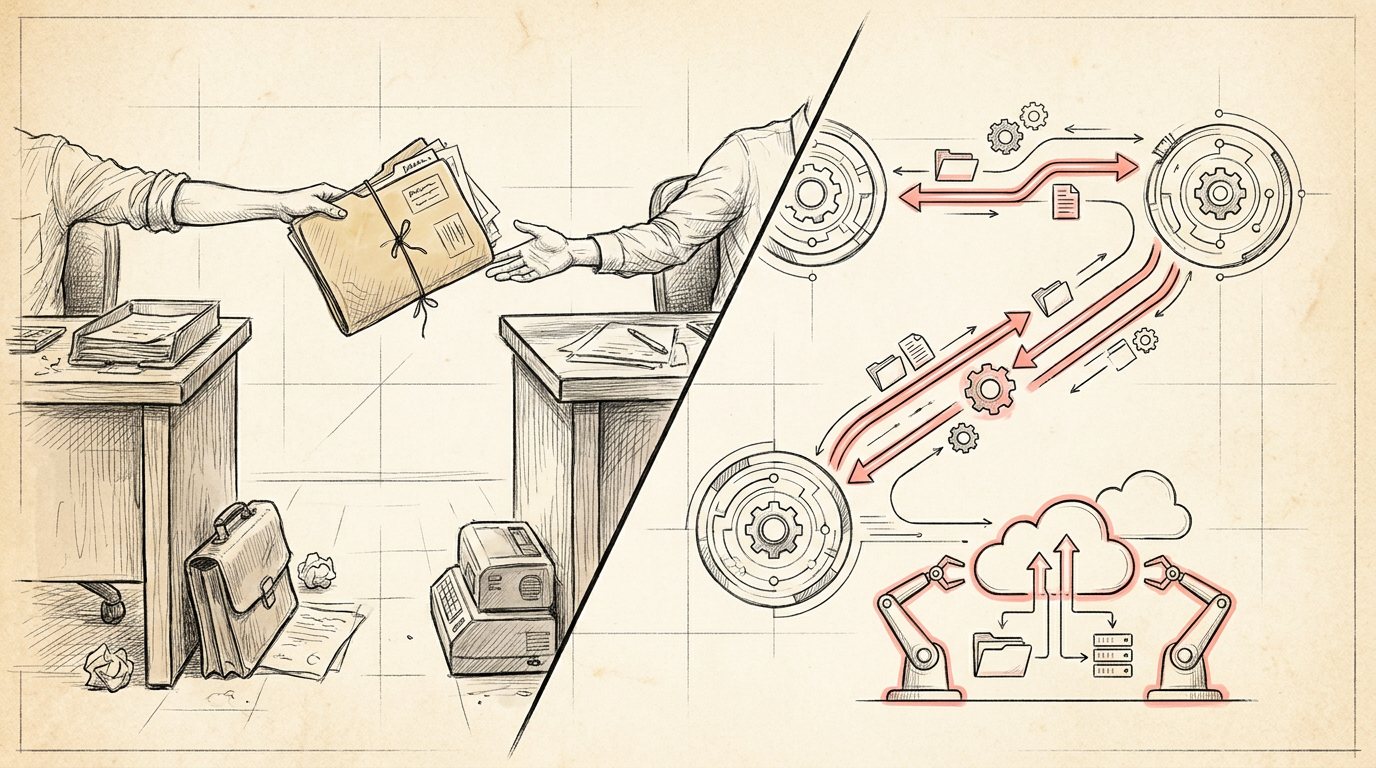
AI-assisted means AI is one tool in a larger manually-managed process. A copywriter uses ChatGPT to draft a section. A sales rep uses an AI tool to clean a prospect list. A manager uses an AI tool to summarize a meeting. Each use is discrete, initiated by a human, and exits back to a human-managed workflow.
AI-assisted teams move faster because humans are doing less manual work. The human is still the connective tissue between each AI step.
AI-native means the workflow itself is built on AI infrastructure. The agents are the connective tissue. Humans set direction and review outputs — they don't manage the hand-offs between steps.
An AI-native content operation doesn't have a human moving a brief to a writer to an editor to a publisher. An agent scouts topics, research agents pull data in parallel, writer agents produce drafts, audit agents verify quality, a linking agent adds internal links, and a publish agent routes to the platform. Humans approve the output and set the strategy. The execution chain runs without human coordination in the middle.
The distinction sounds incremental. The compounding difference is not.
The Free Upgrade Problem
When Anthropic ships a better model, what happens in each type of organization?
AI-assisted organization
- Someone on the team sees the announcement
- They evaluate whether the new model is worth adopting
- If yes: they update prompts, test outputs, retrain the team on new behaviors
- Each individual tool that uses AI may need separate updates
- The workflow improvements are marginal — the bottleneck was never the model, it was the manual coordination between steps
Time to benefit: weeks. Multiplied by however many AI touchpoints exist in the org.
AI-native organization
- The model parameter in the infrastructure updates to the new version
- Every agent running on that infrastructure is now running on the better model
- Parallel subagent capabilities are available to every workflow that benefits from them
- Trust improvements reduce the frequency of human review interrupts — automatically
Time to benefit: immediate. Zero coordination required.
The compounding effect is not just speed. It's coverage. An AI-native organization doesn't have to decide which workflows to upgrade. Every workflow upgrades simultaneously because they all run on the same foundation.
Why the Gap Widens Over Time
Model releases are not one-time events. Anthropic, OpenAI, Google, and Meta are each releasing major model improvements multiple times per year. Each release widens the capability delta between the current frontier and the previous generation.
For AI-assisted teams, each release is an adoption event. Evaluate, decide, implement, retrain. Some improvements get adopted quickly; others sit in the backlog indefinitely; some never get implemented because the workflow integration cost isn't worth it.
For AI-native teams, each release is an automatic upgrade. No evaluation cycle, no implementation backlog, no retraining cost. The infrastructure absorbs the improvement and every workflow benefits.
Over 12 months, with 4-6 major model releases: the AI-native team has automatically incorporated all of them. The AI-assisted team has manually adopted some percentage of them, incompletely, at a significant coordination cost.
The gap at month 12 is not the gap at month 1 multiplied by a constant. It's compounding. Each model release is a delta that the AI-native team absorbs in full and the AI-assisted team absorbs in part — at a lag.
The Orchestration Gap
The parallel subagent capabilities in Opus 4.8 illustrate a specific version of this gap.
AI-assisted teams can use subagents. But getting leverage from them requires redesigning your prompt patterns, rethinking how workflows are structured, and building the orchestration logic externally. That's a project.
AI-native teams built with orchestration in mind from the start. Their architecture already thinks in terms of parallel work streams, orchestrators and subagents, verification passes. When Opus 4.8 makes that pattern more capable, they go deeper on what was already working. No redesign required.
The architectural choice made at day one determines whether capability improvements are free upgrades or costly adoption projects.
What AI-Native Actually Requires
Being AI-native is not about using more AI tools. It's about where the connective tissue lives.
AI-assisted connective tissue: human hands moving work between tools, human judgment deciding when to initiate each AI step, human coordination managing the workflow.
AI-native connective tissue: agents managing hand-offs, orchestrators routing work, verification passes replacing human quality gates, schedules replacing human initiation.
The practical test: if the humans on your team disappeared for a week, how much of your execution continues? AI-assisted operations stop. AI-native operations continue — they just accumulate a review queue.
Building to that standard requires:
1. Agent-first workflow design. Start from the assumption that agents will handle execution. Design the workflow around what agents need — structured inputs, defined outputs, clear verification criteria — not around what humans are comfortable reviewing.
2. Orchestration over tool-use. Individual AI tool calls are not AI-native infrastructure. Orchestrated execution chains — where one agent manages others, passes context, verifies outputs, and routes results — are. The difference is whether you're using AI as a lookup or as a workflow engine.
3. Memory and compounding. AI-native systems learn. Preferences persist across sessions. Feedback improves future outputs without requiring manual updates. CLAUDE.md + MEMORY.md patterns in Claude Code are the lightweight version; full RAG layers with organizational knowledge are the deeper version. Systems that start from zero every time are not native — they're stateless tools.
4. Human review as exception, not bottleneck. AI-assisted teams route everything through human review before it advances. AI-native teams define what requires human review (strategy, high-stakes decisions, novel situations) and what doesn't (routine execution, structured reports, templated outputs). The review rate decreases over time as the system proves reliability.
The Talent Analogy
Hiring a senior engineer and asking them to work on tasks a junior could handle is waste. The value of seniority is not faster execution of basic tasks — it's the capacity to handle more complex problems, make better judgment calls, and work more autonomously.
Model improvements are analogous to seniority increases in your workforce. Every Opus release is, in some sense, your AI team getting promoted.
AI-assisted organizations give their promoted team the same tasks as before, maybe slightly faster.
AI-native organizations continuously rebalance: what can the agents handle that humans were handling before? Where does the human's role shift from execution to direction? What gets removed from the human's plate with each capability increase?
The question is not "what can we do with the new model?" It's "what can we stop managing manually now that the model is better at it?"
Objections
"We're not ready to go fully AI-native."
Fair. The starting point is not fully native — it's structurally native. Design your first two workflows as orchestrated chains rather than human-coordinated tool use. The principle applies at any scale. Two native workflows compound better than twenty AI-assisted ones.
"We need humans in the loop for quality."
Correct — at the right checkpoints. The goal is not removing humans from quality judgment. It's removing humans from coordination tasks: moving work between steps, initiating the next prompt, managing the hand-off. Those steps don't add quality. They add latency. Human review at the output — yes. Human coordination at every step — no.
"Our use case is too complex for AI agents."
Complexity favors native architecture. Simple, one-step tasks work fine as AI-assisted. Complex, multi-step workflows — with research, drafting, verification, routing, publishing — break down when managed manually and scale when orchestrated. The more complex the use case, the more leverage native architecture provides.
The Positioning of AI Topia
AI Topia's AI CMO platform is built AI-native by design.
Scout agents monitor competitors and trends on a schedule. Research agents pull keyword data, SERP analysis, and AEO citation coverage in parallel subagents. Writer agents draft content in brand voice against approved briefs. Audit agents verify AEO structure. Linking agents add internal links from the knowledge base. Publish agents route approved content to the blog.
Humans set strategy, approve briefs, and review final outputs. The execution chain between strategy and published content runs without human coordination in the middle.
When Opus 4.8 ships parallel subagents and improved reliability — everything above gets sharper. Research runs deeper in the same time window. Verification catches more. Audit passes require less human review because the trust bar on outputs is higher.
We changed nothing. The foundation improved. Every workflow on it improved with it.
That is what AI-native means. And it's why the teams building this way now will be operating at a different level in 12 months than the teams still adopting improvements manually.
For a practical starting point on building AI-native infrastructure with Claude Code: How to Set Up Claude Code: Complete Guide for Founders.
For more on the Opus 4.8 capabilities that widen this gap: Claude Opus 4.8: What It Actually Means for AI Automation Builders.
FAQ
What is the difference between AI-native and AI-assisted?
AI-native means the workflow execution itself runs on AI infrastructure — agents handle the connective tissue between steps, orchestrators manage hand-offs, and humans set direction and review outputs rather than coordinating every step. AI-assisted means AI is one tool among many in a manually-managed process — humans initiate each AI step and move the output to the next tool themselves. The difference is where the coordination load lives: in the agents or in the people.
Do I need to rebuild everything to become AI-native?
No. Start with one or two workflows redesigned as orchestrated chains rather than human-coordinated tool use. A single well-designed native workflow — where an orchestrator manages subagents, passes context, verifies outputs, and routes results — teaches the architectural principles and demonstrates the compounding value more clearly than twenty AI-assisted workflows. Expand from there.
Why do AI-native teams benefit more from model upgrades?
Because the upgrade propagates through the infrastructure automatically. When the underlying model improves, every agent running on it improves simultaneously. AI-assisted teams have to manually re-evaluate, re-prompt, and re-integrate the new model for each individual use case — which takes time, has adoption friction, and never reaches 100% coverage. Native teams receive the full delta instantly, across everything.
Is AI-native only for large companies?
The opposite is true. AI-native architecture provides the most leverage to small teams — because small teams have the least execution capacity relative to scope. A two-person marketing team running AI-native content infrastructure can operate at the output level of a five-person team. A solo founder with AI-native sales automation can cover more pipeline than a two-rep team running AI-assisted tools. The fewer humans you have, the more the compounding advantage matters.
What is the first step toward AI-native infrastructure?
Design one workflow as an orchestrated chain. Pick a repetitive process with clear inputs and outputs — content production, prospect research, weekly reporting. Map the steps. Identify which steps can run in parallel. Build an orchestrator (in Claude Code, or as an agent prompt) that decomposes the task, delegates to subagents, verifies outputs, and returns a consolidated result. The first native workflow is the hardest to build and the most instructive. After one, the pattern becomes replicable.
How does AI Topia use AI-native architecture?
AI Topia's AI CMO platform runs content operations as orchestrated agent chains — scout, research, brief, write, audit, link, publish — with parallel subagents handling simultaneous work streams at each stage. The human role is strategy setting, brief approval, and final output review. Execution between strategy and published content runs without human coordination in the middle. Every Anthropic model release improves the platform without requiring architectural changes.
Ready to Automate Your Business?
Book a 30-minute call to discuss how AI can transform your Marketing, Sales, or Operations.
Book a Call