
Claude Subagents Explained: How Multi-Agent Orchestration Changes What's Possible
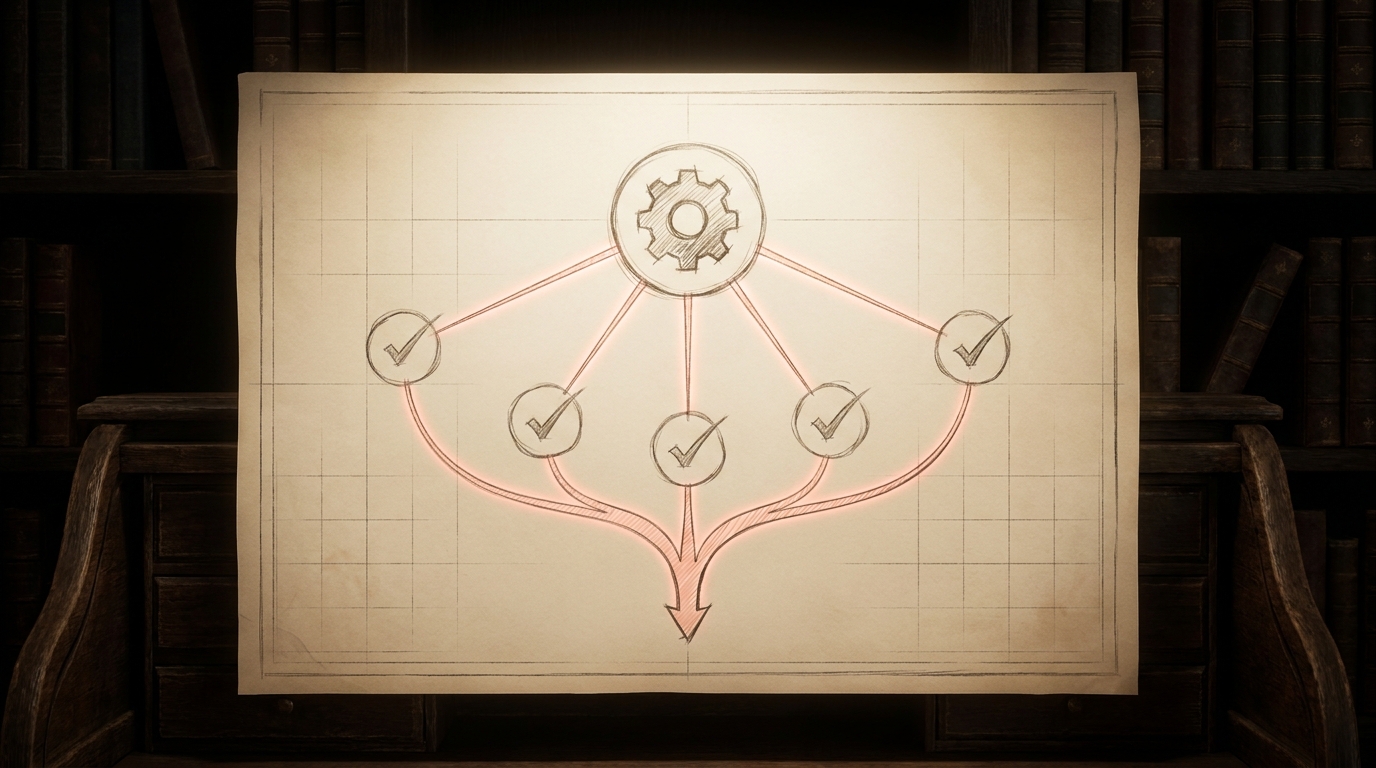
Most AI automation runs sequentially. One prompt, one response, one output. You get the next result after the last one finishes.
Claude subagents break that pattern entirely.
A single instruction can now spawn multiple Claude agents running in parallel — each handling a different part of the task simultaneously, verifying each other's outputs, and consolidating results back into one coherent response.
Here's how it works, why it matters, and what it changes for teams building on Claude.
What Are Claude Subagents?
A Claude subagent is a Claude instance spawned by a parent agent to handle a specific sub-task.
The parent agent receives an instruction, plans the work, identifies components that can run independently, and spawns subagents to execute each component in parallel. When the subagents complete their work, the parent verifies the outputs, reconciles any conflicts, and returns the final consolidated result.
The key word is parallel. Not sequential delegation — simultaneous execution.
Before subagents: a complex research task runs step by step. Pull source A, then source B, then source C. Each step waits for the previous one.
With subagents: sources A, B, and C are pulled simultaneously by three parallel agents. The parent waits for all three, compares the outputs, and synthesizes the result. Total time: the duration of the longest single step, not the sum of all steps.
The Architecture: How It Actually Works
Claude's multi-agent orchestration follows a three-layer structure:
Layer 1 — The orchestrator (parent agent) Receives the task, decomposes it into parallel work streams, spawns subagents, monitors execution, verifies outputs, handles errors, and returns the final result. Does not do the granular work itself — delegates it.
Layer 2 — The subagents Each subagent receives a specific, scoped task from the orchestrator. It executes that task — which may involve tool calls, file reads, API requests, or further decomposition — and returns its output back to the orchestrator.
Layer 3 — Verification Before returning the final result, the orchestrator runs a verification pass — cross-checking subagent outputs for consistency, flagging conflicts, and resolving discrepancies. This is what makes the system reliable rather than just fast.
The orchestrator pattern maps to how complex work actually gets done in organizations: a manager who plans, delegates to specialists, checks the work, and integrates it into a coherent deliverable.
Why This Changes the Economics
Sequential AI automation has a fundamental ceiling: every complex task takes N steps times the average step duration. You can make each step faster, but you can't collapse the sequential structure without a different architecture.
Subagents collapse the sequential structure.
Research at scale: Instead of pulling 20 sources one by one, spawn 20 parallel subagents — one per source. Total time = the duration of one pull, not twenty.
Multi-channel content: Instead of adapting a piece of content for LinkedIn, then X, then email sequentially, spawn three subagents simultaneously. Total time = one adaptation cycle, not three.
Cross-source data reconciliation: Instead of querying your CRM, then your marketing analytics, then your revenue data sequentially and then reconciling manually, spawn three parallel subagents, have the orchestrator reconcile their outputs, and return a single synthesized summary.
Competitive analysis: Instead of analyzing 10 competitors one by one, spawn 10 parallel research agents and have the orchestrator identify patterns across their simultaneous outputs.
The time compression compounds. For workflows with 20 sequential steps, subagent parallelization can reduce wall-clock time by an order of magnitude. For workflows that run on a schedule — daily reports, weekly research pulses, monthly audits — that compression applies every cycle.
What Subagents Make Possible That Wasn't Practical Before
Deep research in near-real-time
Comprehensive competitive research — multiple competitors, multiple sources per competitor, SERP analysis, content gap identification — used to take hours if run sequentially by an agent. With subagents, the same depth runs in minutes.
The implication: you can move deep research from a weekly scheduled batch job to a near-real-time triggered workflow. A new competitor publishes a piece? A parallel subagent cluster can analyze it across dimensions simultaneously and flag what matters — within the same session it was detected.
Verification as a first-class step
Before subagents, verification was either skipped (trust the output) or added as a manual review step (slow). With an orchestrator model, verification is built into the architecture: subagents produce outputs, the orchestrator cross-checks them, and the final result only surfaces content that passed the reconciliation pass.
This is the structural reason Opus 4.8 scores 0% on uncritically reporting flawed results. The architecture changes the incentive structure for accuracy — the orchestrator has access to multiple independent data points and doesn't have to guess.
Autonomous execution chains
A single user instruction can now trigger execution chains that were previously only possible with custom-built orchestration infrastructure.
Example: "Audit our entire SEO cluster, identify the 3 highest-opportunity gaps, draft briefs for each, and save them to Notion for review."
That instruction used to require: a human kicking off each step, a workflow tool managing the hand-offs, and multiple Claude calls managed externally. With subagents, a single call can: spawn a research agent for each gap, spawn a brief-drafting agent for each finding, have an orchestrator consolidate and route outputs to Notion — all inside one execution.
Practical Subagent Patterns
The fan-out / fan-in pattern
Orchestrator receives task → spawns N parallel subagents (fan out) → each executes independently → orchestrator collects all outputs (fan in) → synthesizes and returns.
Best for: research, competitive analysis, multi-source data pulls, content adaptation across channels.
The pipeline pattern
Sequential steps where each step can itself be parallelized internally. Orchestrator manages the top-level sequence; subagents handle the parallel work within each stage.
Best for: multi-stage content production (research → brief → draft → audit → publish), where stages must happen in order but each stage has parallelizable components.
The verification pattern
Two independent subagents tackle the same question from different angles. Orchestrator compares their outputs, flags discrepancies, resolves or escalates. Final output only releases if outputs align within threshold.
Best for: data analysis, financial summaries, any output where confident accuracy matters more than speed.
The specialization pattern
Orchestrator routes sub-tasks to specialized subagents based on task type. Research tasks go to a research-configured subagent. Writing tasks go to a writing-configured subagent. Analysis tasks go to an analysis-configured subagent.
Best for: complex workflows that span multiple domains — where a generalist agent would produce lower-quality output than a purpose-configured one.
How to Build With Claude Subagents
In Claude Code
Claude Code natively supports multi-agent task decomposition. Define the orchestrator behavior in your CLAUDE.md — how it should decompose tasks, what subagent types to spawn, how verification should work. When you invoke a complex task, Claude Code handles the orchestration automatically.
The simplest starting point: write a skill file that defines a parallel research pattern — N sources to query, format for each, how to consolidate. Invoke the skill. Claude Code spawns the parallel agents internally.
Via the Anthropic API
The API supports multi-agent patterns through tool use and recursive calls. An orchestrator agent can invoke tools that spin up subagent calls, passing context and collecting structured outputs. The orchestrator manages the execution tree; the API handles each call.
For production systems: define clear schemas for subagent inputs and outputs. The orchestrator's verification pass is more reliable when subagents return structured data rather than free-form text.
With Claude AI CMO
The AI Topia AI CMO platform is built on this architecture natively. Scout agents, research agents, writer agents, audit agents, and linking agents run in parallel orchestration — each specialized, each verified before outputs advance to the next stage.
A "write and publish a cluster of articles" instruction doesn't run sequentially. It spawns parallel research subagents per topic, parallel writer agents per section, parallel audit agents per draft, with an orchestrator managing verification and routing at each stage.
This is what makes the platform able to handle full content operations for B2B SaaS companies without a human in every step.
The Bigger Shift
Subagents are not a feature. They're a change in what AI automation is.
Single-step AI: input → output. Useful for drafting, answering, summarizing.
Multi-agent AI: goal → planned execution → parallel work → verified output. Useful for running workflows that used to require coordination, tooling, and human oversight at every step.
The teams building for multi-agent patterns now — designing orchestrator architectures, building verification into execution chains, thinking in terms of parallel work streams rather than sequential prompts — are building for where the capability is heading, not where it was.
For more on the Opus 4.8 release that expanded these capabilities: Claude Opus 4.8: What It Actually Means for AI Automation Builders.
For a practical setup guide: How to Set Up Claude Code: Complete Guide for Founders.
FAQ
What is a Claude subagent?
A Claude subagent is a Claude instance spawned by a parent orchestrator agent to handle a specific, scoped component of a larger task. Subagents run in parallel, execute their assigned work (which may include tool calls, API requests, or further sub-decomposition), and return outputs to the orchestrator for verification and synthesis.
How are Claude subagents different from regular Claude tool use?
Tool use lets Claude call external functions and incorporate results into a single response. Subagents let Claude spawn parallel Claude instances, each running independently and returning structured outputs. Tool use is a single-agent capability. Subagents are a multi-agent capability — the distinction is the ability to run multiple independent Claude executions simultaneously, coordinated by an orchestrator.
How many subagents can Claude spawn in parallel?
Claude Opus 4.8 supports spawning hundreds of parallel subagents from a single orchestrator instruction. Practical limits depend on task complexity, context window allocation per subagent, and API rate limits. For most business automation use cases — research, content production, data analysis — the practical ceiling is well above what the task requires.
Do Claude subagents have memory of each other?
Within a single orchestration call, the orchestrator has visibility into all subagent outputs and can pass context between them. Across sessions, memory depends on your implementation — whether you're using CLAUDE.md memory files, a RAG layer, or a database to persist cross-session context. Subagents don't inherently share memory; the orchestrator manages what context is passed to each.
What is the difference between Claude subagents and an AI agent framework like LangChain?
LangChain and similar frameworks provide infrastructure for orchestrating multiple AI calls, managing memory, and chaining tools. Claude subagents are a native capability built into the model — the orchestration logic runs inside Claude itself rather than being implemented externally. Native orchestration is simpler to build, more flexible in decomposition strategy, and benefits automatically from model improvements. External frameworks give you more infrastructure control at the cost of architectural complexity.
Can non-technical teams use Claude subagent capabilities?
Yes, through Claude Code and platforms built on Claude. Claude Code's CLAUDE.md + skill system abstracts the orchestration away — you define the workflow, Claude handles the parallel execution. You don't need to write orchestrator code. Platforms like AI Topia AI CMO expose subagent-driven workflows through plain instructions — "research and write this cluster" triggers the full parallel execution chain without any technical configuration required.
Ready to Automate Your Business?
Book a 30-minute call to discuss how AI can transform your Marketing, Sales, or Operations.
Book a Call