
Competitive Intelligence Tools: 4 Categories Plus the AI-Native 5th (2026)

Key Takeaways
- Competitive intelligence tools fall into five categories: market and brand monitoring, sales and win/loss intelligence, SEO and digital competitive analysis, financial and strategic research, and autonomous AI CI agents.
- Legacy tools like Crayon (starting around $15,000 per year) and Klue track competitor content changes. They are strong at monitoring but weak at acting on what they find.
- SEO-focused tools like Semrush ($129.95 to $499.95 per month) and SpyFu ($9 per month) give the deepest view of search-channel competition, but they miss brand sentiment and win/loss data.
- Financial and expert-network tools like AlphaSense (which indexes over 240,000 expert call transcripts) suit enterprise teams doing deep due diligence, not weekly content decisions.
- Autonomous AI CI agents are the fifth category. They fetch signals, analyze them, and trigger content or sales responses without waiting for a human to log in and read a dashboard.
- In 2026, the right stack for most B2B SaaS companies is one tool per category, connected by an orchestration layer that closes the gap between insight and action.
- The biggest failure in competitive intelligence is not lack of data. It is the gap between data collection and response. Most teams collect signals they never act on.
What Are Competitive Intelligence Tools?
Competitive intelligence tools collect, organize, and surface information about competitors so your team can act on it. They watch competitor websites, pricing pages, job postings, ad libraries, review sites, search rankings, and executive statements. The goal is always the same: shorten the time between a competitor making a move and your team responding to it.
The category has expanded significantly in recent years. In 2026, over 200 products claim some form of competitive intelligence capability. Most fall into one of five distinct categories based on what data they collect and what actions they enable. Knowing which category solves your specific problem saves budget and avoids the mistake of buying a market monitoring tool when you actually need a win/loss platform.
A mid-market B2B SaaS company selling project management software ran Crayon for 18 months before realizing the tool was surfacing competitor landing page changes but nobody had time to read the weekly digest. The problem was not the data. The problem was that no workflow existed to turn the data into a response. That gap is what the fifth category, autonomous AI CI agents, is designed to close.
The term "competitive intelligence" covers a broad range of activities. At the narrow end, it means tracking what a competitor posts on their website. At the wide end, it means analyzing expert call transcripts, earnings call statements, job posting patterns, and search ranking shifts to build a full picture of a competitor's strategy and likely next moves. The tools that serve these two use cases are entirely different, and the buyers who need them have different budgets, team structures, and decision timelines.
The 4 Established Categories of Competitive Intelligence Tools
Category 1: Market and Brand Monitoring. Tools like Crayon, Klue, Kompyte, and Contify (which monitors over 500,000 sources in real time) track competitor websites, press releases, product updates, social posts, and review sites. Crayon's enterprise tier runs approximately $15,000 per year and is built for product marketing teams that need to feed battlecards and enable sales. Klue targets revenue teams and connects directly to CRM data to tie competitor mentions to deal outcomes. Kompyte focuses on automation and alert routing, sending real-time notifications when a competitor changes a pricing page or publishes a new case study. These tools answer the question "what is the competitor doing?" They do not answer "what should we do about it?"
A B2B cybersecurity SaaS company used Klue to feed automated competitor battlecards into Salesforce. When a rep opened an opportunity where the competitor appeared in notes, Klue surfaced the relevant battlecard automatically. Win rate on those deals improved by 14 percentage points over two quarters. The investment was approximately $2,000 per month for a 50-seat sales team. That is a clear ROI case for the brand monitoring category when the CRM integration is set up correctly.
Brandwatch serves a related but distinct use case. It is primarily a social listening and consumer intelligence platform, priced at custom enterprise contracts that typically start above $1,000 per month. It monitors brand mentions, sentiment trends, and share of voice across social channels. For B2B SaaS companies competing heavily on category ownership, Brandwatch tells you when a competitor's brand sentiment is declining, which creates an opening for targeted content. Contify's 500,000-source monitoring covers not just social channels but also trade press, government publications, and niche industry forums that standard monitoring tools miss.
Category 2: SEO and Digital Competitive Analysis. Semrush and SpyFu are the two dominant tools in this segment. Semrush runs from $129.95 per month at the Pro tier to $499.95 per month at the Business tier, with add-ons pushing enterprise contracts higher. It tracks organic rankings, paid ad copy, backlink profiles, content gaps, and traffic estimates for any domain. SpyFu is the budget option at $9 per month for the basic tier, focused on paid search intelligence and historical ad data. SimilarWeb offers traffic intelligence at $125 per month for the Starter plan and is the best tool for estimating competitor website traffic by channel mix.
A content marketing team at a B2B HR software company used Semrush's keyword gap tool in May 2026 to identify 340 keywords that three competitors ranked for in positions 1 to 10 while they ranked outside the top 50. They used that list to prioritize six months of blog content. Within four months, 89 of those keywords had moved into the top 20 for the company's domain. The Semrush Business tier at $499.95 per month paid for itself on the first content sprint alone.
Category 3: Win/Loss and Sales Intelligence. Tools like Gong, Chorus, and dedicated win/loss platforms like Clozd and Wynter specialize in analyzing why deals are won or lost. Gong's revenue intelligence platform captures call recordings, extracts competitor mentions, and shows which competitor objections come up most often at which deal stages. Pricing starts around $1,200 per user per year for enterprise contracts. Clozd conducts structured win/loss interviews with buyers and delivers analysis by segment, deal size, and competitor. These tools answer the question "why are we losing to this competitor?" which the monitoring tools cannot.
A B2B SaaS finance software company with an 18-person sales team ran Gong for 90 days and identified that a specific competitor was being mentioned in 43% of deals that went to final-stage evaluation. Of those, they were losing 62%. The competitor objection that killed the most deals was a perception gap around reporting features. The product team used that data to prioritize a reporting update. The marketing team updated the relevant battlecard. Win rate against that competitor improved by 22 percentage points in the following quarter.
Category 4: Financial and Strategic Research. AlphaSense is the enterprise leader here. It indexes over 240,000 expert call transcripts through its Expert Insights network, plus earnings call transcripts, broker research, regulatory filings, and news. A typical AlphaSense subscription runs $15,000 to $50,000 per year depending on seat count and data access. For a corporate strategy team or investor doing deep competitive due diligence, it has no direct substitute. Contify's 500,000-source monitoring engine also serves this segment for companies that need broad coverage across industry publications, government filings, and niche trade press. For most B2B SaaS marketing teams running quarterly competitive refreshes, AlphaSense is overkill. For a Series C company preparing a competitive narrative for a fundraise, it is the right tool.
The 5th Category: Autonomous AI Competitive Intelligence Agents
Autonomous AI CI agents do not wait for a human to log in, read a dashboard, and decide what to do. They run continuous signal-fetch loops, analyze what they find, and trigger responses automatically. This is a structural shift, not a feature upgrade. In 2026, this category has moved from prototype to production for early-adopter B2B SaaS companies.
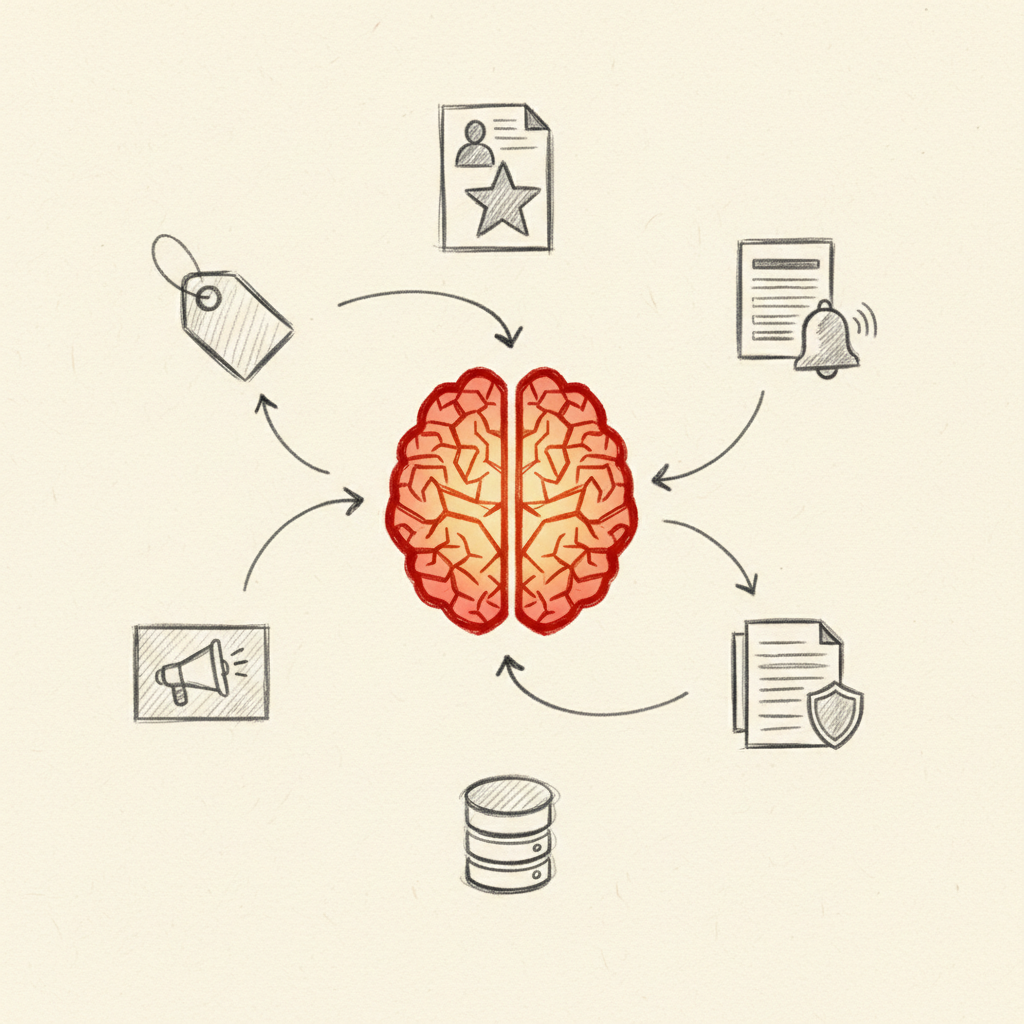
The difference between an AI CI agent and a monitoring tool is the action layer. Crayon tells you a competitor changed their pricing page. An AI CI agent detects the change, analyzes the delta, drafts a comparison blog post and an updated sales battlecard, routes both to the appropriate human for approval, and logs the event in the CRM. The human reviews and approves. The agent executes. That loop runs in hours, not the weeks it takes a manually operated stack to respond.
The competitive advantage is not just speed. It is consistency. Manual competitive intelligence programs depend on one or two analysts who get pulled into other projects, miss signals during vacation, and produce uneven output quality week to week. An AI CI agent runs every day, processes every source on the configured list, and produces consistently formatted outputs. Teams that switch from manual CI to agent-driven CI in 2026 report that the volume of actionable competitive insights delivered per month increases by 3 to 5 times, while the analyst time required drops by 60 to 80%.
How AI CI Agents Fetch Signals
AI CI agents combine multiple data-fetch mechanisms into a single pipeline. The core components are web crawlers (checking competitor sites on configurable schedules), RSS and news feed parsers, social API connectors (LinkedIn, Twitter/X, Reddit), G2 and Capterra review scrapers, job board watchers (new job postings reveal product roadmap signals), and ad library monitors (Meta Ads Library, Google Ads transparency report). The agent runs these in parallel and normalizes the outputs into a structured signal stream.
In 2026, the most effective agents add an LLM analysis layer on top of raw signal collection. Instead of delivering "competitor X added a new feature page," the agent delivers a classified signal: "Competitor X launched a new AI reporting feature targeting enterprise HR buyers. This directly overlaps with our Q3 roadmap item 17b. Recommended response: accelerate battlecard update and publish a comparison post within 10 days." That analysis layer is what separates an autonomous agent from a better-organized RSS reader.
The AI Topia platform uses this fetch architecture across its client base. Agents poll between 40 and 120 sources per client, depending on the competitive landscape density. Sources include direct competitor domains, review platforms, LinkedIn company pages, and relevant subreddits. Each signal passes through a relevance classifier before hitting the response queue, which cuts false positives by approximately 70% compared to raw monitoring feeds.
Signal quality matters more than signal volume. A monitoring tool that surfaces 200 alerts per week overwhelms the team reviewing them. An AI CI agent that surfaces 15 high-relevance, pre-classified signals with recommended responses gets acted on. The classification layer is the product, not the crawling infrastructure. Any tool can crawl the web. The AI layer that turns crawl data into prioritized, actionable signals is what creates the value.
How AI CI Agents Trigger Content Responses
When a signal clears the relevance threshold, the agent decides which content response is appropriate. The decision tree is built on signal type. A competitor pricing change triggers a battlecard update plus a comparison landing page draft. A negative competitor review cluster on G2 triggers a win-theme blog post draft. A competitor job posting for "Head of Enterprise Sales" triggers a sales alert noting the competitor is moving upmarket, plus a content brief for a post targeting the segment they are about to pursue.
The content response is generated as a draft, not published directly. The agent queues the draft in the CMS or content calendar with a priority score and a recommended publish window. A human editor reviews the draft before it goes live. This keeps quality control in human hands while eliminating the two to three week lag that typically occurs between a competitive signal and a published response in manually operated teams.
For a B2B SaaS legal technology company with a four-person marketing team, this workflow replaced what had previously required a dedicated competitive analyst. The team went from reacting to competitive moves an average of 19 days after the event to responding within 3 days. Content quality held because the human review step remained. Speed increased because the agent handled the fetch, triage, and first draft.
The content types the agent generates cover the full competitive response playbook. Comparison landing pages ("Our Product vs. Competitor X") are generated when a competitor updates positioning or pricing. Battlecard refreshes are generated when new objection data surfaces from review platforms or sales calls. Blog posts targeting keywords the competitor ranks for are generated when a keyword gap analysis flags a new opportunity. Email sequences for sales reps are generated when a competitor announces a new feature that overlaps with current deal cycles.
How AI CI Agents Integrate with CMS and CRM
The integration layer is where autonomous CI agents create compounding value. A standalone monitoring tool delivers alerts. An agent integrated with your CMS and CRM turns those alerts into traceable revenue actions. The three integrations that matter most are CMS (WordPress or Webflow for content publishing), CRM (Salesforce or HubSpot for battlecard and deal-stage updates), and team communication (Slack for human-in-the-loop approval workflows).
In a typical AI CI agent deployment, the CMS integration works via API. When the agent generates a draft blog post or comparison page, it creates a draft in WordPress (using the REST API) or Webflow (using the CMS API), tags it with the relevant competitor and topic metadata, and assigns it to the designated editor. The editor receives a Slack notification with the signal summary, a one-paragraph brief, and a link to the draft. Approval takes one click. The post goes live on the scheduled date.
The CRM integration is equally direct. When the agent detects a competitor move that affects active deals, it writes a note to the relevant opportunity records in Salesforce or HubSpot. Sales reps see the update in their activity feed the next time they open the deal. No separate login to a competitive intelligence dashboard. No weekly digest email to ignore. The insight appears where the rep already works.
Current as of May 2026, the AI Topia platform manages these integrations for clients across WordPress, HubSpot, and Webflow. The average setup time for a new client integration is three days: one day for signal source configuration, one day for CMS and CRM API authentication and field mapping, and one day for the first approval-loop test with the client's content team. The result is a fully operational competitive intelligence production system with no ongoing manual data pulling required.
Competitive Intelligence Tools Compared (Pricing, Best For, AI-Native)
The table below covers the tools most commonly evaluated by B2B SaaS marketing and product teams in 2026.
| Tool | Category | Price (Starting) | Best For | AI-Native |
|---|---|---|---|---|
| Crayon | Market monitoring | ~$15,000/yr | Product marketing, battlecards | Partial |
| Klue | Market monitoring + Win/Loss | Custom (~$2,000/mo for 50 seats) | Revenue enablement teams | Partial |
| Kompyte | Market monitoring | Custom | Alert routing, sales enablement | Partial |
| Contify | Market + Strategic monitoring | Custom | 500K+ sources, enterprise coverage | No |
| Semrush | SEO intelligence | $129.95/mo | Search-channel competition | Partial |
| SpyFu | SEO + PPC intelligence | $9/mo | Budget SEO and paid search intel | No |
| SimilarWeb | Traffic intelligence | $125/mo | Website traffic by channel | Partial |
| Brandwatch | Social listening | Custom (~$1,000/mo+) | Brand sentiment, share of voice | Partial |
| AlphaSense | Financial/strategic research | $15,000-$50,000/yr | Enterprise M&A, fundraise prep | Yes |
| AI Topia CI Agent | Autonomous AI CI | Custom | Signal-to-action automation | Yes |
Pricing is current as of May 2026 and based on published rates where available. Custom pricing reflects enterprise-only tiers.
The "AI-Native" column matters because partially AI-enabled tools bolt AI features onto existing monitoring architectures. They use AI to summarize alerts or suggest responses, but the core data model is still human-review-first. Fully AI-native tools are designed from the ground up for autonomous signal-to-action loops, where AI handles fetch, triage, and first draft generation without a human initiating each step.
A Series A B2B SaaS company with a two-person marketing team should not start with Crayon at $15,000 per year. The right starting stack at that stage is SpyFu at $9 per month for paid and organic search intelligence, plus a basic Brandwatch or Mention account for brand monitoring, plus a lightweight AI CI agent for automated response drafting. Total cost under $500 per month. As the team scales past 20 people and the competitive landscape gets more complex, adding Klue or Semrush Business makes sense.
Kompyte sits between Crayon and Klue in terms of focus. It emphasizes automated alert routing and integrates directly with sales tools to push competitor update summaries into deal records. For teams whose primary use case is sales enablement rather than content marketing, Kompyte often wins over Crayon on workflow fit even when Crayon offers slightly deeper monitoring coverage.
How to Pick the Right Competitive Intelligence Tool in 2026
The selection process has three steps. First, identify which of the five categories matches your highest-priority competitive intelligence need. Second, map that category to the two or three tools that serve it best at your company size and budget. Third, evaluate integration depth with your existing CMS, CRM, and team communication stack.
Start with the question you most need answered. If the question is "why are we losing deals to Competitor X?" the answer is in win/loss data, which points to Clozd, Gong, or Klue's win/loss module. If the question is "which keywords should we target to take traffic from Competitor Y?" the answer is in SEO intelligence, which points to Semrush or SpyFu. If the question is "what moves is Competitor Z making this quarter across all channels?" the answer is in market monitoring, which points to Crayon, Klue, or Kompyte. The worst outcome is buying a multi-feature platform that does five things adequately when you need one thing done well.
Integration depth determines whether a tool generates action or just generates dashboards. A monitoring tool that connects to your CRM means competitive signals appear where your sales team already works. One that does not means the signals live in a separate login that your team checks when they remember to. In a 10-person sales organization, a tool with no CRM integration has approximately a 30% chance of being used consistently after the first 60 days.
For B2B SaaS companies in 2026 that are growing past $5 million ARR, the full five-category stack typically runs: Semrush Business ($499.95 per month) for SEO intelligence, Klue (approximately $2,000 per month) for market monitoring and sales enablement, Gong (approximately $1,200 per user per year) for win/loss and call intelligence, and an autonomous AI CI agent for signal-to-action automation. That stack costs between $5,000 and $8,000 per month all-in and gives complete competitive coverage across search, brand, and revenue channels.
Companies below $5 million ARR should start with two tools maximum. Semrush Pro at $129.95 per month plus SpyFu at $9 per month covers the search channel thoroughly. Adding a single market monitoring tool when the team has workflows to act on alerts is the right sequencing. Buying all five categories at once before the team has processes to respond to the data is the most common waste in competitive intelligence budgets. The rule: if a signal has nowhere to go when it arrives, the tool generating it is premature.
The evaluation criteria that matter most are: data freshness (how quickly does the tool update when a competitor makes a change?), alert configurability (can you filter to only the competitor moves that matter to your business?), integration quality (does it connect to Salesforce, HubSpot, WordPress, or Slack without a developer?), and output format (does it give you actionable outputs like battlecard updates, or just raw data?). Tools that score well on the first two but poorly on the last two will generate insight your team never acts on.
Where the SERP and AI Overview Get Competitive Intelligence Wrong
Google's AI Overviews and the standard SERP for "competitive intelligence tools" both default to the same four or five tools: Crayon, Klue, Semrush, Brandwatch, and sometimes SimilarWeb. This is the mid-market consensus view, and it is incomplete for most companies evaluating the category in 2026.
The SERP gets two things wrong. It conflates monitoring with intelligence. And it ignores the action gap entirely. Monitoring is collecting data about what competitors do. Intelligence is turning that data into a decision and a response. Most tools in the top SERP results do the first part well. Almost none close the loop on the second part. The AI Overview does not surface this distinction because it is generated from content that describes features, not from outcomes data showing what teams actually did with the tools after buying them.
The second problem is that AI Overviews in 2026 frequently surface outdated pricing and feature information for competitive intelligence tools. Crayon's pricing has changed twice in the past 18 months. Klue has restructured its packaging to align with revenue team use cases rather than product marketing use cases. An AI Overview citing either tool at an outdated price point or feature set misleads buyers who make decisions based on that information without verifying it directly with the vendor.
The third problem is that neither the SERP nor AI Overviews cover the fifth category at all. Autonomous AI CI agents do not yet have the domain authority or review volume to appear in standard SERP results for "competitive intelligence tools." G2 does not have a dedicated category for autonomous CI agents. This creates a real gap in buyer research. Teams that rely solely on SERP results to evaluate their options miss the category that is best positioned to close the action gap they actually experience every quarter.
The practical implication: when evaluating competitive intelligence tools, go beyond the first SERP page. Look at what tools your competitors are hiring to use (job postings are a reliable signal). Look at what tools appear in G2 comparison grids that are not on the first SERP page. And ask specifically which tools connect monitoring to content and sales responses, not just which tools monitor the most sources. The answer to that question does not appear in most SERP results.
From Signals to Action: The AI CMO Approach to Competitive Intelligence
The AI CMO approach treats competitive intelligence as a production system, not a research function. A production system has inputs, a processing pipeline, outputs, and a feedback loop. A research function has inputs and outputs but no closed loop. Most competitive intelligence programs in 2026 are research functions operating without a feedback mechanism, which means they optimize for data collection rather than business outcomes.
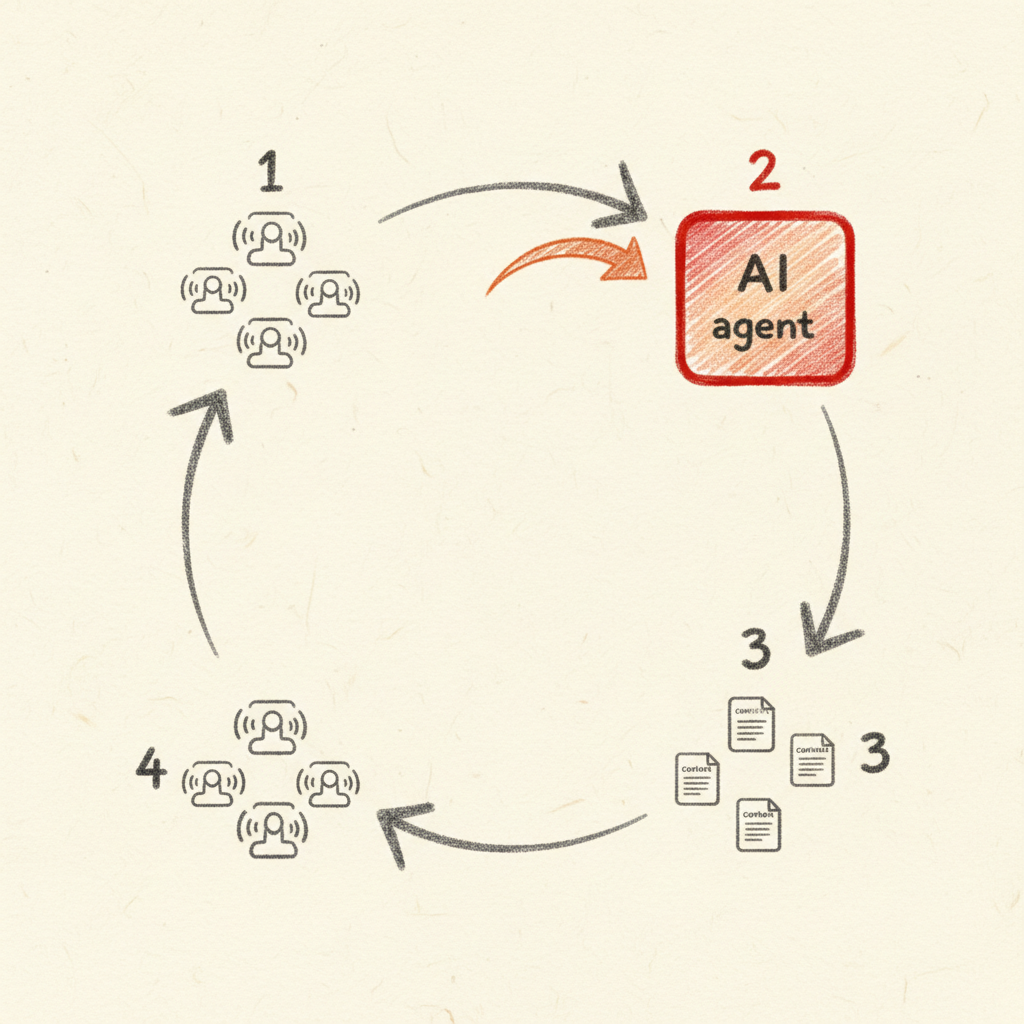
The inputs are signal sources: competitor websites, review platforms, search rankings, job boards, social channels, and ad libraries. The processing pipeline is the AI CI agent, which fetches, classifies, and prioritizes signals. The outputs are content drafts, battlecard updates, sales alerts, and CRM notes. The feedback loop is performance data: did the content response drive traffic? Did the battlecard update improve win rate on deals where that competitor appeared? Without the feedback loop, competitive intelligence is a cost center. With it, it becomes a revenue function with measurable outcomes.
For AI Topia clients, this cycle runs weekly. Every Monday, the agent delivers a competitive digest with three tiers of signals: urgent (requires action within 48 hours), standard (requires action within two weeks), and background (logged for quarterly review). The content team reviews the urgent signals in a 30-minute standup and approves the pre-drafted responses. By Tuesday, the content responses are queued in the CMS. By Thursday, they are live. The entire process from signal detection to published content takes under 96 hours.
Across AI Topia's client base, teams running this system in 2026 respond to competitor moves 6 times faster than teams using manual monitoring workflows. They also publish 40% more competitive comparison content per quarter because the drafting work is done by the agent, not the content team. The content team's job shifts from writing to reviewing and approving. That shift is worth recovering 8 to 12 hours per week of content team capacity in a typical five-person marketing organization.
The tool stack that enables this is not the most expensive stack on the market. SpyFu at $9 per month covers paid and organic search signals. SimilarWeb at $125 per month covers traffic intelligence. An AI CI agent handles the orchestration, classification, and content drafting. The total investment is under $500 per month for most teams at the $1 million to $10 million ARR stage. At the $10 million to $50 million ARR stage, adding Semrush Business and Klue brings the total to approximately $3,000 per month for a complete competitive intelligence production system that covers all five categories.
The measure of a competitive intelligence program is not how many signals it collects. It is how quickly and consistently the organization responds to those signals with content, sales messaging, and product positioning. Tools that close the gap between signal and response generate revenue. Tools that generate dashboards without driving responses generate reports that nobody reads after the first 60 days.
Frequently Asked Questions
What is the difference between competitive intelligence and market research?
Market research studies aggregate market behavior: customer segments, market size, purchase drivers, and trend lines. It is typically conducted quarterly or annually through surveys, focus groups, and secondary data sources. Competitive intelligence focuses specifically on what named competitors are doing right now: pricing moves, product launches, messaging changes, hiring patterns, and content strategies. Market research tells you where the market is going. Competitive intelligence tells you what your specific competitors are doing today. Most B2B SaaS companies need both, but they serve different decision timelines. Market research informs annual planning. Competitive intelligence informs this week's content calendar and next month's battlecard update. Tools like Semrush, Crayon, and Klue are competitive intelligence tools. Tools like SurveyMonkey or Qualtrics combined with a research firm are market research tools.
How much does competitive intelligence software cost?
Pricing varies widely by category and company size. Budget options start at $9 per month for SpyFu and $129.95 per month for Semrush Pro. SimilarWeb Starter runs $125 per month. Mid-market tools like Klue and Crayon run $1,500 to $3,000 per month for a typical 20 to 50 seat deployment. Brandwatch enterprise contracts start above $1,000 per month. Enterprise tools like AlphaSense start at $15,000 per year and scale past $50,000 per year for large seat counts. A complete five-category stack for a $10 million ARR B2B SaaS company typically runs $3,000 to $5,000 per month all-in. Companies under $5 million ARR can cover the most critical competitive intelligence needs for under $500 per month by prioritizing SEO intelligence tools and one monitoring platform.
What is the best competitive intelligence tool for a small B2B SaaS team?
For a team of two to five people, SpyFu at $9 per month is the single highest-ROI competitive intelligence tool available in 2026. It gives you historical paid search data, organic ranking history, and keyword overlap analysis for any competitor domain. Pair it with Semrush Pro at $129.95 per month when the team has capacity to act on SEO gaps consistently. Add a basic social listening tool like Mention (starting around $41 per month) for brand monitoring. Total cost under $200 per month. This covers the two highest-value use cases for small teams: search-channel competitive gaps and brand mention tracking. Add Klue or a dedicated win/loss tool when your sales team exceeds 10 reps and deal volume makes systematic battlecard management worthwhile.
Can AI replace manual competitive intelligence research?
AI does not replace competitive intelligence research entirely. It replaces the manual fetch-and-organize steps that consume most of the time in a manual CI workflow. A human analyst spending 10 hours per week pulling competitor data, organizing it into a spreadsheet, and writing a summary can be replaced by an AI CI agent that completes the same data collection in minutes. The analyst's time shifts to interpretation, prioritization, and driving responses across the content and sales team. The strategic judgment about which signals matter and which competitive moves require a response still requires human expertise. In 2026, the best competitive intelligence programs pair AI agents for signal collection and first-draft generation with human experts for strategic interpretation and response prioritization. AlphaSense's expert call transcript analysis is a good example: AI surfaces the relevant transcripts, but a human analyst synthesizes the strategic picture from what they find.
What data sources do competitive intelligence tools monitor?
The most useful data sources for B2B SaaS competitive intelligence are competitor websites and pricing pages (for feature and pricing changes), G2 and Capterra review platforms (for customer sentiment and objection patterns), LinkedIn company pages and job postings (for headcount growth and product roadmap signals), Google and Meta ad libraries (for messaging and campaign strategy), organic search rankings via tools like Semrush (for content strategy direction), and social channels including Twitter/X, LinkedIn, and Reddit (for executive statements and community sentiment). Contify monitors over 500,000 sources including trade press, regulatory filings, and niche industry publications, which is valuable for enterprise companies in regulated industries. AlphaSense adds expert call transcripts and earnings call analysis, covering over 240,000 transcripts indexed as of 2026. Most B2B SaaS companies in the $1 million to $20 million ARR range get 80% of the value they need from the first four source types without the complexity of enterprise research platforms.
How do I build a competitive intelligence program from scratch?
Start with the output, not the tool. Define the three competitive decisions your team makes most often: what content to publish to win on competitive keywords, which objections to train sales reps on, and which product gaps to prioritize based on competitor feature launches. Then identify which data sources answer those questions. Buy tools that cover those specific data sources first. For content decisions, Semrush covers search-channel gaps starting at $129.95 per month. For sales objections, Klue or Gong covers deal-level competitor mentions. For product gaps, G2 review monitoring covers customer-stated feature requests for competitor products. Run each tool for 90 days with a defined workflow: who reviews the data, on what schedule, and what action gets triggered by what signal type. If a tool does not drive at least one documented action per week after 90 days, cut it. Build the feedback loop before expanding the stack, and consider adding an autonomous AI CI agent once the manual workflow is proven.
Want Weekly Founder Video Without Filming Weekly?
We run the Video Engine for you, or install it in your team. AI avatar, real footage, or both.