
Competitor Analysis Tools: Why the Best Ones Track Social Signals, Not SEO Data (2026)
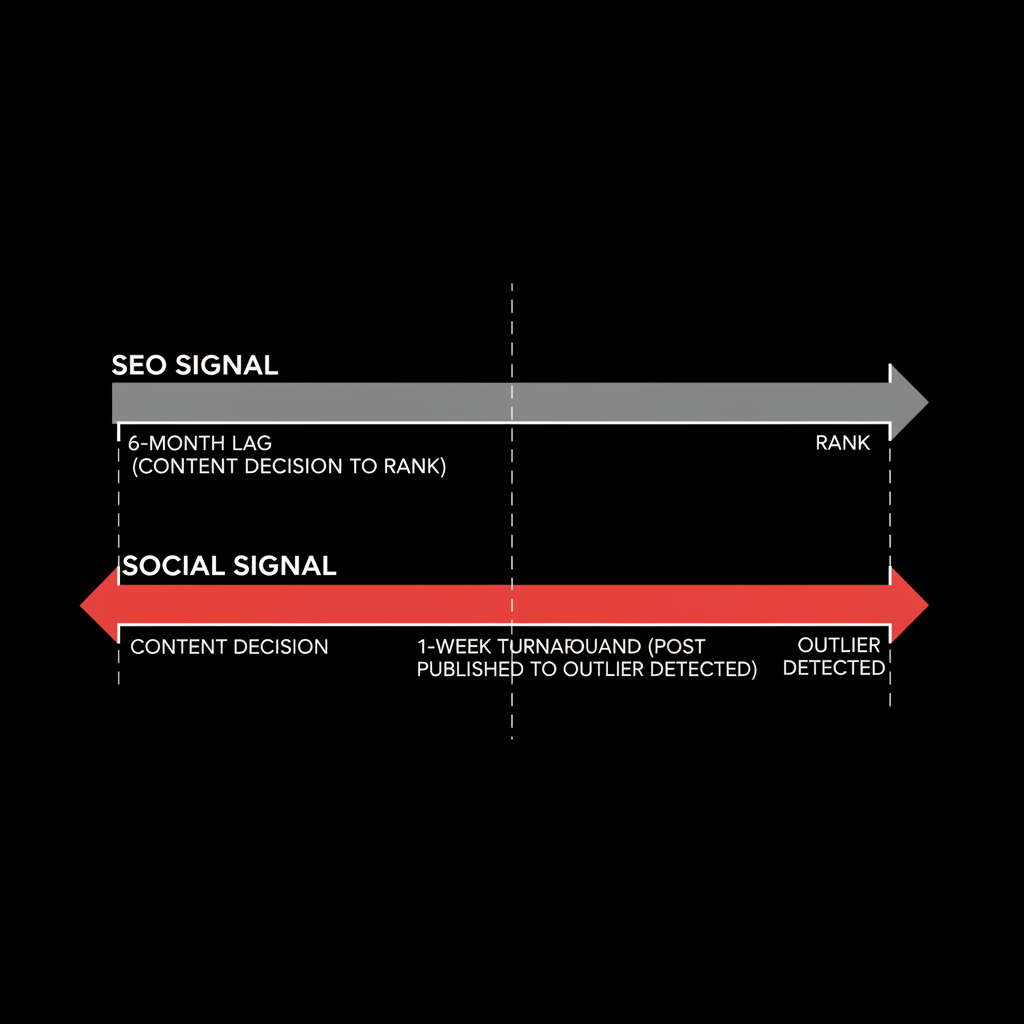
Every competitor analysis tool on this list is showing you last quarter's data.
That's not a critique of any specific product. It's a description of what the entire first through fourth generation of competitor analysis tools was built to measure: artifacts of decisions your competitors already made. Keyword ranks, backlink profiles, ad spend history — all of it is a record of the past, not a signal for what's happening now.
The category has evolved past that ceiling. Understanding which generation of tool you're using, and what it is structurally incapable of showing you, is the first decision in building a competitive intelligence stack that actually keeps pace with how fast markets move in 2026.
Key Takeaways
- Most competitor analysis tools measure lagging indicators — keyword rank and backlinks reflect decisions made 3-12 months ago
- Social post engagement is a leading indicator: a competitor's breakout post this week predicts their next content cluster in 60 days
- AI Topia scout composite score = engagement + recency decay + competitor tier boost — flags viral outliers at ≥0.9 composite
- The same engine tracks your own content, making AI Topia a unified competitive + self-performance monitor
- The right stack: monthly SEO baseline check + weekly social outlier feed — not one tool trying to do both
- 5th-gen tools scrape X, LinkedIn, Reddit, and TikTok per competitor — 1st-gen tools still rely on Google data alone
What Competitor Analysis Tools Actually Track (And What They Miss)
Most competitor analysis tools show you what your rivals already did — not what they're doing now. Keyword rank data reflects a decision your competitor made 3 to 6 months ago. By the time a keyword move appears in SERP results, the content was written, published, indexed, and aged. You're reading yesterday's newspaper and calling it market intelligence.
The gap is structural, not a product flaw. SEO tools measure lagging indicators by design. Backlink data is even slower — it reflects publishing decisions from 6 to 12 months prior. As Klue's 2026 competitive intelligence guide puts it: "By the time you finish building that competitive spreadsheet, half of it is stale." That's not a jab at spreadsheets. It's a description of how SEO data works.
Google Alerts, the most widely used free monitoring tool, only catches news mentions and blog posts. It misses all social activity, website changes, and anything behind a login. That's three of the four signal layers where competitors test new ideas before committing to SEO.
Here's what those tools miss: social post engagement is a leading indicator. When a competitor publishes a post that overperforms their own 30-day baseline, that topic is typically promoted to a full SEO content push 8 to 12 weeks later. The social layer is where topic experiments happen before they cost money. A competitor's breakout LinkedIn post in May 2026 tells you what they'll rank for in August 2026.
Why Do Most Competitor Analysis Tools Show Stale Data?
The tools that dominate this category in 2026 were built for a world where search was the only channel worth tracking. That world is gone. Understanding which generation of tool you're using — and what each generation is structurally incapable of showing you — is the first decision in building a competitive intelligence stack that moves fast enough to matter.
The 5 Generations of Competitor Analysis Tools
Competitor analysis tools fall into two fundamental layers: data-layer tools (Gen 1 through Gen 4) that report what already happened, and signal-layer tools (Gen 5) that detect what competitors are testing right now. This taxonomy is AI Topia's framework for understanding why most tools leave marketing teams reacting to decisions their competitors made months ago.
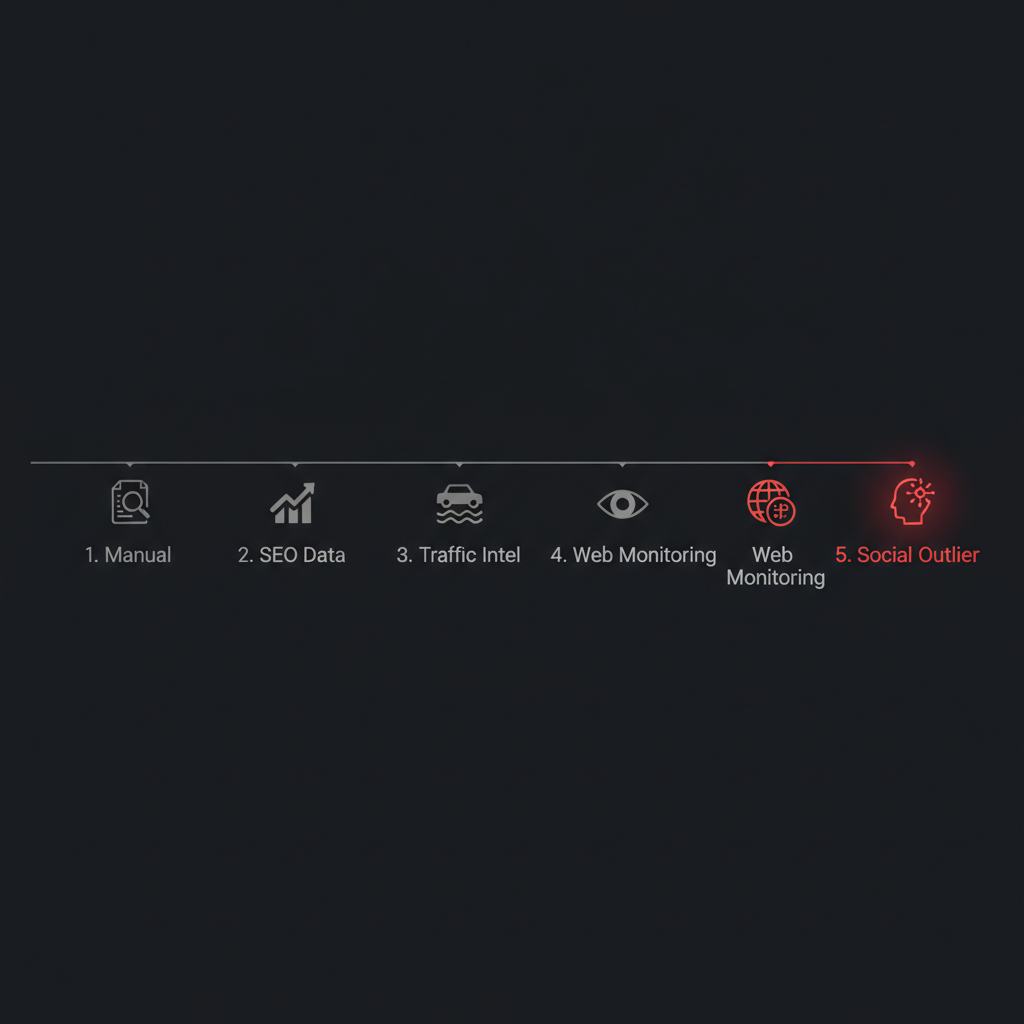
Gen 1 — Manual tools are Google Alerts and spreadsheets. They catch news mentions and blog posts, but Klue's competitive intelligence research confirms they miss all website changes, social activity, and anything behind a login. Gen 1 is the data-layer floor — free, easy to set up, and blind to 90% of competitive activity.
Gen 2 — SEO Data tools are SpyFu, Ahrefs, and SEMrush. They built keyword rank tracking and backlink databases at scale, and they price accordingly: Ahrefs starts at $129/month, SEMrush at $139.95/month (Zapier, 2025). The structural problem is lag — by the time a competitor's keyword decision surfaces as a rank change, 3 to 12 months have passed.
Gen 3 — Traffic and Ad Intelligence tools are SimilarWeb and Moat. SimilarWeb processes 10 billion digital signals per day and analyzes 2TB of data daily (SimilarWeb own data), but the output still carries a 1 to 3 month lag. Gen 3 tells you where competitors spent their ad budget last quarter, not what they're testing this week.
Gen 4 — Web Monitoring tools are Crayon and Klue. These tools introduced anomaly detection for pricing changes and messaging updates, narrowing the lag window to 1 to 4 weeks. Crayon's AI flags major marketing performance or messaging updates that seem out of the ordinary (Sprout Social, 2026) — a genuine improvement, but still web-layer only, with no visibility into social post performance.
Every tool in Gen 1 through Gen 4 shares the same ceiling: they measure artifacts of decisions already made. None of them score individual competitor posts for engagement outliers in real time. For a deeper breakdown of how these generations map to tool categories, see competitive intelligence tools.
Gen 5 — Social Outlier Detection is the signal-layer. AI Topia scout scrapes X, LinkedIn, Reddit, and TikTok per competitor simultaneously, scores each post with a composite formula (engagement + recency decay + competitor tier boost), and flags posts that overperform the competitor's own 30-day baseline in real time. In 2026, this is the first generation of competitor analysis tools built to show you what competitors are experimenting with before it reaches any SEO database.
The distinction matters because Gen 1 through Gen 4 answer the question "what did they do?" Gen 5 answers "what are they testing now?" — and that 8 to 12 week head start is where competitive advantage is won.
Old-Layer vs New-Layer: What Each Tool Type Actually Shows You
The split between old-layer and new-layer tools is structural, not cosmetic. Gen 2-3 SEO and traffic tools all share the same flaw: lag time measured in months. By the time keyword rank data surfaces a competitor's move, the decision behind it is already 3-12 months old. That is not a data-quality problem. It is a category limitation built into how those tools collect data.
The demand for faster intelligence is real. The Competitive Intelligence Alliance (via Klue, 2026) reports that 60% of CI teams now use AI tools daily, cutting data-processing time by 45%. The table below shows exactly why those teams are switching layers. The Lag Time column is the one to read first — it is the single biggest differentiator between tool categories, and no article currently provides this comparison.
| Tool Category | Data Type | Lag Time | What It Tells You | What It Misses |
|---|---|---|---|---|
| SEO Tools (SpyFu, Ahrefs) | Keyword rank, backlinks | 3–12 months | What already ranked | What competitors are testing now |
| Ad Intelligence (SimilarWeb) | Paid traffic, display ads | 1–3 months | Where they're spending budget | Organic content strategy signals |
| Web Monitoring (Crayon, Klue) | Pricing, messaging changes | 1–4 weeks | Positioning shifts and copy updates | Content resonance and engagement |
| Social Listening (Brandwatch, Sprout) | Brand mentions, sentiment | 1–7 days | Reputation and brand sentiment | Per-post outlier scoring vs. baseline |
| Social Outlier Detection (AI Topia) | Composite-scored posts | Real-time | What's overperforming their baseline this week | Nothing — the most complete signal layer |
No article ranking for "competitor analysis tools" in 2026 includes a Lag Time column in its comparison. This table is the first to make that distinction explicit across all five tool categories.
The right takeaway is not that Gen 5 tools replace Gen 2-4. It is that each category answers a different question at a different clock speed — and the next section shows exactly how the Gen 5 scoring engine produces that real-time signal.
How Social Outlier Detection Works (The Gen 5 Engine)
The AI Topia scout engine classifies every competitor into one of three tiers — high, medium, or self — and weights the composite score by tier. High-tier competitors receive a score boost, so their outlier posts surface first. This tier-weighting is the core architectural decision that separates Gen 5 social outlier detection from flat social listening tools.
The composite score has three components: eng_score (raw engagement), rec_score (recency decay), and the competitor tier boost. rec_score starts at 1.0 for posts published within 7 days and decays to approximately 0.7 at 30 days. A post scoring 0.976 composite in production means it hit near-maximum recency (1.0 rec_score), strong raw engagement (0.946 eng_score), and carried a tier boost — all three signals firing at once.
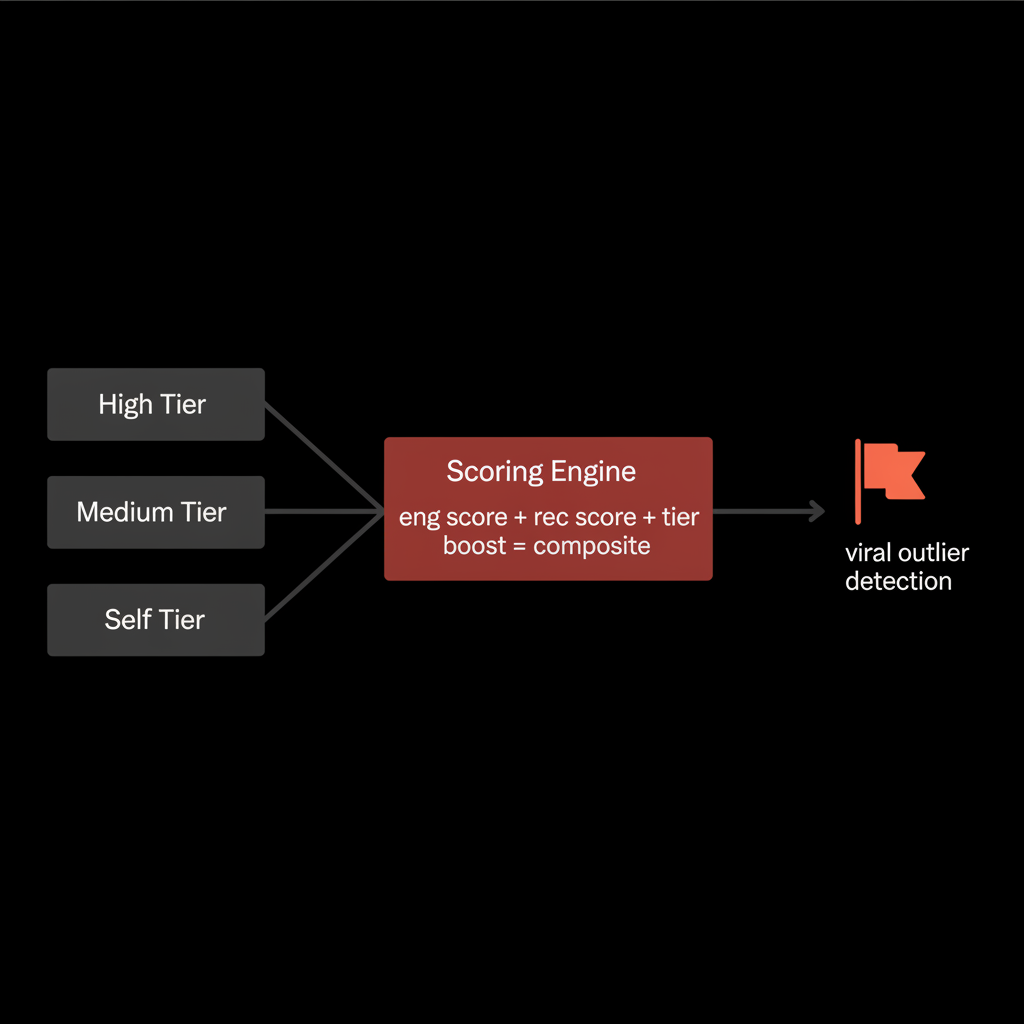
In May 2026, AI Topia scout flagged a LinkedIn post at 0.976 composite — 2,968 likes, 871 comments, 97 shares — as a viral outlier against that competitor's 30-day baseline. That single score is the citable proof point: a Gen 5 tool does not measure volume in isolation; it measures overperformance relative to each competitor's own history. Understanding how AI marketing agents use this signal layer is what separates reactive monitoring from proactive competitive strategy.
How does AI Topia scout handle cross-platform scraping without duplicate signals?
AI Topia scout ingests LinkedIn, X, TikTok, and RSS simultaneously. Every signal is deduplicated by a unified (source, source_id) key — so the same post cannot appear twice regardless of how many scrape batches run. Engagement schemas are platform-native: X signals record likes, views, replies, and retweets; TikTok records diggs, plays, and shares. This ensures composite scores are calibrated to each platform's engagement norms, not forced into a single generic engagement count.
The self-tier is the mechanism that makes AI Topia a unified monitoring platform rather than a dedicated competitor tool. The is_own_content boolean applies the identical scoring engine to your own posts. One platform produces two feeds: competitors' outlier signals and your own performance ranked by the same composite formula. In 2026, running separate tools for competitive monitoring and self-performance analysis is an unnecessary stack overhead this architecture eliminates.
7 Best Competitor Analysis Tools in 2026 (By Use Case)
The right competitor analysis tool depends on which data layer you need — SEO history, traffic estimation, web monitoring, or live social signals. No single tool covers all four layers well. The seven tools below are ranked by generation and matched to the use case each one handles best.
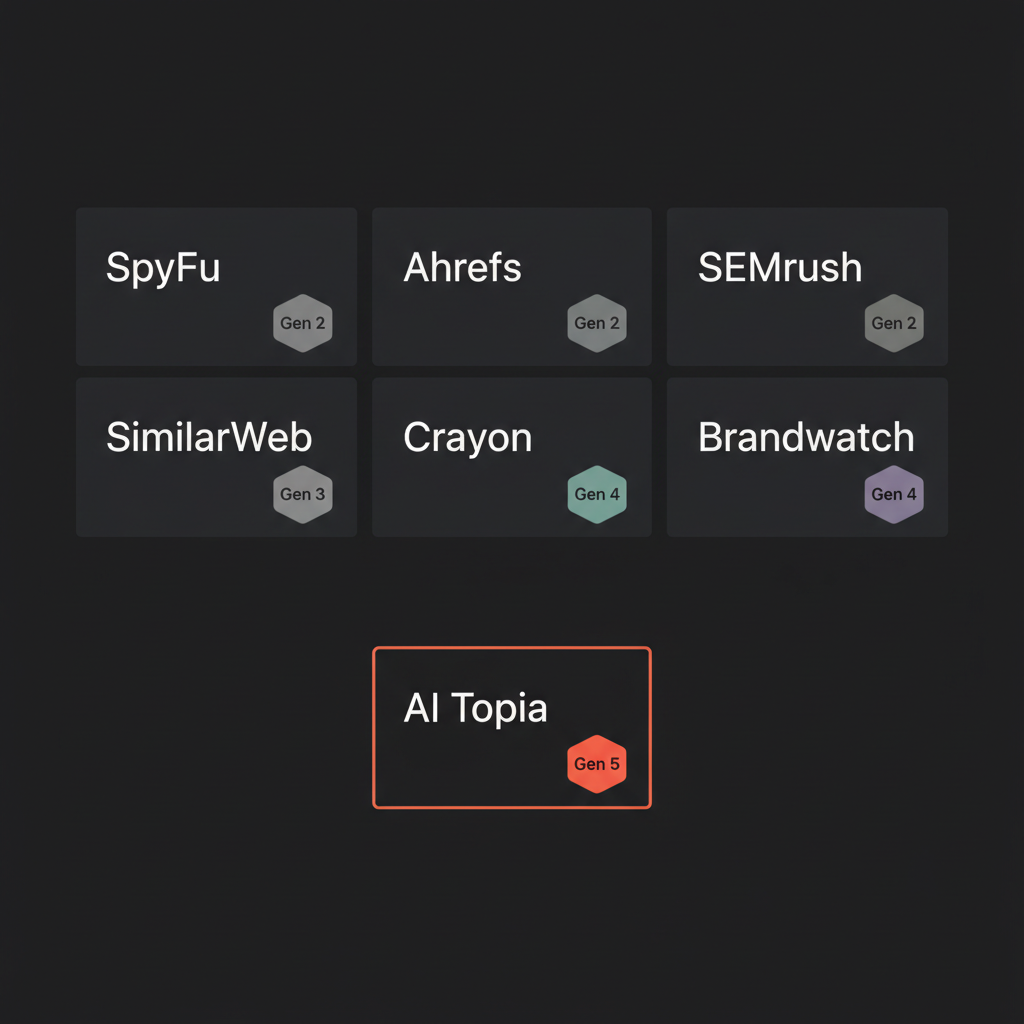
SpyFu (Gen 2) — Best for: PPC + Keyword History
SpyFu shows you a competitor's paid search history by domain — every ad campaign they've run, every keyword they've bid on. The free tier makes it accessible for early-stage teams before they commit to paid plans. For PPC competitive research and long-tail keyword discovery, SpyFu remains one of the most practical Gen 2 options in 2026.
Ahrefs (Gen 2) — Best for: Backlink Analysis
Ahrefs runs the deepest backlink database in the category. At $129/month entry pricing, it anchors most serious SEO teams' link-gap workflow. If you need to know which sites are linking to your competitors and why, Ahrefs is the benchmark tool.
SEMrush (Gen 2-3 Hybrid) — Best for: All-in-One SEO Teams
SEMrush covers SEO, paid, and some social analytics under one roof at $139.95/month. The breadth is genuine — it handles keyword research, site audits, and display ad research in one platform. The tradeoff is depth: for pure backlink analysis, Ahrefs outperforms it; for pure PPC research, SpyFu goes further. SEMrush earns its place when a team needs one subscription covering multiple data types.
Crayon (Gen 4) — Best for: Enterprise Pricing and Messaging Tracking
Crayon monitors competitor websites for changes to pricing pages, product copy, and positioning — then surfaces those changes with anomaly detection. For enterprise teams that need to track when a competitor quietly reprices or rewrites their homepage messaging, Crayon is the standard. It operates in the 1-4 week lag window, which makes it genuinely faster than SEO tools for positioning intelligence.
Brandwatch / Sprout Social (Gen 4) — Best for: Social Brand Monitoring
Sprout Social's listening tool uses AI pulling from a decade of historical data points to surface brand sentiment and mention volume across social platforms. It tracks aggregate sentiment well and gives brand teams a clear signal on reputation shifts. What it does not do is score individual posts against a competitor's own baseline — so a breakout post that signals a new content experiment will be absorbed into the aggregate, not flagged as an outlier.
AI Topia (Gen 5) — Best for: Social Outlier Detection + Self-Monitoring
AI Topia scout is the only competitor analysis tool in 2026 with per-competitor composite scoring across X, LinkedIn, Reddit, and TikTok simultaneously. A competitor post scoring ≥0.9 composite that outperforms that competitor's own 30-day baseline gets flagged as a viral outlier — surfacing topic experiments 8-12 weeks before they appear in search. The self-tier feature applies the same scoring engine to your own content, making AI Topia a unified competitive and self-performance monitor in one platform. Learn more about the broader AI CMO platform.
SimilarWeb (Gen 3) — Best for: Traffic Estimation and Launch Planning
SimilarWeb processes 10 billion digital signals per day across web and app properties, giving traffic share and channel-mix estimates at the domain level. At $199/month, it is the right tool when entering a new market or planning a paid campaign and you need to benchmark a competitor's traffic before you spend. It is not a weekly monitoring tool — traffic estimates move slowly, and checking it more than monthly adds noise rather than insight. For the foundational principles behind building with these tools, see AI marketing fundamentals.
Which Competitor Analysis Tool Is Best for Small Teams on a Budget?
SpyFu's free tier covers PPC keyword history with no credit card required — the lowest-friction entry point in Gen 2. For social signal detection, AI Topia's Gen 5 engine is the only tool in this list that tracks leading indicators rather than lagging data. The right pairing for a lean team in 2026: SpyFu for monthly SEO snapshots + AI Topia scout for weekly outlier feeds.
The right stack uses these tools in layers — not as substitutes for each other, but as complements covering different lag windows.
How to Build a Competitor Intelligence Stack in 2026
A three-layer stack beats any single tool. Layer 1 gives you the SEO baseline. Layer 2 gives you the leading signal. Layer 3 gives you paid-market context on demand. Each layer has a cadence — and mixing them up wastes time.
Layer 1 (Monthly): SEO Baseline. Run SpyFu or Ahrefs once a month for a keyword and backlink snapshot. That data reflects decisions your competitors made 3-12 months ago. Monthly review is the right cadence — daily would show noise, not signal.
Layer 2 (Weekly): Social Outlier Feed. Run AI Topia scout every week to see what's breaking through across LinkedIn, X, TikTok, and Reddit. This is the leading-indicator layer — a competitor's outlier post this week predicts their next SEO cluster in 60 days. Weekly cadence is where competitive advantage lives in 2026.
For teams scaling this workflow across multiple competitors and platforms, multi-agent AI marketing systems explain how to automate the routing and distribution of those weekly signals.
Layer 3 (On-Demand): Traffic and Ad Intelligence. Pull SimilarWeb when you're launching a paid campaign or entering a new market. It processes 10 billion digital signals per day — but that data shifts slowly. Running it weekly adds no value. Use it when a specific business decision requires traffic or spend context.
Most competitive intelligence programs fail at distribution, not collection. Klue's 2026 competitive intelligence guide puts it plainly: "They build impressive repositories that sellers never open." A three-layer stack works only when insights reach the team that can act on them — share Layer 2 outliers in Slack weekly, not in a quarterly deck.
Start a free trial of AI Topia to see your competitors' outlier posts this week.
Frequently Asked Questions
What is the difference between competitor analysis tools and competitive intelligence tools?
Competitor analysis tools focus on specific rival metrics — keywords they rank for, backlinks they've earned, ads they're running. Competitive intelligence tools synthesize signals across all competitors to inform strategic decisions. Gen 5 tools like AI Topia do both simultaneously: per-competitor outlier scoring delivers the specific metrics, while the cross-platform signal layer delivers the strategic synthesis. The distinction collapses at Gen 5.
How does social outlier detection differ from standard social listening?
Social listening tracks aggregate brand mentions and sentiment — it measures volume. Social outlier detection scores each individual post against that competitor's own baseline — it measures anomalies. A post flagged by social listening means the brand got mentioned a lot. A post flagged by social outlier detection means that specific post is dramatically overperforming what that competitor typically publishes, signaling a deliberate topic experiment.
Can competitor analysis tools predict what will rank before it ranks?
Not directly. But a competitor's social content overperforming their baseline by 2-3x is typically promoted to a full SEO content push 8-12 weeks later. Social outlier detection provides an 8-12 week leading signal window. The mechanism: viral social performance confirms audience demand before the team commits budget to SEO production. Spotting that social outlier is functionally equivalent to spotting their next keyword cluster before they build it.
What engagement threshold signals a competitor is A/B testing a new topic?
AI Topia flags posts at ≥0.9 composite score that outperform the competitor's own 30-day post average. Two flagged posts on the same topic within 30 days is a strong signal of deliberate topic testing — the competitor is running an experiment, not posting opportunistically. The 30-day baseline comparison is what makes this actionable: a post with 500 likes from a competitor who typically gets 50 is a bigger signal than a post with 5,000 likes from a competitor who regularly hits 4,000.
How often should you review competitor social content vs. competitor keywords?
Weekly for social signals — they move fast and the recency decay scoring means last month's outlier is already deprioritized. Monthly for keyword and backlink data — it changes slowly and daily review creates noise. Quarterly for full SEO content audits — structural analysis that informs editorial calendars. Never respond to keyword data the same week you pull it; the underlying competitive decision that created it was made months ago.
Do competitor analysis tools work for LinkedIn and TikTok, or just Google?
Gen 1-3 tools are Google and web-layer only. Gen 4 tools like Crayon and Klue add some website monitoring, and Brandwatch/Sprout Social add social sentiment — but not per-post outlier scoring. Gen 5 tools like AI Topia scrape X, LinkedIn, Reddit, and TikTok natively with platform-native engagement schemas, so a TikTok outlier (diggs + plays + shares) is scored on TikTok-native norms rather than mapped to a generic engagement count.
Build the Stack That Shows You What's Coming
SEO data is not wrong — it is the right tool for the right question. The question "what already ranked?" still matters. What changed in 2026 is that the question "what are my competitors testing right now?" has a better answer than "run another keyword report."
The three-layer stack — monthly SEO baseline, weekly social outlier feed, on-demand traffic intel — covers both questions at the right cadence. Gen 2-4 tools answer the first. Gen 5 tools answer the second. Build the stack around the questions you need to answer, not the tools you already own.
Start a free trial of AI Topia to see your competitors' outlier posts this week.
Want Weekly Founder Video Without Filming Weekly?
We run the Video Engine for you, or install it in your team. AI avatar, real footage, or both.