
GTM Engineering: Build an Agent-Powered Revenue Engine
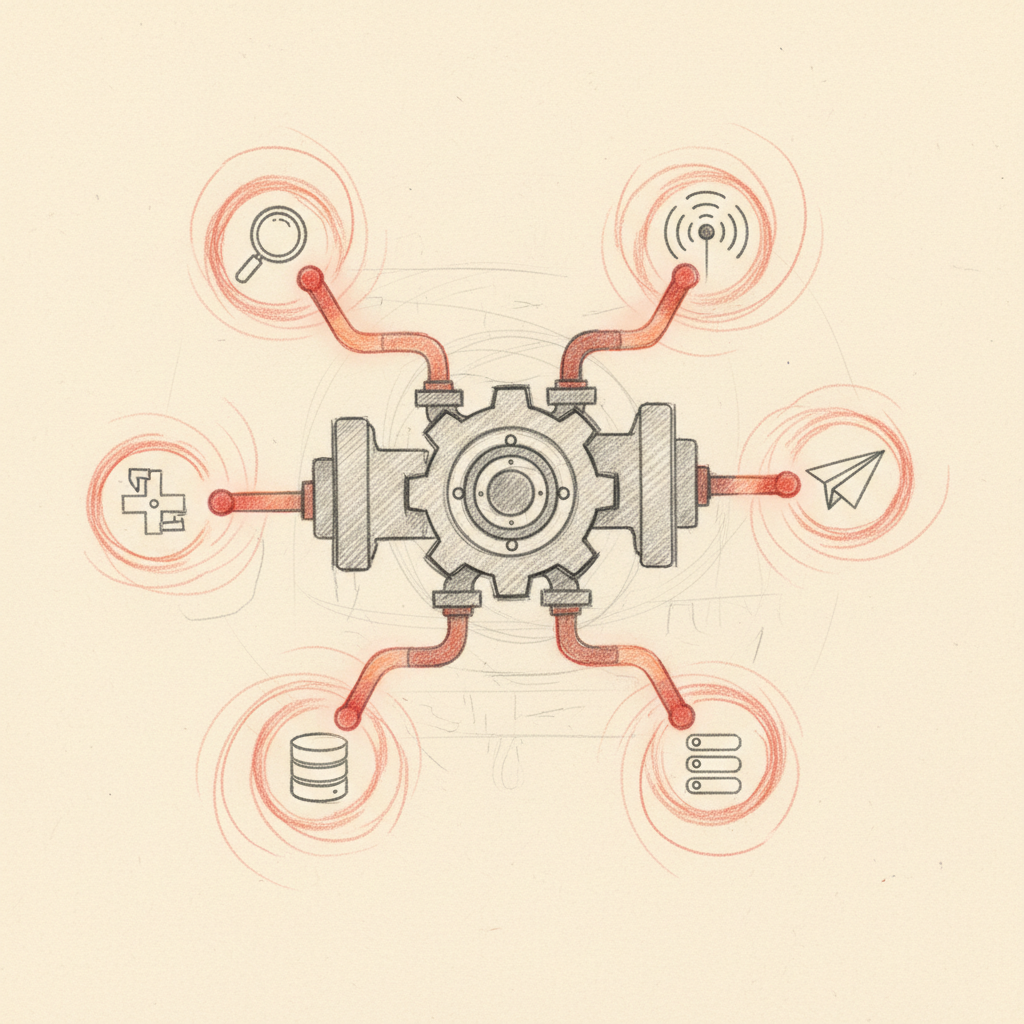
GTM engineering is the practice of building a go-to-market system run by AI agents instead of people clicking through tools. A GTM engineer designs, connects, and supervises a small set of agents that find accounts, read buying signals, write outreach, run sequences, and sync your CRM. The result is a revenue engine where software does the repeatable work and humans approve the high-stakes moves.
This pillar explains what GTM engineering is, why the role grew 260% in the last year, and how to build an agent-powered GTM function step by step. It is written for operators, not for vendors. I have built agent-powered GTM systems across more than 200 B2B SaaS engagements over the last 10 years, and the same pattern wins every time. The frame is simple. The old GTM stack was RevOps plus five disconnected tools plus manual handoffs. The new GTM system is a set of agents with one engineer at the controls.
Key Takeaways
- GTM engineering is the discipline of building an agent-powered go-to-market system, not just wiring tools together.
- The role grew 260% in search demand year over year. Companies hire GTM engineers to grow revenue without growing headcount.
- A modern GTM engine runs on five agents: enrichment, signal/intent, SDR/outreach, sequencing, and CRM-sync.
- One GTM engineer with agents replaces the old setup of RevOps plus five tools plus five SDRs doing manual work.
- Every agent needs a human gate on its risky output. No orchestration and bad data are the two failure modes that kill GTM systems.
- You do not need to be a software engineer to start. You need to think in systems and supervise agents.
What Is GTM Engineering?
GTM engineering is the discipline of designing and running an AI-agent-powered go-to-market system that turns raw market data into booked revenue. The GTM engineer builds the pipeline. AI agents do the work inside it. People review the output that matters.
Clay coined the term "GTM engineering" in 2023. Since then the meaning has shifted. Early definitions called it tooling and workflow automation. That framing is now too small. A workflow is a fixed set of steps. An agent makes decisions. The difference matters because buyers, signals, and inboxes change every day, and a fixed workflow breaks the moment reality moves.
Here is the cleanest definition. A GTM engineer orchestrates AI agents across the full revenue motion: account discovery, data enrichment, signal detection, outreach, follow-up, and CRM hygiene. The engineer owns the system. The agents own the tasks.
This is different from RevOps. As Apollo notes in its GTM engineer career guide, the role bridges sales, marketing, and technology. RevOps keeps the existing stack running and reports on it. GTM engineering builds a new kind of stack where agents replace the manual steps RevOps used to coordinate. A GTM engineer ships a system. A RevOps lead maintains one.
It is also different from a single AI SDR. An AI SDR is one agent that sends outreach. GTM engineering is the whole engine that feeds that agent good data, tells it who to contact and when, and writes the result back to your CRM. The AI SDR is one part. The GTM system is the machine. You can read our breakdown of AI SDR agents for outbound sales to see how one agent fits inside the larger engine.
Why GTM Engineering Is Exploding in 2026
Search demand for "gtm engineering" grew 260% in the past year. Demand for "what is a gtm engineer" grew 556%. These are not vanity numbers. They track a real shift in how B2B companies build revenue teams.
Three forces drive the growth.
First, agents got good enough to trust with real work. Two years ago an AI agent drafted a rough cold email and nothing more. Today an agent researches an account, finds the right contact, reads recent buying signals, writes a personal message, and logs the activity. The quality crossed the line where a human review beats a human doing the task from scratch.
Second, the math changed. The old way to scale outbound was to hire more SDRs. Each SDR cost salary, ramp time, and management. A GTM engineer with agents does the research and outreach volume that used to need five to seven SDRs. One Reddit thread in r/sales put it plainly: the role lets one person do the job of five SDRs. Companies grow pipeline without growing payroll.
Third, the tools fragmented and then begged to be unified. A typical revenue team ran Clay for enrichment, Apollo for data, an email tool for sending, a separate scheduler, and a CRM that never matched any of them. Someone had to glue these together by hand. GTM engineering is the answer to that mess. The engineer builds one system where agents pass work between each other with no human in the middle.
The role is so new that the title is still moving. Some companies now post jobs for Applied AI Engineer or Growth Engineer that describe the same work. The label will keep shifting. The function will not. Building an agent-powered GTM system is now a core job at high-growth companies.
The Old GTM Stack vs the Agent-Powered GTM System
The fastest way to understand GTM engineering is to see what it replaces.
The old GTM stack looked like this. RevOps owned the tools. Marketing pulled a list. An analyst enriched it in a spreadsheet. SDRs researched each account by hand. A copywriter or the SDR wrote the emails. A sequencing tool sent them on a fixed schedule. Someone, usually nobody, updated the CRM after each reply. Every handoff between these steps lost data, added delay, and created a place for the process to break. The stack had five tools and three teams, and the work moved between them by hand.
The agent-powered GTM system looks different. One engineer designs the flow. An enrichment agent builds and cleans the account data. A signal agent watches for buying intent. An SDR agent writes outreach grounded in that data and those signals. A sequencing agent decides timing and channel per contact. A CRM-sync agent writes every action back to the system of record. The agents pass work to each other. The engineer reviews the parts that carry risk.
The contrarian point is this. Most GTM engineering content treats the discipline as buying better tools. That is wrong. Better tools without orchestration is still manual work with a nicer interface. GTM engineering is about replacing the handoffs, not the logos. The value is in the agents that connect the steps, not in any single product. This is the same shift we cover in our guide to multi-agent AI marketing systems, where agents that talk to each other beat any single tool.
When you stop thinking in tools and start thinking in agents, the whole job changes. You stop asking "which platform do we buy" and start asking "which agent owns this step and who reviews its output."
The 5 Agents in a Modern GTM Engine
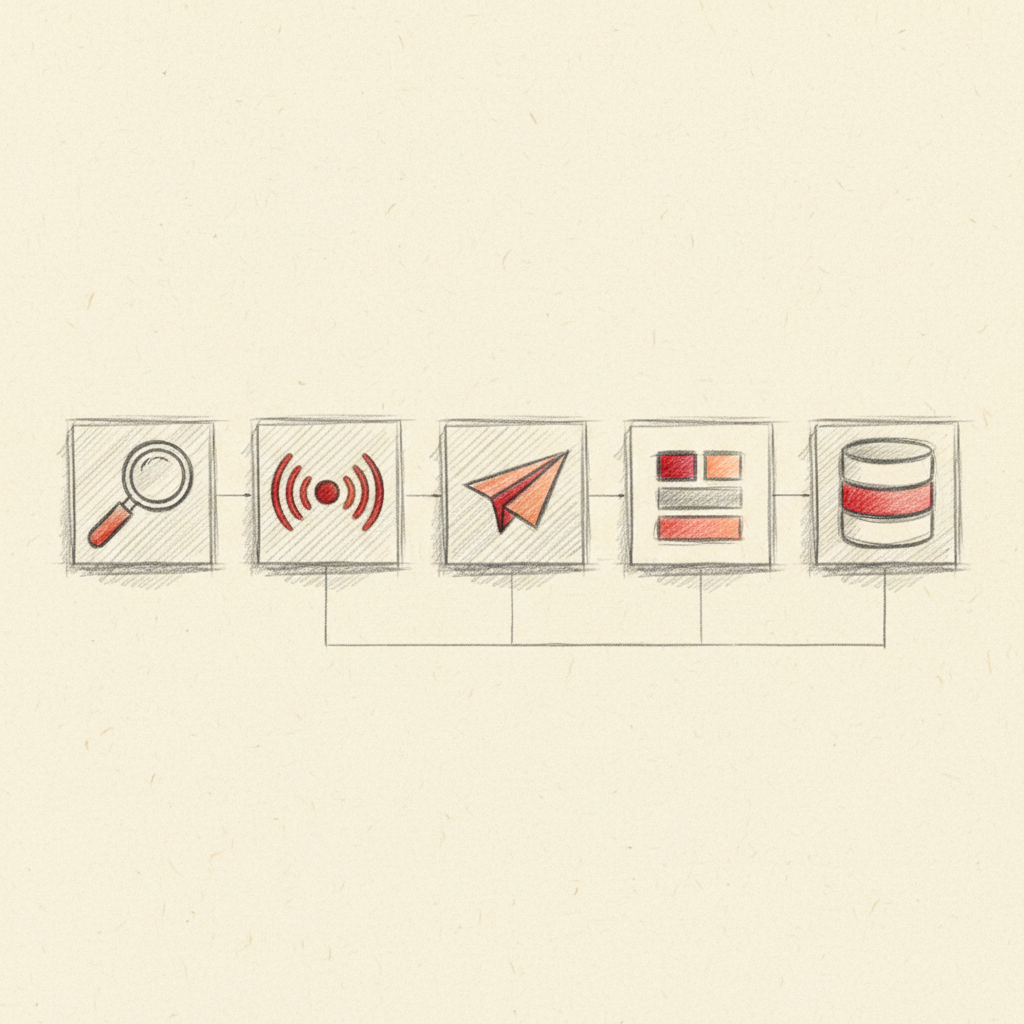
A complete GTM engine runs on five agent roles. Each agent owns one job. The GTM engineer connects them and sets the human gate on each one.
1. The Enrichment Agent
The enrichment agent builds and cleans your account and contact data. It pulls company details, finds the right people, fills in missing fields, and removes records that are wrong or dead. Tools like Clay and Apollo supply the raw data. The agent decides what to keep, how to format it, and when a record is good enough to act on. Bad data is the number one reason GTM systems fail, so this agent is the foundation. Everything downstream depends on it.
2. The Signal/Intent Agent
The signal agent watches for buying intent. It tracks job changes, funding news, hiring posts, website visits, tool adoption, and other markers that a company is ready to buy. ZoomInfo frames GTM engineering as turning buying signals into revenue motion, and this agent is where that starts. It scores each account on how warm it is right now, then hands the hot ones to the outreach agent. Without this agent your system sends the same message to everyone. With it, the system reaches people at the moment they care.
3. The SDR/Outreach Agent
The SDR agent writes the outreach. It takes the enriched data and the live signals, then drafts a message that references something true about the account. This is the agent most people picture when they think of AI in sales. It is also the one that needs the tightest human gate, because a bad message at scale damages your brand. Our full guide to AI sales automation and revenue strategy covers how to keep outreach quality high while volume grows.
4. The Sequencing Agent
The sequencing agent decides timing and channel. It chooses when to send, which channel to use, how long to wait, and when to stop. A fixed sequence sends step two three days after step one no matter what. A sequencing agent adapts. If a contact opens an email twice, it moves them up. If a contact goes cold, it pauses. This agent turns a static drip into a system that responds to behavior.
5. The CRM-Sync Agent
The CRM-sync agent keeps your system of record clean. It logs every email, reply, call, and status change. It updates stages, fills fields, and flags records that need a human. The old GTM stack lost data at this exact step because updating the CRM was a manual chore nobody wanted. The sync agent removes that gap. Clean CRM data then feeds the enrichment and signal agents, and the loop closes.
These five agents form the spine of GTM engineering. The enrichment agent feeds the signal agent. The signal agent feeds the outreach agent. The outreach agent feeds the sequencing agent. The sequencing agent feeds the CRM-sync agent. The CRM-sync agent feeds the enrichment agent again. The GTM engineer designs that loop and watches it run.
How to Build Your GTM Engineering Function
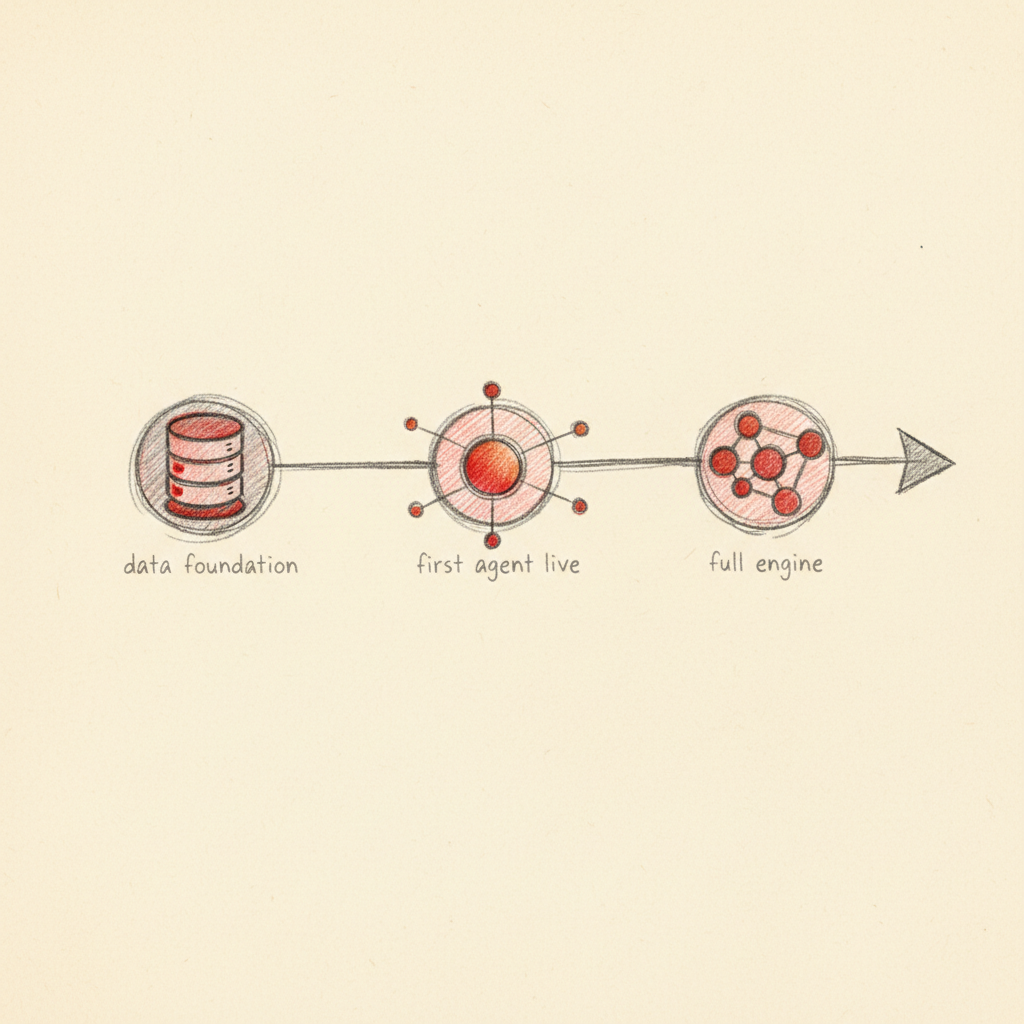
You build a GTM engineering function in stages, agents first. Do not buy a tool and hope. Start with the system design.
Step 1: Map the revenue motion. Write down every step from raw account to closed reply. List who does each step today and where data gets lost. This map becomes your agent list. Each manual step is a candidate for an agent.
Step 2: Fix the data first. Stand up the enrichment agent before anything else. Connect your data sources, set the rules for a clean record, and run it on a small list. Check the output by hand. A GTM system on bad data fails no matter how good the other agents are.
Step 3: Add the signal agent. Once your data is clean, layer in intent. Pick three or four signals that matter for your buyer. Have the agent score accounts and surface the warm ones. Review the scores against accounts you already know. Tune until the scores match reality.
Step 4: Turn on outreach with a tight gate. Bring in the SDR agent. Set it to draft, not send. Read every message for the first week. Once the quality holds, let it send to a small segment while you spot-check. Widen the segment as trust grows.
Step 5: Automate timing and sync. Add the sequencing agent to manage cadence and the CRM-sync agent to write everything back. At this point the loop is closed and the system runs on its own, with you reviewing the gates.
Step 6: Supervise, do not babysit. Your job shifts from doing the work to watching the system. Check the gates, read a sample of outputs, fix the data when scores drift, and improve one agent at a time. A GTM engineering function is never finished. It is tuned.
Many operators run their full GTM system on top of an AI platform that ties these agents together. Our AI CMO platform is built for exactly this, so one operator can run enrichment, signals, outreach, and sync from one place.
GTM Engineering Tools and Agent Stack
The market sells GTM engineering as a list of tools. The better way to choose is by agent role. Match each agent to a tool, then decide where a human reviews the output. The table below maps the five agents to common tools and the human gate each one needs.
| Agent Role | What It Does | Common Tool | Human-in-the-Loop |
|---|---|---|---|
| Enrichment Agent | Builds and cleans account and contact data | Clay, Apollo | Spot-check record quality on new lists |
| Signal/Intent Agent | Detects buying intent and scores accounts | ZoomInfo, Clay | Review scores against known accounts |
| SDR/Outreach Agent | Drafts personal outreach from data and signals | Salesforge, Apollo | Read every message until quality holds |
| Sequencing Agent | Sets timing, channel, and stop rules | HubSpot, Apollo | Approve cadence logic, watch reply rates |
| CRM-Sync Agent | Logs activity and updates the system of record | Salesforce, HubSpot | Audit field accuracy weekly |
The lesson from the table is clear. The tools are interchangeable. Clay, Apollo, ZoomInfo, HubSpot, and Salesforce all do good work. What makes the system a GTM engine is the agent layer that connects them and the human gate that keeps each agent honest. Buy tools for the data. Build agents for the work. Keep humans on the risk.
GTM Engineering Failure Modes
Most GTM engineering projects fail for the same three reasons. Each one is avoidable.
No orchestration. A team buys five tools and calls it GTM engineering. The tools never talk to each other, so a person still moves work between them by hand. This is the old manual stack with a bigger bill. The fix is to build the agent layer that passes work between steps. If a human still copies data from one tool to the next, you have automation theater, not a GTM system.
Bad data. The system runs on records that are wrong, old, or incomplete. The signal agent scores the wrong accounts. The outreach agent writes to dead contacts. The whole engine produces volume and zero pipeline. The fix is to make the enrichment agent the foundation and to audit its output before you trust anything downstream. Clean data first, always.
No human gate. A team lets the agents run with no review. The outreach agent sends a broken message to ten thousand contacts. The CRM-sync agent corrupts the pipeline. The brand takes the hit. The fix is a human gate on every risky output. Agents do the work. People approve the moves that carry brand or revenue risk. A GTM engineering function without human gates is not autonomous. It is unsupervised, and unsupervised systems break in public.
Avoid these three and your GTM engine will outperform any team doing the work by hand. The discipline is not hard. It is just new, and most teams skip the orchestration, the data work, and the gates because those steps are less exciting than buying a tool.
Frequently Asked Questions
What is a GTM engineer?
A GTM engineer is the person who builds and runs an agent-powered go-to-market system. They design the flow, connect the agents that handle enrichment, signals, outreach, sequencing, and CRM-sync, and review the outputs that carry risk. They own the revenue system the way a software engineer owns a product.
How is GTM engineering different from RevOps?
RevOps maintains the existing tool stack and reports on it. GTM engineering builds a new stack where AI agents replace the manual steps RevOps used to coordinate. RevOps keeps the current machine running. GTM engineering builds a different machine that needs fewer hands. One maintains, the other ships.
Do you need to code to be a GTM engineer?
No. You do not need to be a software engineer to start GTM engineering. You need to think in systems and supervise agents. Many GTM engineers come from RevOps, sales ops, or marketing ops. The core skill is designing a flow and reviewing agent output, not writing code. Coding helps for custom work, but it is not the entry requirement.
What agents make up a GTM engine?
A modern GTM engine runs on five agents: an enrichment agent that cleans data, a signal agent that detects buying intent, an SDR agent that writes outreach, a sequencing agent that sets timing, and a CRM-sync agent that updates the system of record. The GTM engineer connects these five and sets a human gate on each.
How is GTM engineering different from an AI SDR?
An AI SDR is one agent that sends outreach. GTM engineering is the full system that feeds that agent good data, tells it who to contact and when, and writes results back to the CRM. The AI SDR is one part of the engine. GTM engineering is the whole engine and the engineer who runs it.
How do you start GTM engineering?
Start by mapping your revenue motion and listing every manual step. Build the enrichment agent first to fix your data. Add the signal agent, then the outreach agent with a tight human gate. Finish with sequencing and CRM-sync. Then shift your job from doing the work to supervising the system. Start small, fix the data, and widen as trust grows.
GTM engineering is the discipline that decides who wins revenue in 2026. The teams that build agent-powered systems will outpace the teams still hiring SDRs and gluing tools together by hand. Start with one agent, gate its output, and grow the engine from there. For a wider view of how agents reshape go-to-market, read our complete guide to AI agent marketing.
Want Weekly Founder Video Without Filming Weekly?
We run the Video Engine for you, or install it in your team. AI avatar, real footage, or both.