
The 3-Person Lean Marketing Team Blueprint for 2026

A 3-person team now runs the work that took ten people in 2023. The change is not effort. It is structure. Three humans direct the strategy. An AI agent stack runs the production line.
This blueprint gives you the exact model. You get the three roles, their jobs, the AI agents each role runs, and a 30-60-90 day plan to make the switch. I have built this structure across 200-plus B2B SaaS engagements over the last ten years. It works, and it is current as of May 2026.
Key Takeaways
- A lean marketing team in 2026 is three humans: a Strategist, an Operator, and a Distribution Lead.
- Each human directs a named AI agent stack across content, SEO, analytics, and paid media.
- The Strategist owns positioning, brand voice, and every approval gate. Nothing ships without a human checkpoint.
- The Operator owns the agent stack, the workflows, data hygiene, and QA. This is the production line.
- The Distribution Lead owns channels, paid media, partnerships, and demand capture.
- A 30-60-90 day plan moves a legacy team to the lean model with weekly milestones.
- Data hygiene and a brand-voice system are the foundation. Skip them and quality breaks.
What Is a Lean Marketing Team in 2026?
A lean marketing team is three people who direct an AI agent stack instead of doing the production work by hand. The humans set strategy, guard the brand, and approve output. The AI agents write, optimize, measure, and test at scale.
The term lean marketing is not new. Planview and HubSpot both define lean marketing as cutting waste and moving fast like a startup. That idea still holds. What changed in 2026 is the engine. Old lean teams cut waste by working in sprints. New lean teams cut waste by handing the production work to AI agents. The goal is the same. The method is faster.
This is a new shape. In 2023 a startup marketing team had eight to twelve people. You needed a content writer, an SEO specialist, a designer, a paid media buyer, an analyst, a social manager, and an email marketer. Each person did one job by hand.
That structure is gone for lean teams. AI agents now do the hand work. One agent writes a draft in minutes. Another finds keywords and builds briefs. Another reads your analytics and writes the report. The humans no longer produce. They direct.
Three things made this possible in 2026. AI agents got reliable enough to run real workflows. Agent stacks got cheap enough for a startup budget. And the orchestration tools got simple enough that one person can run a dozen agents. The result is a team of three that ships the output of ten. To go deeper on the agents themselves, read our complete guide to AI marketing agents.
The lean team is not about working harder with fewer people. It is about a clean split between thinking and doing. Humans think. Agents do. The old team blurred this line. One person wrote, edited, posted, and measured the same piece. The lean team draws a hard line. The Strategist thinks. The agent writes. The Operator checks. That split is the whole trick.
People worry that a 3-person team means lower quality. The opposite is true when you set it up right. A focused team of three with a clean agent stack ships more on-brand work than a scattered team of ten. The reason is simple. Three people share one voice and one set of rules. Ten people each bend the voice a little. We cover this trade-off in detail in our breakdown of AI marketing teams and the reality of cost reduction.
The 3 Human Roles and Their Responsibilities
A lean marketing team has three roles. Each one owns a clear slice of the work. No overlap. No gaps.
The Strategist owns the brain of the operation. This person decides what the company says, who it says it to, and what bets to make each quarter. The Strategist sets positioning, writes the messaging, defines the brand voice, and picks the quarterly bets. The Strategist also owns every approval gate. No piece of content goes live without their sign-off. This is the human checkpoint that keeps the AI on-brand.
The Operator owns the machine. This person builds and runs the AI agent stack. The Operator sets up the workflows, keeps the data clean, and checks the quality of every agent output. When an agent breaks, the Operator fixes it. When output drops in quality, the Operator catches it. This is the production line, and the Operator runs it.
The Distribution Lead owns the reach. Great content means nothing if no one sees it. The Distribution Lead owns the channels, the paid media budget, the partnerships, the community, and the demand capture. This person decides where content goes, how much to spend, and which partners to work with. The Distribution Lead turns output into pipeline.
Here is the full split.
| Role | Owns | Approval Power | Reports On |
|---|---|---|---|
| Strategist | Positioning, messaging, brand voice, quarterly bets | Final sign-off on all published content | Pipeline and brand health |
| Operator | AI agent stack, workflows, data hygiene, QA | Production go or no-go | Output volume and quality scores |
| Distribution Lead | Channels, paid media, partnerships, community | Spend and channel mix | Reach, leads, and CAC |
These three roles cover every job a marketing team needs to do. The Strategist decides. The Operator produces. The Distribution Lead delivers. Each one runs AI agents to do the heavy lifting.
The split matters most at the seams. The Strategist hands the angle to the Operator. The Operator hands finished content to the Distribution Lead. The Distribution Lead hands results back to the Strategist. This loop runs every week. When the seams are clean, the team moves fast. When the seams blur, work stalls and people step on each other.
Pick the right person for each role. The Strategist needs taste and judgment. This person reads the market and knows what the brand should say. The Operator needs a love of systems. This person likes tools, process, and clean data. The Distribution Lead needs a growth mind. This person thinks in channels, budgets, and numbers. Match the person to the role and the team runs itself.
Mapping Roles to the AI Agent Stack
The three humans do not work alone. Each one directs AI agents across four functions: content, SEO, analytics, and paid media. The human sets the goal and approves the output. The agent does the work.
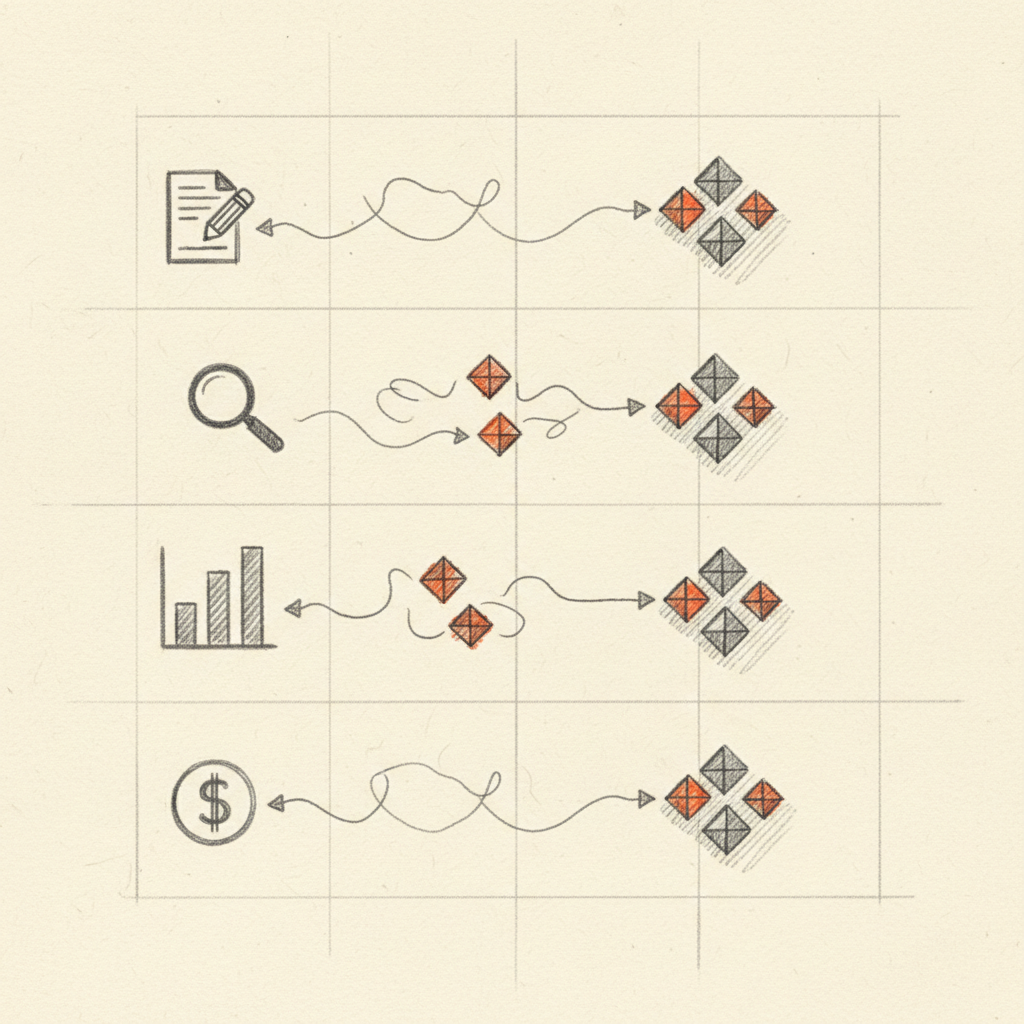
Content is the biggest function. The Strategist directs it and the Operator runs it. A research agent gathers the facts. A writer agent drafts the piece. An editor agent cleans it and checks the voice. A repurposing agent turns one article into ten social posts. The Strategist approves the angle. The Operator runs the pipeline.
SEO belongs to the Operator. A keyword agent finds the terms worth ranking for. A brief agent turns each term into a writing plan. An internal-link agent ties your pages together. An audit agent checks the site for problems each week. The Operator reads the output and acts on it.
Analytics belongs to the Distribution Lead. A performance agent tracks what each piece of content does. An attribution agent shows which channels drive leads. A report agent writes the weekly summary in plain words. The Distribution Lead uses these to decide where to push next.
Paid media also belongs to the Distribution Lead. An ad-copy agent writes the variants. A budget-pacing agent keeps spend on track. A creative-test agent runs the experiments and reports the winners. The Distribution Lead sets the budget and the agents run the campaigns.
Here is the full map.
| Function | Owning Role | AI Agents |
|---|---|---|
| Content | Strategist directs, Operator runs | Research agent, writer agent, editor agent, repurposing agent |
| SEO | Operator | Keyword agent, brief agent, internal-link agent, audit agent |
| Analytics | Distribution Lead | Performance agent, attribution agent, report agent |
| Paid Media | Distribution Lead | Ad-copy agent, budget-pacing agent, creative-test agent |
This map is the heart of the lean model. Four functions. Three humans. A dozen agents. Every agent has one human owner who sets its goal and checks its work.
Notice the rule that holds the map together. One agent does one job. The writer agent writes. It does not also do research or editing. Each step is its own agent with its own check. This keeps quality high and makes problems easy to spot. When a draft reads wrong, you know the editor agent failed. When a draft has bad facts, you know the research agent failed. The chain is clear.
The agents also talk to each other. The keyword agent feeds the brief agent. The brief agent feeds the writer agent. The writer agent feeds the editor agent. The editor agent feeds the repurposing agent. One input flows into a finished asset with no human typing in the middle. This is what a multi-agent marketing system looks like in practice. The human starts the chain and approves the end. The agents handle the middle.
This is also why a small team can replace a big one. The work that took eight specialists now flows through one connected stack. We break down how this shift works in our piece on how AI content engines replace marketing teams of ten. The math is plain. Fewer humans, more output, same brand.
From Legacy Structure to the Lean Model
Most teams do not start lean. They start with a legacy structure of eight to twelve people. The move to three is a transition, not a layoff plan. You map the old roles onto the new three and let agents take the hand work.
Start by mapping people to roles. Your content lead, brand manager, or head of marketing becomes the Strategist. Your most technical marketer, the one who likes tools and process, becomes the Operator. Your growth or demand-gen person becomes the Distribution Lead. The other roles fold into the agent stack.
Next, decide what to automate first. Automate the work that is high-volume and rule-based. Content drafting, keyword research, internal linking, ad-copy variants, and reporting all fit. These tasks eat hours and follow clear patterns. Agents do them fast and well.
Then decide what to keep human. Keep strategy human. Keep brand voice human. Keep the final approval human. Keep partnership talks and big creative bets human. These need judgment, taste, and trust. Agents support them. Agents do not own them.
The transition takes about 90 days. You do not flip a switch. You move one function at a time, prove it works, then move the next. The next section gives you the week-by-week plan.
One warning on the transition. Do not automate a broken process. If your content was bad before agents, it will be bad faster with agents. Fix the process first. Write down how a good piece gets made. Then teach the agents that process. Agents copy what you give them. Give them a clean process and they copy clean work.
Also plan for the human side. Roles change. A writer who becomes an Operator now runs agents instead of writing. A buyer who becomes a Distribution Lead now sets agent budgets instead of placing ads by hand. These are new skills. Give your people time to learn them. The teams that move fastest are the ones that train hard in the first 30 days. For agencies making this move, our guide on building AI-first marketing agencies maps the same shift at the firm level.
The 30-60-90 Day Implementation Guide
You build the lean team in three phases. Each phase has weekly milestones. Do not skip ahead. Each phase sets up the next.
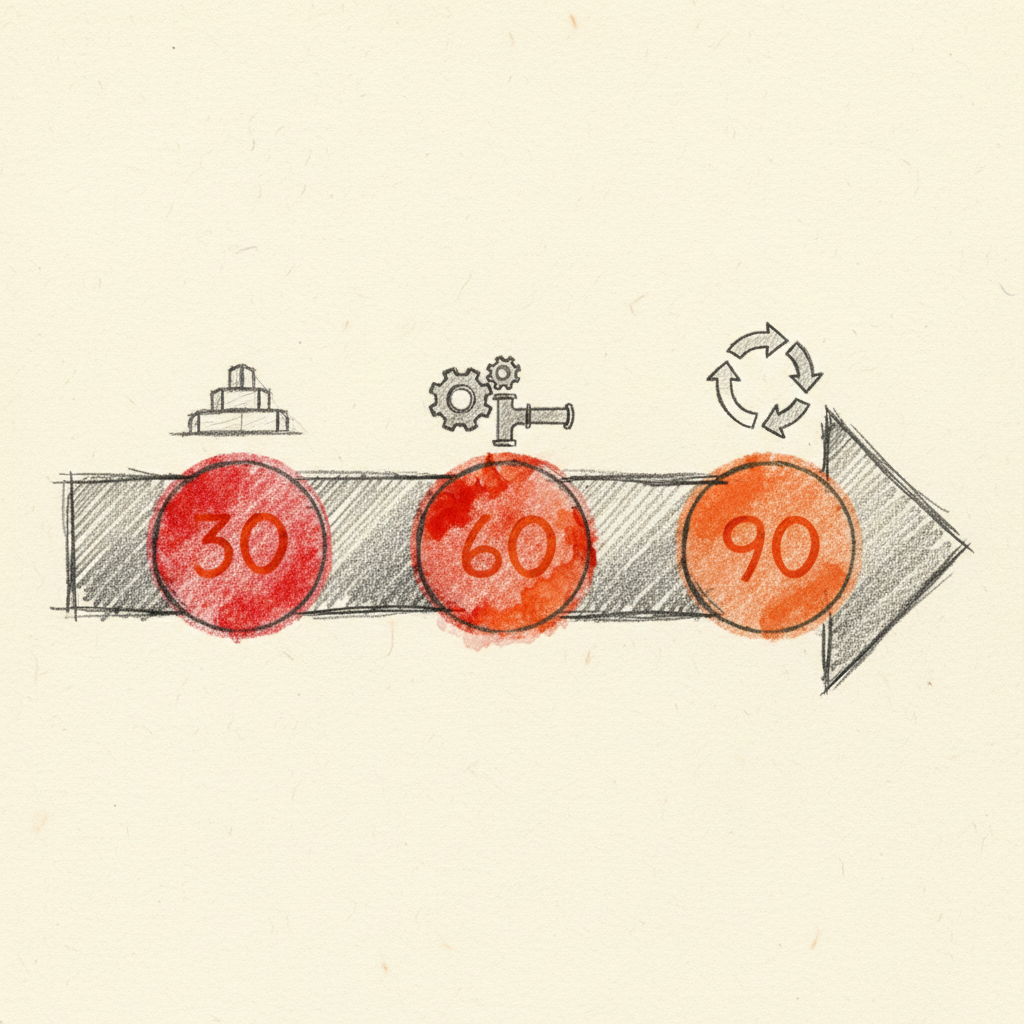
Days 0 to 30: Build the foundation.
- Week 1: Assign the three roles. Name your Strategist, Operator, and Distribution Lead.
- Week 2: Clean your data. Connect your analytics, your CRM, and your content history into one place.
- Week 3: Build the brand-voice system. Write down your voice rules, your banned words, and three sample posts.
- Week 4: Launch one agent. Start with the content writer agent. Run it on five drafts and review every one.
Days 31 to 60: Build the production line.
- Week 5: Add the research and editor agents. Now the content pipeline runs end to end.
- Week 6: Launch the SEO stack. Turn on the keyword agent and the brief agent. Feed briefs into the content pipeline.
- Week 7: Add the internal-link and audit agents. Your SEO function now runs on its own each week.
- Week 8: Set quality scores. The Operator sets a quality bar and checks every batch against it.
Days 61 to 90: Scale the full loop.
- Week 9: Launch the analytics stack. Turn on the performance and report agents. The Distribution Lead gets weekly reports.
- Week 10: Add the attribution agent. Now you see which channels drive leads.
- Week 11: Launch the paid media stack. Turn on the ad-copy and creative-test agents with a small budget.
- Week 12: Close the loop. Analytics feeds strategy. Strategy feeds content. Content feeds distribution. The team runs.
At day 90 you have a working lean marketing team. Three humans direct a full agent stack across all four functions. The output matches a team of ten.
Two mistakes slow teams down in these 90 days. The first is launching too many agents at once. Start with one. Prove it. Then add the next. A team that turns on ten agents in week one drowns in output it cannot check. The second mistake is skipping the review step. In the first month, the human reads every agent output. This teaches you where the agents fail and how to fix the rules. Once the quality holds, you check batches instead of every piece. Earn the speed. Do not assume it.
The Foundational Checklist: Data Hygiene and Brand Voice
Two systems decide whether your lean team works or breaks. The first is data hygiene. The second is a brand-voice system. AI agents are only as good as the data and the rules you give them. Set these up first.
Dirty data makes agents guess. Bad voice rules make agents sound generic. Both kill quality. Use this checklist before you turn on a single agent.
Data hygiene checklist:
- Connect your analytics, CRM, and content history into one source.
- Remove duplicate records and dead links.
- Tag every past piece of content by topic and funnel stage.
- Set one naming rule for all files and campaigns.
- Give agents read access to clean data only.
- Set a weekly data check so the Operator catches drift.
Brand-voice system checklist:
- Write your voice in one page: tone, reading level, sentence length.
- List your banned words so agents never use them.
- Save three to five sample posts that show the voice.
- Define your point of view on the top five topics in your space.
- Set the approval gate so the Strategist signs off before anything ships.
- Update the voice file each quarter as the brand grows.
Run both checklists before launch. They are the guardrails. With clean data and a clear voice, your agents produce on-brand work at scale. Without them, you ship fast and lose quality. The Operator owns data hygiene. The Strategist owns brand voice.
Treat the brand-voice file as a living document. The first version will be rough. After two weeks of agent output, you will see where the voice slips. Add new rules. Add new banned words. Add new sample posts. Each update makes the next batch better. The best lean teams refine the voice file every quarter. A sharp voice file is the cheapest quality tool you own.
The same goes for data. Set a weekly 15-minute data check. The Operator looks for new duplicates, dead links, and untagged content. Fifteen minutes a week keeps the data clean for the whole stack. Skip it and the data rots, and rotten data makes every agent worse. These two habits, a living voice file and a weekly data check, are what keep a fast team from drifting off-brand.
How AI Topia Powers the 3-Person Model
The lean model needs an agent stack that one person can run. That is the Operator role, and that is the job an AI CMO does. AI Topia built its AI CMO to be that stack.
The AI CMO maps to the Operator. It runs the agents for content, SEO, analytics, and paid media in one place. The Operator does not stitch together a dozen tools. One stack covers all four functions, so a single person keeps the production line moving.
The approval gates are built in. The Strategist reviews and signs off inside the same system. Nothing publishes without the human checkpoint. This is what keeps a fast team on-brand. You get the speed of agents and the control of a human gate.
The stack also keeps the data clean. The Operator does not pull numbers from five places by hand. The AI CMO reads your analytics and your content history in one view. That clean data feeds every agent. The writer agent knows what topics already rank. The report agent knows what content drove leads. Clean data in, on-brand work out.
I built this model across more than 200 B2B SaaS engagements over the last ten years. The pattern holds every time. Teams that try to run a dozen separate tools burn out their Operator. Teams that run one stack with built-in approval gates keep the speed and keep the quality. The single stack is what makes the 3-person team possible.
This is the point of the lean model. Three humans set the direction and guard the brand. The agent stack does the work. A startup runs marketing with three people and the output of ten. That is the shape of marketing in 2026.
Frequently Asked Questions
What is a lean marketing team?
A lean marketing team is three people who direct an AI agent stack instead of doing the production work by hand. The three roles are Strategist, Operator, and Distribution Lead.
How many people do you need to run marketing in 2026?
Three. A Strategist owns strategy and brand voice. An Operator runs the AI agent stack. A Distribution Lead owns channels and paid media. AI agents do the hand work.
What does a marketing Operator do?
The Operator owns the AI agent stack, the workflows, data hygiene, and quality checks. When an agent breaks, the Operator fixes it. The Operator runs the production line.
Can AI replace a marketing team?
No. AI runs the production line. Humans own strategy, brand voice, and every approval gate. The lean model uses AI to do the work, not to make the decisions.
What is the 30-60-90 plan for a lean marketing team?
Days 0 to 30 build the foundation: roles, clean data, brand voice, and one agent. Days 31 to 60 launch the content and SEO agents. Days 61 to 90 add analytics and paid media to close the loop.
How do you keep AI marketing on-brand?
You set up a brand-voice system and clean your data first. Both gate every piece of agent output. The Strategist signs off before anything ships. Clean data and a clear voice keep quality high.
Want Weekly Founder Video Without Filming Weekly?
We run the Video Engine for you, or install it in your team. AI avatar, real footage, or both.