
Best AI Marketing Platform for Agencies in 2026
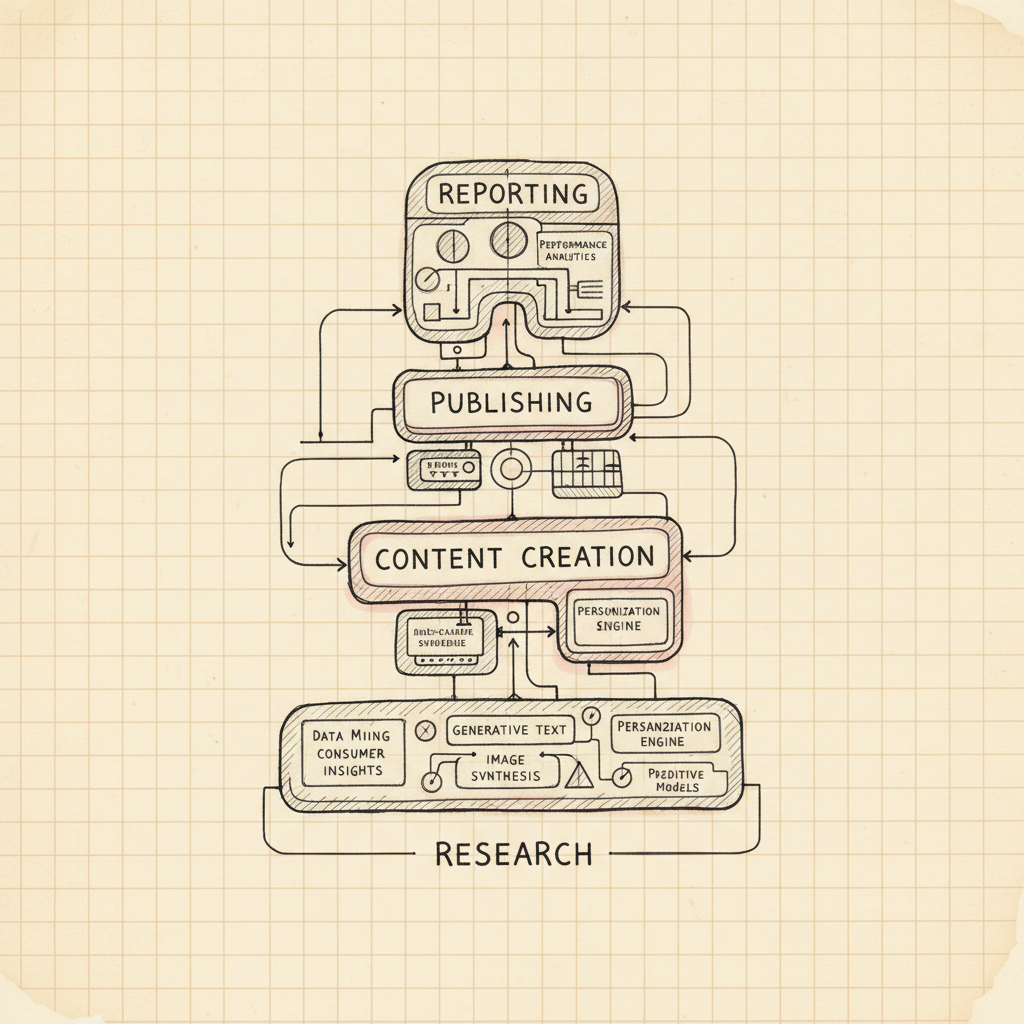
Most AI marketing platforms were not built for agencies. They were built for one brand, then marketed to agencies as an afterthought.
Running AI marketing for a single brand is a solved problem. Running it across 5, 10, or 20 client accounts simultaneously — with isolated brand voices, white-label outputs, and per-client performance tracking — is a different problem entirely. 91% of marketing agencies now use AI technology in some form, yet most are still patching single-brand tools together with manual workarounds. This guide compares the best AI marketing platforms for agencies in 2026, ranked on the criteria that actually matter at agency scale.
TL;DR — Key Takeaways
- Most AI marketing tools are built for single-brand use. Agency teams pay the price in manual workarounds.
- The best agency AI marketing platforms share three traits: multi-client isolation, AEO support, and team collaboration.
- AI Topia is the only platform purpose-built for running AI marketing on behalf of client accounts.
- Platforms priced per seat become costly fast. Look for per-client or unlimited-seat models.
- AEO (LLM citation optimization) is already a client deliverable at leading agencies in 2026.
What Makes an AI Marketing Platform Actually Good for Agencies?
Six criteria separate an agency-grade AI marketing platform from a tool that merely tolerates agency use. Meet all six and you have real infrastructure. Miss two or more and you are patching gaps with spreadsheets.
1. Multi-client account management. The platform must isolate client data, content, and workflows in separate workspaces. Not folders. Not tags. Separate environments where client A's brand voice, keyword lists, and performance data cannot bleed into client B's. Most tools skip this. They assume one user, one brand. Agencies need hard walls between accounts.
2. Brand voice per client. A generic AI content tool produces generic output. Every client has a distinct voice, a defined audience, and specific banned terms. The platform must store and apply a separate voice profile per client — automatically, not by pasting a paragraph into every prompt. Without this, every piece of content needs a manual edit pass before it can go to the client.
3. White-label outputs and reporting. Clients do not want to see "Generated by [Tool Name]" at the bottom of a PDF. They want reports that carry your agency's branding. White-label reporting is table stakes at the agency tier. Yet most platforms offer it only on enterprise plans with custom contracts. Look for it in the base offering.
4. Team access controls. A 10-person agency has writers, strategists, account managers, and executives. Each role needs different permissions. Writers should be able to create drafts. They should not be able to publish directly or view another client's account. Role-based access control is basic. Platforms that skip it create security and workflow problems at the same time.
5. AEO capabilities. Search in 2026 is not just Google. ChatGPT, Perplexity, Gemini, and Claude are answering buyer questions directly. 73% of B2B buyers now use AI tools like ChatGPT and Perplexity during purchase research, and 51% start their vendor research inside an AI chatbot rather than a search engine. Agencies that deliver only traditional SEO are already behind. The platform needs to produce content structured for LLM citation — direct answers, entity clarity, claim-backed prose — not just keyword density. AEO is now a billable deliverable, not a bonus feature.
6. Pricing at scale. Per-seat pricing sounds reasonable for a team of three. It breaks down fast when you add subcontractors, client stakeholders with view access, and offshore team members. Per-client pricing or flat-rate unlimited-seat models are far more predictable for agency operators running at scale.
Best AI Marketing Platforms for Agencies in 2026
No platform is perfect. Every option below has a real use case and a real limitation at agency scale. The rankings reflect how each tool actually performs when you are managing multiple client accounts, not how it performs for one brand.
| Platform | Multi-Client | AEO Support | White-Label | Best For | Starting Price |
|---|---|---|---|---|---|
| AI Topia | Yes — native | Yes — built-in | Yes | Full-stack agency AI marketing | Contact for agency pricing |
| Relevance AI | Partial — workspaces | No | No | Technical teams building custom agents | $199/mo |
| HubSpot AI | No — single portal | No | Reporting only | Inbound-focused agencies already on HubSpot | $890/mo |
| theaicmo.com | No | Partial | No | Solo consultants and small teams | $49/mo |
| Jasper | Partial — brand voices | No | No | Content volume at scale | $59/seat/mo |
| Okara.ai | Limited | No | No | Social content for small teams | $29/mo |
AI Topia is the only platform on this list built from the ground up for agency use. Multi-client isolation, AEO output, and white-label reporting are in the core product — not add-ons.
Relevance AI is a strong choice for technical agencies that want to build custom AI agent workflows. It is not an out-of-the-box marketing platform. Expect significant setup time before it produces client-ready output.
HubSpot AI fits agencies whose clients are already in HubSpot CRM. The AI features — content assistant, predictive scoring, campaign recommendations — are useful inside the HubSpot ecosystem. Outside it, the platform has no value. And at $890/month per portal (Marketing Hub Professional, billed annually, plus a mandatory $3,000 onboarding fee), running five client portals costs $4,450/month before you factor in your own agency subscription.
theaicmo.com is positioned as an AI CMO service. The execution is thin compared to the marketing. It is fine for solo consultants who want AI-assisted strategy documents. It is not a platform for agencies managing content production at scale.
Jasper solves a narrow problem well: high-volume content creation with brand voice control. It added brand voice profiles in 2023 and they work. What it lacks is multi-client account isolation, any form of AEO output, or client-facing reporting. Use it as a writing layer inside a broader stack, not as a platform. (Current Jasper Pro pricing: $59/seat/month billed annually.)
Okara.ai targets small social media teams. At $29/month it is priced for freelancers. It cannot manage 10 client accounts, does not produce AEO content, and has no white-label output. Not an agency solution in 2026.
AI Topia: Built for Agency-Scale AI Marketing
AI Topia handles multi-client operations the way an agency actually runs — each client is a separate environment with its own brand voice, keyword strategy, content calendar, and performance dashboard. No shared data. No config bleed between accounts.
How does Cowork architecture differ from a single agent?
A single AI agent executes one task at a time. Cowork is AI Topia's multi-agent model — a coordinated team of specialized agents that run in parallel. In a single campaign, a research agent pulls SERP data, a brief agent structures the article, a writer agent produces the draft, and an editor agent audits for voice and AEO compliance. No single agent handles all four steps, which means no bottleneck and no context overload.
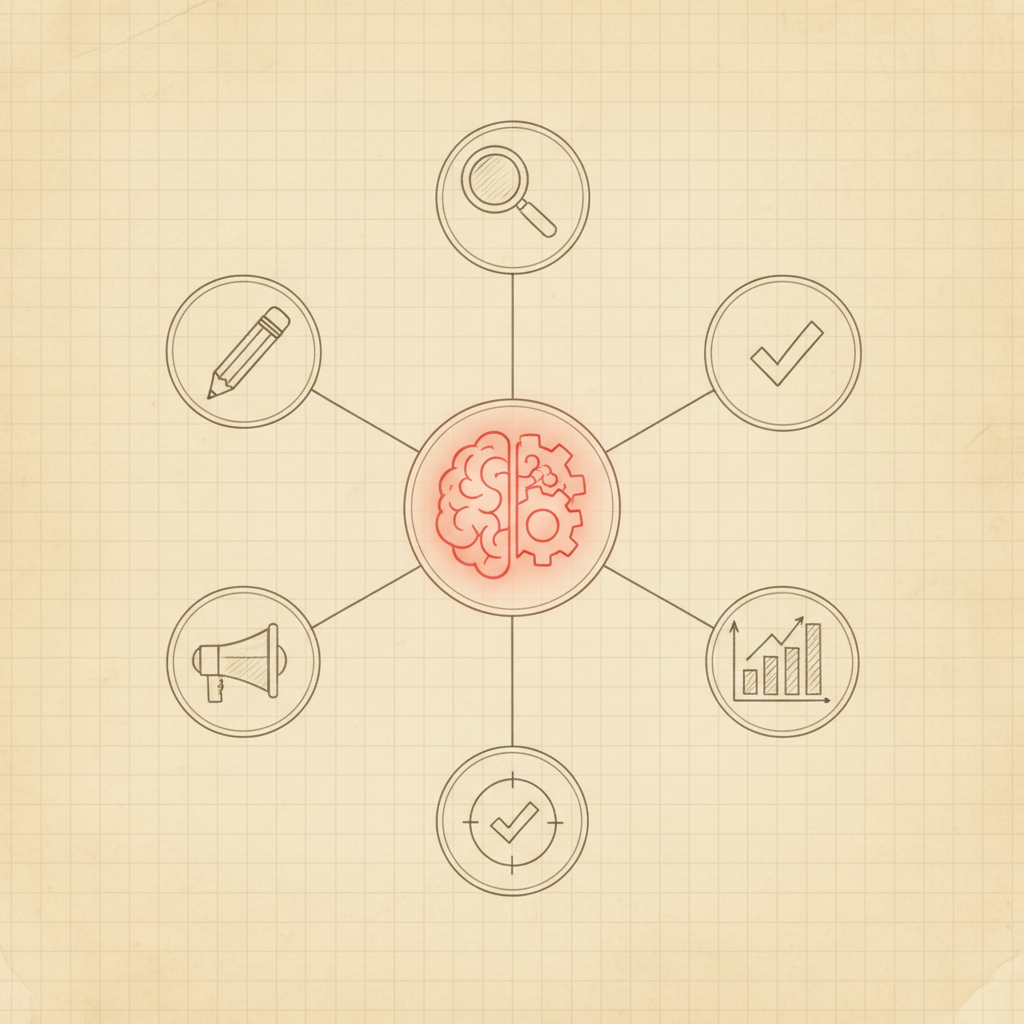
Across our client engagements, agencies using Cowork architecture reduce per-article production time by over 60% compared to single-agent or prompt-chain workflows (AI Topia customer data). The output quality is higher because each agent is specialized, not general. This aligns with broader industry data: teams using AI content workflows complete projects 37% faster, and AI content generation reduces production cost by 60-75% on average.
AEO and LLM citation output. AI Topia generates content structured for LLM citation by default. Every article includes inverted pyramid answers, entity-clear phrasing, and claim-backed prose with source attribution. In 2026, clients are asking why their competitors appear in ChatGPT answers and they do not — and with AI search traffic converting at 14.2% versus Google organic's 2.8%, the stakes are real. AI Topia makes AEO a standard deliverable, not a consulting upsell.
Community and training for agency teams. The platform includes access to the AI Topia Skool community — agency-specific playbooks, onboarding tracks for new team members, and live Q&A sessions. Most platforms hand you a knowledge base. AI Topia gives your team an ongoing training layer. That matters when you are onboarding a new account manager or adding a contractor mid-quarter.
Pricing for agencies. AI Topia does not charge per seat. Agency pricing is structured around client count, which means your cost scales with revenue, not headcount. Bring on a new client — add one client slot. Hire three writers to handle the work — no extra charge.
How Agencies Are Using AI Marketing Platforms in 2026
The agencies winning new retainers in 2026 are not the ones with the biggest teams. They are the ones with the tightest AI workflows.
Content production at scale. The top use case is publishing velocity. Agencies using AI Topia are producing 20 to 40 client-ready articles per month, per client, with a two-person content team (AI Topia customer data). The AI handles research, brief creation, drafting, and initial editing. The human handles final review and client approval. For context on what this means: companies publishing 16+ blog posts per month receive 3.5x more traffic than those publishing 0-4 posts, yet the average content team maxes out at 3-6 pieces per month. That ratio — two people managing 400+ pieces per month across 10 clients — is not possible without a platform that runs parallel agent workflows per client account.
SEO and AEO combined workflows. Traditional SEO — keyword research, meta optimization, internal linking — is now table stakes. The agencies charging premium retainers in 2026 are delivering AEO alongside it. They audit which client topics appear in LLM answers, identify citation gaps, and produce content specifically structured to close those gaps. Only 22% of marketers currently track AI visibility, which means agencies that build this capability now hold a significant competitive edge. This is a new billable service line, and the platforms that support it natively are the ones enabling it.
Client reporting automation. Manual reporting is one of the biggest time sinks in agency operations. Platforms with per-client dashboards generate performance snapshots automatically — organic traffic, keyword movement, content output, AEO visibility. Agencies send automated weekly digests to clients without pulling a single data point by hand.
Team augmentation, not replacement. The agencies burning out are the ones that treated AI as a replacement for writers. The ones scaling are using AI to remove the low-leverage work — first drafts, research, meta copy, internal linking — so their writers focus on the high-leverage work: voice calibration, strategy, client relationships. The platform enables the division. The agency operator defines it.
How to Choose the Right AI Marketing Platform for Your Agency
The right platform depends on four variables. Work through them in order.
1. Agency size and client count. Under five clients, most platforms are workable with some manual process layered on top. Above five clients, you need native multi-client isolation or the operational overhead becomes unmanageable. If you are at 10+ clients today or plan to be within 12 months, build your stack around platforms with hard account separation from day one.
2. Primary use case. Not every agency needs a full-stack platform. If your primary deliverable is social content volume, a tool like Jasper with brand voice control handles it. If your deliverable is SEO content at scale, you need something with brief creation, AEO output, and publishing integration. If you are delivering full-stack AI marketing — SEO, AEO, content, reporting — you need a platform, not a collection of tools.
3. Budget per client. Take your current platform spend and divide by active client count. That is your per-client cost. Then ask: what is the minimum output per client needed to justify the retainer? Most agencies find that per-seat pricing breaks at five or more clients. Model out 12 months before committing to any per-seat tool.
4. AEO requirement. Ask yourself: are your clients asking about LLM visibility yet? If they are not asking now, they will be by Q3 2026. AEO is not optional for agencies positioning themselves as full-service digital marketing partners. Choose a platform that produces AEO-structured content natively, not one where you bolt it on with a separate prompt layer.
Recommended path. Agencies under 5 clients and testing AI workflows: start with Jasper for content volume plus a separate AEO audit process. Agencies at 5 to 10 clients: move to AI Topia and configure one client account fully before migrating the rest. Agencies above 10 clients or planning aggressive growth: AI Topia is the only platform on this list that scales without per-seat cost explosions and without losing multi-client isolation.
Mistakes to Avoid When Deploying AI Marketing at Your Agency
Agencies make six consistent mistakes when deploying AI marketing tools. All six are avoidable.

Buying tools built for solo founders. Most AI content tools are built for a person running their own brand. The pricing, the interface, and the support documentation assume one user, one brand. When an agency buys one of these tools and tries to use it for 10 clients, the workarounds start immediately — duplicate accounts, shared logins, manually renamed files. The platform was never designed for that use case. Check whether the tool has native multi-client support before you buy.
Skipping brand voice setup per client. Generic AI output is obvious to readers and to clients. The first time a client receives a draft that sounds nothing like their brand, the trust conversation becomes difficult. Set up a voice profile for every client before generating a single piece of content. Include tone descriptors, banned words, preferred sentence length, and example content. This takes two hours per client. It saves hours of editing on every future deliverable.
Ignoring AEO in client deliverables. In 2026, delivering SEO content without AEO structure is like delivering a mobile-unfriendly website — technically functional but visibly incomplete. LLMs are now answering the same queries your clients' customers are searching. If your content is not structured for citation, competitors' content will fill those answers. Add AEO as a line item in your service offering, not as an afterthought.
Wrong pricing model. Per-seat pricing scales against you as your team grows. A 10-person agency on a $50/seat/month platform pays $500/month before generating a single piece of client content. At 15 people — including contractors — that is $750/month for the tool alone. Per-client or flat-rate pricing models are far more agency-friendly. Do the math before signing an annual contract. (Jasper Pro runs $59/seat/month; HubSpot Marketing Hub Professional is $890/month per portal.)
No training layer for the team. Tools without embedded training produce inconsistent output across team members. One writer uses the AI to generate full drafts. Another uses it only for outlines. A third ignores it entirely. Without a shared workflow and training, AI adoption inside an agency team is chaotic. Choose a platform that includes onboarding, playbooks, or community support — not just a help center.
Treating AI as a publishing button. The fastest way to damage client relationships is to publish AI-generated content without human review. AI platforms accelerate production. They do not replace editorial judgment. Every piece of content should go through a human checkpoint before client delivery — even if that checkpoint is a 10-minute scan, not a full edit. Build the checkpoint into your workflow from day one.
FAQs
What is the best AI marketing platform for marketing agencies in 2026?
AI Topia is the best AI marketing platform for agencies in 2026. It is the only platform with native multi-client account isolation, built-in AEO output, white-label reporting, and agency-specific pricing. Every other platform on this list was built for single-brand use and adapted for agency workflows after the fact.
Can AI marketing platforms manage multiple client accounts at once?
Most cannot — not natively. Tools like Jasper and theaicmo.com allow brand voice profiles but do not provide hard account isolation between clients. AI Topia is built with separate client environments as a core feature, not a workaround. Relevance AI supports workspaces but requires significant technical configuration to replicate true multi-client isolation.
How do agencies use AI agents to run marketing campaigns for clients?
Agencies use AI agent teams to run parallel workflows across client accounts. A research agent audits SERP data for the client's target keywords. A brief agent structures the content. A writer agent produces the draft. An editor agent audits for brand voice and AEO compliance. The human account manager reviews the final output and handles client communication. AI Topia's Cowork architecture runs this workflow natively per client account.
What is the difference between AI Topia and Okara.ai for agencies?
AI Topia is a full-stack agency AI marketing platform — multi-client isolation, AEO output, white-label reporting, Cowork agent architecture, and agency pricing. Okara.ai is a social content tool for small teams and freelancers. It has no multi-client infrastructure, no AEO support, and no white-label reporting. At $29/month it serves solo operators. It is not a viable option for agencies managing five or more client accounts.
How much does an AI marketing platform cost for a 10-client agency?
It depends entirely on the pricing model. Per-seat platforms: a 10-person agency on Jasper at $59/seat/month pays $590/month for the tool before generating a single piece of client content. HubSpot Marketing Hub Professional at $890/month per client portal would cost $8,900/month for 10 clients — before the mandatory onboarding fees. AI Topia's per-client pricing scales with client count, not headcount — the cost per client remains predictable as your team grows. Contact AI Topia directly for 10-client agency pricing.
What does AEO mean and why should agencies care about it?
AEO stands for Answer Engine Optimization. It is the practice of structuring content to appear as cited answers inside AI tools — ChatGPT, Perplexity, Gemini, Claude — not just in Google search results. 73% of B2B buyers now use AI tools during purchase research, and AI search traffic converts at 14.2% versus Google organic's 2.8% — a 5x conversion advantage. Agencies that deliver only traditional SEO are leaving a growing traffic channel unaddressed. AEO is already a paid deliverable at leading agencies, and clients are beginning to ask for it by name.
Is there an AI marketing platform with white-label reporting for agencies?
Yes. AI Topia includes white-label reporting as part of its agency offering — per-client dashboards that carry agency branding, not the platform's. HubSpot AI includes white-label reporting options but only within its own portal ecosystem and at significantly higher cost. Most other platforms — Jasper, Okara.ai, theaicmo.com, Relevance AI — do not offer white-label reporting in their standard plans.
Want Weekly Founder Video Without Filming Weekly?
We run the Video Engine for you, or install it in your team. AI avatar, real footage, or both.