
HubSpot Alternatives 2026: Why B2B SaaS Teams Are Moving to AI-Native Marketing
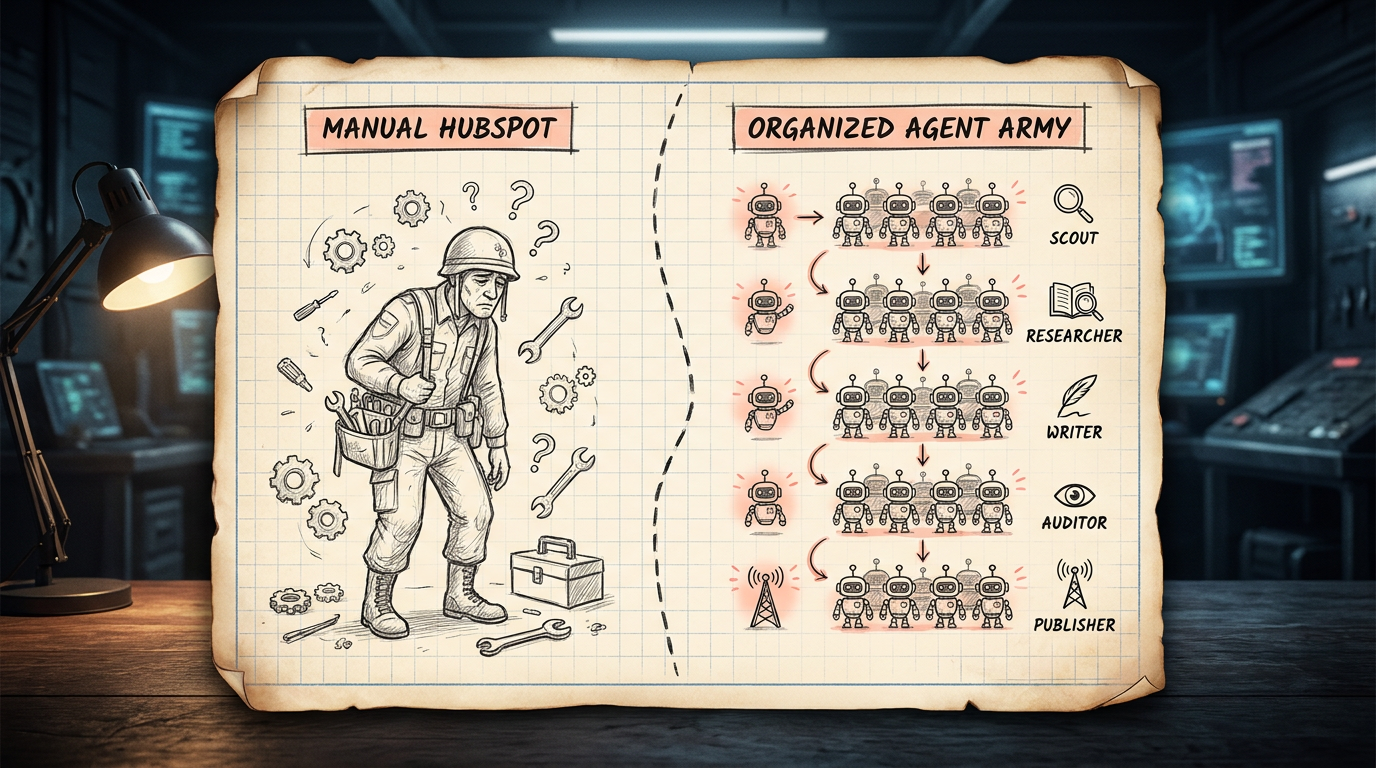
HubSpot is one of the most widely adopted marketing platforms in B2B SaaS. It is also, fundamentally, a database with a workflow editor layered on top.
It organizes your contacts, tracks your campaigns, and logs your interactions. But it does not run your marketing. You do. HubSpot provides the container. Your team provides the execution.
That distinction is driving a growing number of B2B SaaS marketing teams to look for alternatives — particularly as AI-native platforms make it possible to automate not just the tracking, but the actual work.
Why Teams Are Looking for HubSpot Alternatives
The most common complaints from teams evaluating HubSpot alternatives are not about features. They're about the execution model.
It requires a team to run. HubSpot's value scales with the humans operating it. A well-configured HubSpot instance with a skilled team produces excellent results. A small team with limited HubSpot expertise produces average results despite paying for an enterprise platform.
The AI features are bolt-on, not native. HubSpot has added AI writing assistants and predictive lead scoring, but these are utilities layered onto a fundamentally manual platform. The underlying execution model — humans creating campaigns, humans writing content, humans managing sequences — hasn't changed.
Cost-to-value for small and mid-market teams. HubSpot's pricing scales aggressively. The features that justify the cost often require hiring a dedicated HubSpot admin or consultant to configure and maintain.
It optimizes for organization, not execution. HubSpot is exceptional at organizing data, tracking attribution, and reporting on what happened. It is not designed to make things happen autonomously.
The Landscape: Traditional HubSpot Alternatives
Before covering AI-native alternatives, here are the traditional platforms teams evaluate:
Salesforce Marketing Cloud
The enterprise standard for large organizations with dedicated operations teams. More powerful than HubSpot for complex multi-touch attribution and cross-channel orchestration. Significantly more complex to configure and operate. Not a downgrade in features — a significant increase in implementation cost and operational overhead. Best for: large enterprise with dedicated Salesforce admins and a mature GTM operation.
Marketo (Adobe Marketo Engage)
The B2B marketing automation standard for mid-market to enterprise. Powerful lead nurturing, scoring, and multi-channel campaign management. Like Salesforce, the value scales with the expertise of the people operating it. Steep learning curve. Adobe's integration strategy makes it most valuable if you're already in the Adobe ecosystem. Best for: established marketing ops teams with Marketo expertise.
ActiveCampaign
More accessible than HubSpot at the mid-market level. Strong email automation, solid CRM, better pricing for smaller teams. Trade-off: less depth on the analytics and reporting side, weaker native integrations for B2B SaaS stacks. Best for: teams that primarily need email automation and basic CRM without enterprise complexity.
Brevo (formerly Sendinblue)
Strong email and SMS automation at competitive pricing. Limited on the marketing intelligence side — no serious content engine, limited AI features. Best for: teams that need clean email automation without a full marketing platform investment.
The AI-Native Category: A Different Architecture
Traditional HubSpot alternatives compete on features, pricing, and ease of use within the same fundamental model: tools that organize data and automate workflows that humans design.
AI-native marketing platforms operate on a different architecture entirely.
The distinction is not whether they include AI features. It's whether the AI handles execution or just assists it.
AI-assisted platforms (including HubSpot with its AI add-ons): AI helps humans work faster — suggesting subject lines, summarizing contacts, predicting lead scores. Humans still design every campaign, write every piece of content, manage every workflow.
AI-native platforms: agents handle the full execution chain — researching topics, writing content, auditing quality, optimizing for search, scheduling and publishing, monitoring performance, and feeding insights back into the next cycle. Humans set strategy and review outputs. The execution runs without human coordination in the middle.
What AI-Native Marketing Actually Does Differently
Content production runs on a schedule, not on a deadline
In a HubSpot-centered operation, content production depends on the availability of your content team. One writer goes on leave; output drops. Capacity constraints are a constant ceiling.
In an AI-native operation, agent-driven content pipelines run on a schedule. Scout agents identify trending topics and keyword opportunities. Research agents pull competitive data and search intent signals. Writer agents draft content in brand voice. Audit agents verify AEO structure and quality. Publish agents route approved content to the blog. The pipeline continues regardless of team capacity.
SEO execution is automated, not managed
HubSpot gives you SEO recommendations. An AI-native platform executes them. Identifying ranking opportunities, producing content to close gaps, fixing internal linking, monitoring position changes, and generating reports — these run as scheduled agent workflows, not as tasks on a human to-do list.
The system gets sharper over time, automatically
Every Anthropic model release — every improvement to Claude's capabilities — makes an AI-native marketing platform better overnight, without any configuration changes. The platform is built on the model, not alongside it. Model improvements are automatic upgrades.
HubSpot's AI features improve when HubSpot's product team ships an update, which gets rolled out on their timeline and requires user adoption. The compounding is slower and more fragmented.
Head-to-Head: HubSpot vs AI-Native Marketing
| Dimension | HubSpot | AI-Native (e.g. AI Topia AI CMO) |
|---|---|---|
| Content production | Human-driven, team-dependent | Agent-driven, runs on schedule |
| SEO execution | Recommendations + manual | Automated research, writing, auditing |
| AI integration | Bolt-on features | Native architecture |
| Execution model | Humans run workflows | Agents run workflows, humans review |
| Scale | Scales with headcount | Scales with agent configuration |
| Model upgrades | Product team ships features | Foundation model upgrades flow through automatically |
| Best for | Teams with marketing ops expertise | Lean teams maximizing output per person |
| Primary value | Organization, attribution, reporting | Execution, content, SEO, distribution |
When HubSpot Is Still the Right Choice
HubSpot is not the wrong tool for every use case. It's the wrong tool for teams whose primary bottleneck is execution capacity, not data organization.
HubSpot makes sense when:
- You have a dedicated marketing ops function with HubSpot expertise
- Your primary need is CRM, pipeline tracking, and attribution reporting
- You're running complex multi-touch nurture sequences that require precise contact-level logic
- You're deeply integrated into the HubSpot ecosystem and migration cost is prohibitive
An AI-native platform makes more sense when:
- Your primary bottleneck is content volume and SEO execution
- You're a lean team trying to operate at the output level of a larger one
- You want execution that compounds automatically with every model improvement
- You're building for autonomous operation, not for tool orchestration
These two categories are not necessarily mutually exclusive. Some teams run HubSpot for CRM and pipeline management while using an AI-native platform for content and SEO execution — letting each layer handle what it's designed for.
The Army Framing
HubSpot is a single soldier with excellent equipment and a great uniform. It performs exactly as well as the person holding it.
AI-native marketing infrastructure is an army. Scout agents, research agents, writer agents, audit agents, linking agents, publish agents — each specialized, each running in parallel, each reporting back. The army runs whether or not any individual human is present.
B2B SaaS companies with 45 effective AI employees in their marketing operation do not have the same execution ceiling as companies with a two-person content team and a HubSpot subscription.
That is the actual comparison. Not feature checkboxes — execution architecture.
Making the Decision
The right question is not "which platform has more features?" It's "where is your execution bottleneck, and what architecture removes it?"
If your bottleneck is data organization, reporting clarity, or nurture sequence management — HubSpot or a traditional alternative is the right answer.
If your bottleneck is content output, SEO coverage, and autonomous execution — an AI-native platform removes the constraint that traditional tools can't address.
For B2B SaaS companies looking to understand what AI-native marketing infrastructure looks like in practice — the AI Topia AI CMO platform is built for exactly this use case: lean teams running at enterprise output levels through autonomous agent execution.
For more context on the underlying architecture: AI-Native vs AI-Assisted: Why One Gets Free Upgrades.
FAQ
What is the best HubSpot alternative for B2B SaaS in 2026?
The best alternative depends on your primary bottleneck. If your bottleneck is CRM, pipeline management, or nurture automation, Salesforce Marketing Cloud or Marketo are more powerful alternatives at the enterprise level; ActiveCampaign is stronger at the mid-market level. If your bottleneck is content production, SEO execution, and autonomous marketing operations, an AI-native platform like AI Topia AI CMO addresses a problem that traditional HubSpot alternatives don't solve — because they share HubSpot's fundamental architecture of organizing data rather than executing work.
Is HubSpot worth it for small B2B SaaS teams?
HubSpot's value scales with the expertise of the people operating it. For small teams without dedicated marketing ops, the investment often produces below-potential results because the platform requires significant configuration and ongoing management. Small B2B SaaS teams with limited headcount typically see stronger ROI from AI-native infrastructure — which produces high output autonomously — than from a sophisticated CRM platform that requires skilled operators to realize its value.
Can an AI-native platform replace HubSpot entirely?
Not completely, at least not today. AI-native marketing platforms are significantly stronger on content production, SEO execution, and autonomous distribution. They are weaker on CRM, deal pipeline tracking, and multi-touch attribution reporting — areas where HubSpot has invested a decade of product development. The hybrid approach — HubSpot for pipeline and reporting, AI-native for execution — is a valid architecture for teams that need both.
What does AI-native marketing mean?
AI-native marketing means the marketing operation itself runs on AI infrastructure — agents handle the connective tissue between research, content production, SEO optimization, distribution, and reporting. Humans set strategy and review outputs, but the execution chain between strategy and published output runs without human coordination at every step. This is distinct from AI-assisted marketing, where AI tools accelerate individual human tasks but humans still manage every workflow.
How does AI Topia AI CMO compare to HubSpot?
HubSpot and AI Topia AI CMO address different problems. HubSpot organizes your marketing data and enables campaign management — it's a platform for skilled marketing teams to operate efficiently. AI Topia AI CMO runs marketing execution autonomously — scout agents monitor topics and competitors, research agents pull keyword data, writer agents produce content, audit agents verify quality, and publish agents route to the blog on a schedule. For content and SEO operations specifically, AI Topia replaces a team of specialists. For CRM and pipeline reporting, HubSpot is the stronger tool.
What should I look for when evaluating HubSpot alternatives?
Start with your bottleneck. If you're bottlenecked on data organization and reporting visibility — evaluate traditional alternatives (Salesforce, Marketo, ActiveCampaign) based on their CRM depth and integration ecosystem. If you're bottlenecked on content output, SEO coverage, and execution capacity — evaluate whether the alternative actually handles execution autonomously or just assists it. Most traditional HubSpot alternatives share the same fundamental model: tools that require skilled operators. AI-native platforms are a genuinely different architecture.
Ready to Automate Your Business?
Book a 30-minute call to discuss how AI can transform your Marketing, Sales, or Operations.
Book a Call