
SEO Agent: Most Do One Task. A Real One Runs the Whole Loop (2026)
Most SEO agents do one job and call it autonomy. One audits your site. One writes a blog post. One scores how often ChatGPT mentions you. None of them rank you.
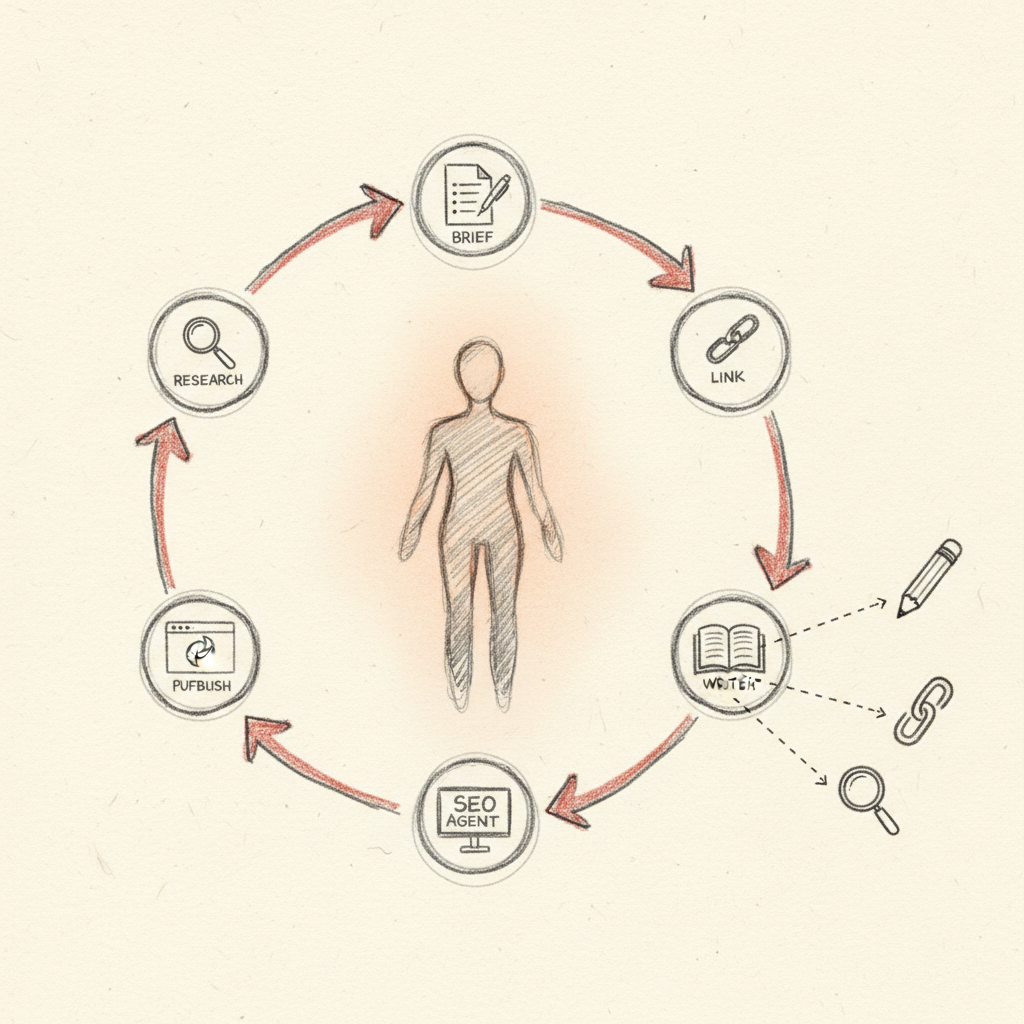
A real SEO agent runs the whole loop. Research, brief, write, internal-link, publish, track, refresh. It does not hand you a to-do list. It does the work, then checks if the work moved a ranking, then does it again.
That difference is the whole article. Here is what an SEO agent is, why most of them are one task wearing a costume, and what the full loop actually looks like.
What Is an SEO Agent?
An SEO agent is software that runs multi-step SEO work on its own, toward a goal, without waiting for a prompt at each step. The defining trait is goal-orientation. A tool waits for you to click. An agent decides the next move and takes it.
That is the line between an SEO agent and an SEO tool. Semrush is a tool. It shows you data. You still do the work. An SEO agent reads the same data, picks the highest-impact action, executes it, and measures the result.
Most "SEO agents" on the market are closer to tools with a chat box. They surface a recommendation and wait for you to act. A recommendation you have to implement yourself is not an agent. It is an alert with better marketing.
The strongest SEO agents are part of a larger system. At AI Topia, the SEO agent is one specialist inside the AI CMO, the Claude-native team that runs the marketing layer of a SaaS company. It does not work alone. It hands off to the writer, the link agent, and the performance agent.
The Three Things Most SEO Agents Skip
Search "seo agent" and you get a wall of products that each do one slice. Look closely and the gap is always the same. They stop before the work pays off.
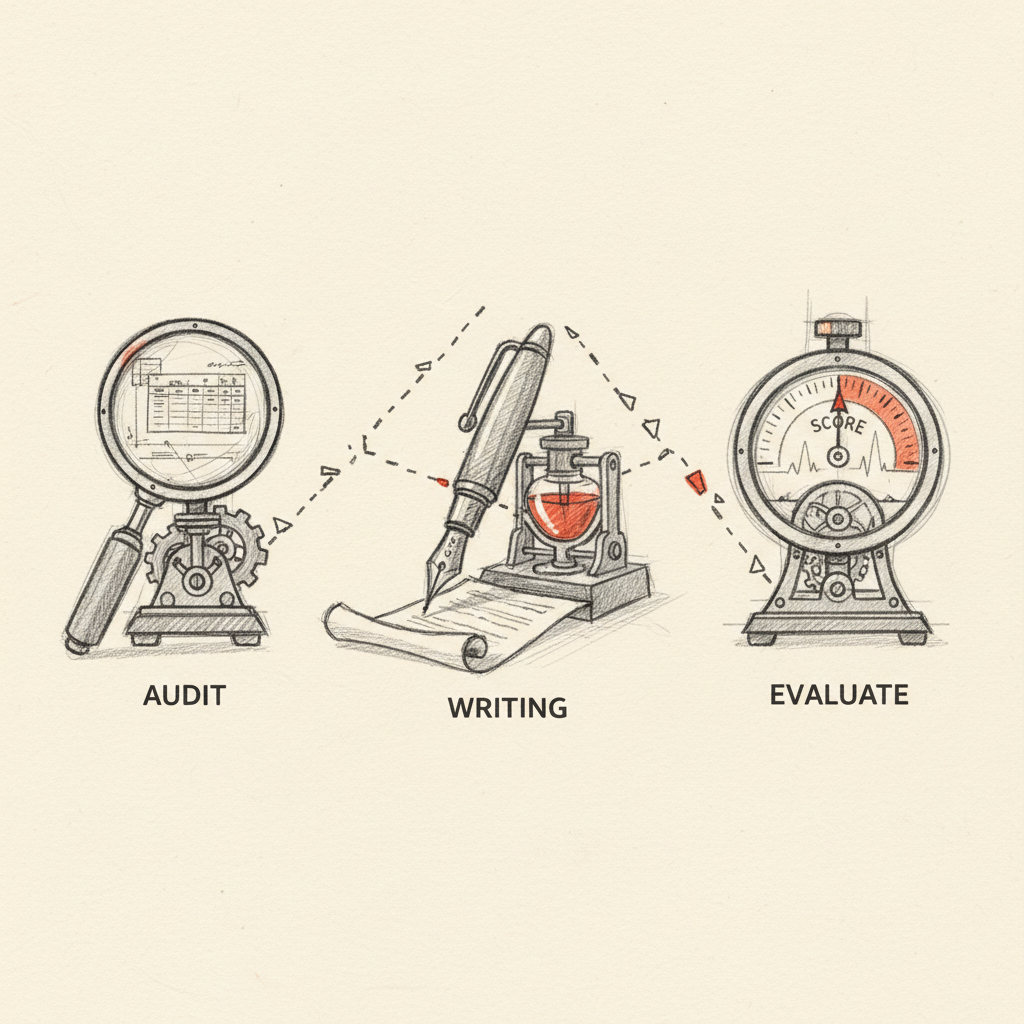
They audit but do not act. Okara's SEO Agent runs a daily audit and sends you two fixes a day with copy-paste snippets. Useful. But you still implement every fix by hand. The agent found the problem. You are the one who fixes it. That is a smart checklist, not an agent that ranks you.
They write but do not rank. Tools like theseoagent.ai and Sedestral take one keyword and produce one blog post. Drafting is the easy 20% of SEO. The post still needs internal links, a real angle that beats the current top result, and a refresh cycle when it slips. A draft is not a ranking.
They score but do not move. A whole category now measures your AI visibility, how often ChatGPT, Claude, and Perplexity mention your brand. Knowing your GEO score is 60 does nothing. The score is a thermometer. It does not change the temperature.
Each of these is real and partly useful. The problem is they get sold as the finished job. They are one link in a chain that has six links. Buy three of them and you have stitched together a process that still needs a human to run it.
What a Real SEO Agent Does: The Full Loop
A real SEO agent closes the loop. Here is the actual chain, the one a human SEO runs and the one most agents skip four steps of.
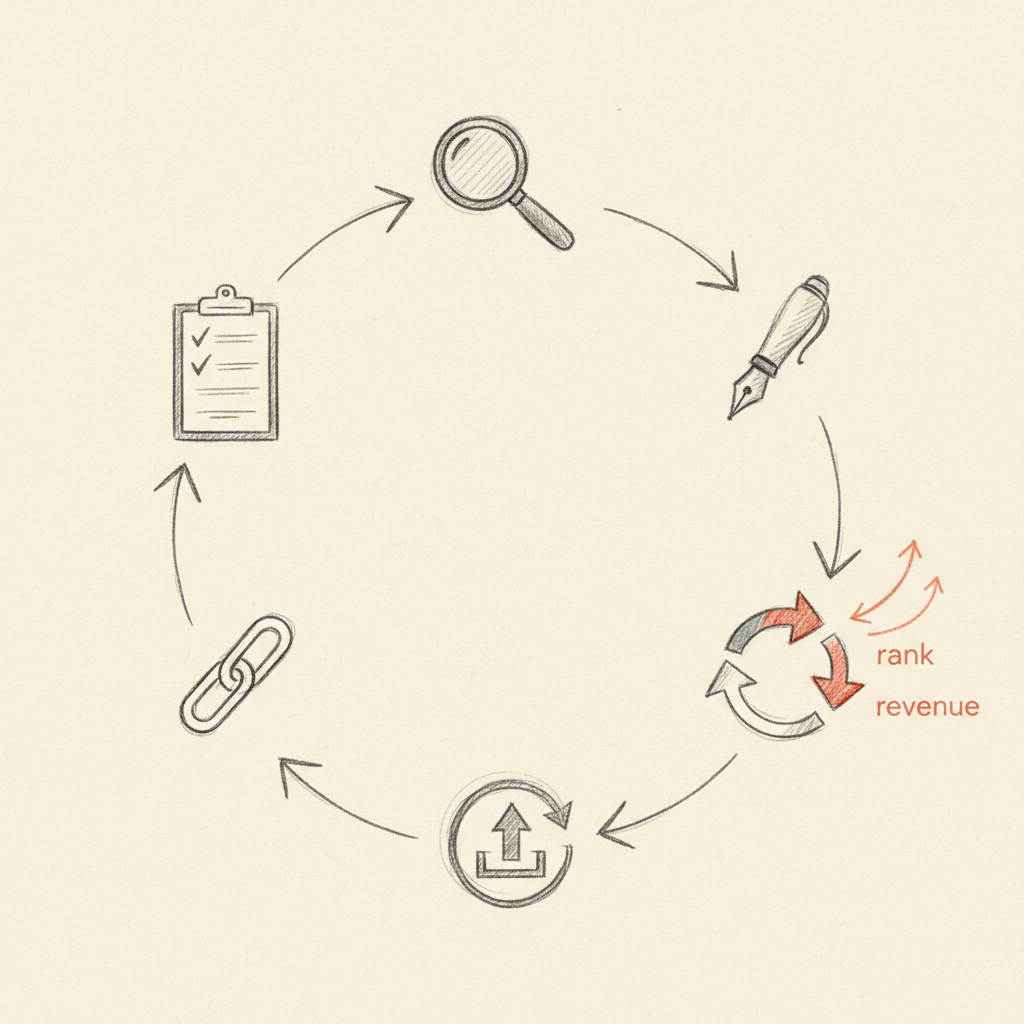
Research. Pull the live SERP for the target keyword. Read the top five results. Find the H2 patterns, the questions they answer, and the angle nobody has taken. This is where you decide what will beat the current winner, not just match it.
Brief. Turn the research into a contract: the hook, the sections, the comparison table, the FAQ, the schema, the internal links, the data points to cite. A good brief is what separates a thin post from one that out-ranks a product page.
Write. Produce the draft against the brief, in the brand voice, with definitive statements and citation-ready sentences. This is the part every "AI SEO agent" already does. It is also the least valuable part on its own.
Internal-link. Wire the new post into the existing content. Pull the right anchor text from related pages, link them in, and log the graph. Internal links are how a cluster compounds into topical authority. Almost no single-task SEO agent touches this.
Publish. Push the post live with the schema markup, meta, and images in place. One keyword in, one ranking-ready page out, wired to the site.
Track and refresh. Watch the ranking and the AI citations. When a post slips, rewrite the weak sections and re-publish. SEO is not a launch. It is a loop that runs every week.
That is six steps. Okara does step one. theseoagent does step three. The score tools do half of step six. A real SEO agent does all six, then starts over.
The harder truth: ranking is not the goal. Revenue is. The SEO agent that matters tracks which ranking article started a deal, not just which one hit position three. Traffic that does not convert is a vanity metric with a green arrow next to it.
SEO Agent vs SEO Tool vs SEO Agency
Three ways to get SEO done. They are not the same purchase.
| SEO Agent (real) | SEO Tool | SEO Agency | |
|---|---|---|---|
| Does the work | Yes, the full loop | No, shows you data | Yes, with humans |
| Runs without you | 24/7, autonomous | Only when you click | Business hours |
| Internal linking | Automatic | Manual | Manual |
| Tracks to revenue | Yes, if wired to CRM | No | Sometimes |
| Speed to publish | Same day | You write it | Weeks |
| Typical cost | Fraction of a hire | $100-$500/mo | $3,000-$10,000/mo |
An SEO tool like Semrush or Ahrefs is a data source. You bring the labor. An agency brings the labor but moves at human speed and human cost. A real SEO agent brings the labor at machine speed, runs the whole loop, and costs a fraction of the agency.
The catch most vendors hide: a single-task SEO agent gives you a tool priced like an agent. You still supply the missing five steps.
Do SEO Agents Actually Work?
This is the real question. The top Reddit thread for "seo agent" is titled "Do AI SEO Agents actually work? Looking for real results." The skepticism is earned.
Here is the honest answer. Single-task SEO agents mostly do not work, because they leave the hard parts to you. A daily audit you never implement is worthless. A blog post with no internal links and no refresh cycle ranks for a week, then fades. The market is full of these, which is why the Reddit verdict is mixed.
Full-loop SEO agents do work, with one condition. They have to be wired to your real pipeline, not just a rank tracker. Across 200+ AI Topia engagements, the pattern is consistent. The teams that win do not buy an audit bot. They deploy a system that researches, writes, links, publishes, and refreshes on a schedule, and they measure it against booked revenue.
The difference between "SEO agents do not work" and "SEO agents print pipeline" is almost always the same thing. Did it run the whole loop, or one slice of it.
How to Choose an SEO Agent
Skip the demos. Ask one question of any SEO agent you are considering: how many of the six loop steps does it actually run, and where does the work land back on me.
If the answer is "we audit and send you fixes," that is a checklist. If it is "we write the post," that is a drafting tool. If it is "we research, write, link, publish, track, and refresh, and here is how we tie it to revenue," that is an SEO agent.
For most lean B2B teams, the strongest move is not a standalone SEO agent at all. It is an SEO agent that lives inside a larger marketing system, so the rankings feed content, the content feeds the funnel, and the funnel feeds the Paid Ads agent and lead acquisition. SEO in a silo is a slower win than SEO wired to the rest of the engine. That wiring is the point of GTM engineering.
AI Topia deploys the SEO agent as one specialist inside the AI CMO we run for you. We own and operate the agent infrastructure. You own your accounts, your data, and your rankings. It runs the full loop, wired to your pipeline, live in days.
Frequently Asked Questions
What is an SEO agent?
An SEO agent is software that runs multi-step SEO work autonomously toward a goal, without a prompt at each step. Unlike an SEO tool that shows you data and waits, an agent decides the next action and executes it: research, writing, internal linking, publishing, and tracking. The strongest ones run the full loop instead of a single task.
Do AI SEO agents actually work?
Single-task agents that only audit or only write mostly do not, because they leave the hard steps to you. Full-loop agents that research, write, link, publish, and refresh do work, but only when they are tied to real pipeline, not just a rank tracker. The result depends almost entirely on how much of the loop the agent actually runs.
What is the best AI SEO agent?
The best one runs every step of the loop and ties it to revenue, not just rankings. Avoid agents that only audit and hand you fixes, or only generate a draft. The best fit for a lean B2B team is an SEO agent embedded in a larger marketing system, so rankings feed content and content feeds the funnel.
Will SEO be replaced by AI?
No, but the work is changing. AI agents now run the repetitive parts of SEO, research, drafting, technical audits, and rank tracking, faster than any human. Strategy, original angle, and brand judgment stay human. The teams that win pair a human for direction with an agent that runs the loop.
Can I do SEO myself?
Yes, and many founders start there. The limit is time. SEO is a weekly loop of research, writing, linking, publishing, and refreshing across dozens of pages. A solo founder can run it for a handful of keywords. Past that, an SEO agent that runs the loop for you is what keeps it moving without hiring a team.
What is the difference between an SEO agent and an SEO tool?
An SEO tool like Semrush or Ahrefs shows you data and waits for you to act. An SEO agent reads that data, picks the highest-impact action, and executes it on its own. The tool is a data source. The agent is the labor. A tool with a chat box that only recommends is still a tool.
How much does an SEO agent cost?
Single-task SEO agents run roughly $30 to $100 a month, similar to an SEO tool. A full-loop SEO agent deployed as a managed service costs more but replaces a chunk of an agency retainer, which typically runs $3,000 to $10,000 a month. Judge the price against pipeline produced, not against the seat fee.
The Bottom Line
The word "agent" got cheap. Most SEO agents are one task with a chat box: an audit you implement yourself, a draft with no links, a score that changes nothing. That is why the Reddit verdict on them is lukewarm.
A real SEO agent runs the whole loop, research to refresh, and ties rankings to revenue. That is the version that works. AI Topia deploys it as one specialist inside the AI CMO, wired to your pipeline and live in days. If your SEO needs to move faster than you can run it by hand, book a build call.
Ready to Automate Your Business?
Book a 30-minute call to discuss how AI can transform your Marketing, Sales, or Operations.
Book a Call