
Signal-Based Marketing: The 2026 Playbook for Marketing Teams
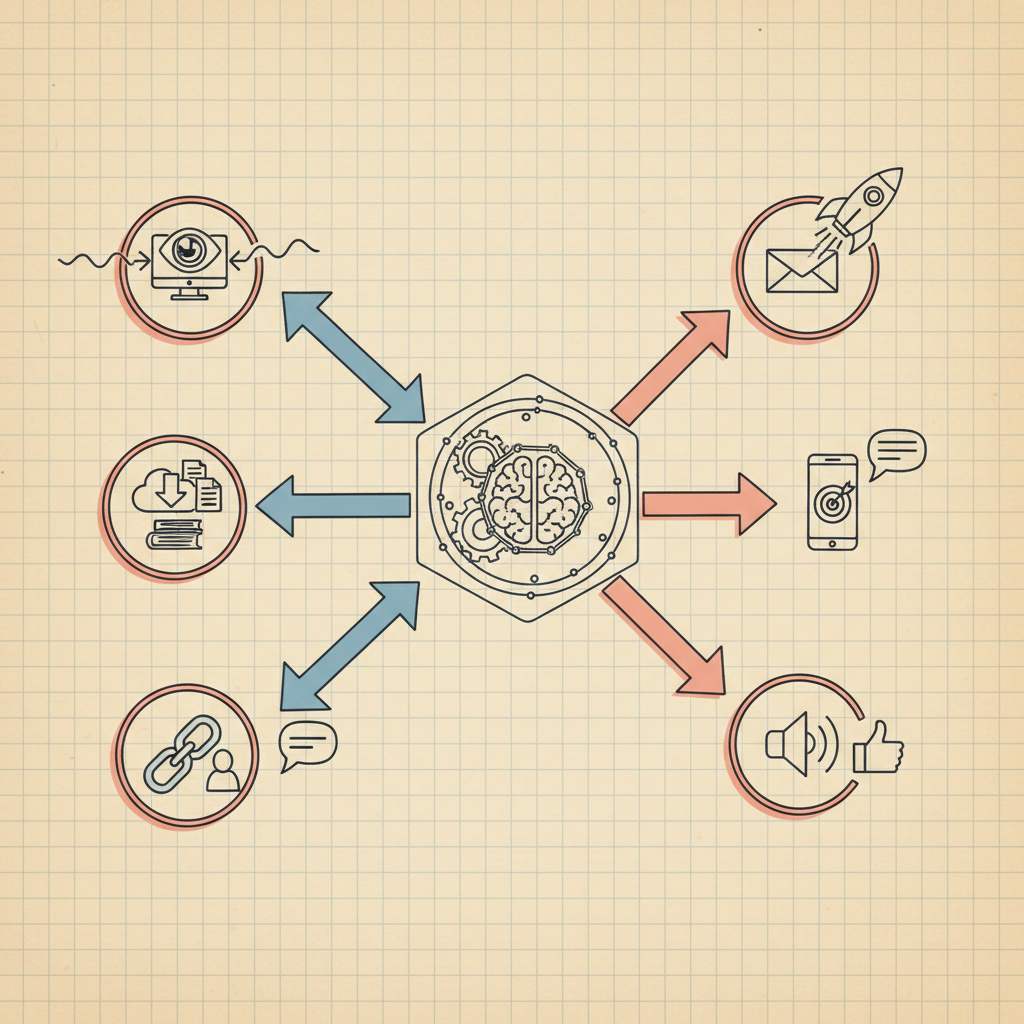
Your sales team gets the intent data. Your marketing team should get it first. Most go-to-market playbooks route every buyer signal straight to SDRs, leaving the highest-leverage actor — marketing — blind to the early-funnel window where deals are actually decided. This playbook reframes signal-based marketing as the trigger layer for content, campaigns, and inbound routing, and shows how a lean team runs it as infrastructure in 2026.
Key Takeaways
- Signal-based marketing acts on real-time buyer intent signals to trigger campaigns, not static-list batch-and-blast.
- The entire SERP frames signals as a sales/SDR tool. Marketing-side activation is the open lane.
- Three signal types stack: fit (firmographic), intent (behavioral), and timing (trigger events).
- First-party signals from your site, content, and product outperform bought third-party intent for most teams.
- The win is not more signals. It is a routing layer that turns each signal into one specific next action.
- An AI CMO can watch, score, and act on signals 24/7 — the part a lean team cannot staff manually.
What Is Signal-Based Marketing? (And How It Differs From Signal-Based Selling)
Signal-based marketing triggers campaigns, content, and inbound routing off real-time buyer behavior instead of static firmographic lists. In short: a prospect visits your pricing page, downloads a competitor comparison, or spikes in category-intent searches, and your marketing system fires a specific play automatically, not days later on a batch send.
That one-liner matters because the SERP has confused the category. Every ranking page on signal-based GTM is written for SDRs. Demandbase, Cognism, and Apollo own the "signal-based selling" framing — routing intent alerts to reps for cold outreach. That is signal-based selling. It sits late in the funnel, after a human account executive decides to act. Signal-based marketing is different: it is the trigger layer that fires content, retargeting, nurture sequences, and inbound scoring before a rep ever gets involved.
The distinction is not semantic. Teams that route all intent data to sales first leave the early-funnel window unworked. A prospect researching your category in 2026 is already 60 to 70 percent through a buying decision before talking to anyone. Marketing needs the signal first to influence that window. GTM engineering for marketing teams covers how to build the infrastructure that makes this routing automatic.
Signal-based marketing does not replace account-based marketing or demand generation. It makes both faster. ABM picks the accounts. Signal-based marketing tells your team when those accounts are ready to hear from you and fires the right asset without waiting for a Monday morning pipeline review. The leverage is in the timing and the automation, not the signals themselves.
AI Topia defines signal-based marketing as the watch-score-act loop owned by marketing, not sales. Watch the signals. Score accounts against fit, intent, and timing. Act by triggering a specific campaign or routing decision. That loop, run as infrastructure, is what separates teams that grow from teams that blast.
The Three Signal Types Every Marketing Team Should Track
Three signal types determine whether an account is ready to buy: fit, intent, and timing. Most marketing teams track one. The ones converting pipeline track all three, stacked.
Fit Signals: Does This Account Match Your ICP?
Fit signals are firmographic. Industry, company size, tech stack, revenue range, geography. They tell you whether an account belongs in your funnel at all.
- What to look for: Job titles matching your buyer persona, tech stack overlap (via Clearbit, Apollo, or BuiltWith), revenue band, and team size relative to your product's sweet spot.
- Marketing-side example: Build a dynamic segment in your CRM that auto-tags accounts hitting your ICP criteria. Feed that segment into a LinkedIn Matched Audience. Your ads stop wasting budget on accounts that will never convert.
Fit is the filter. Without it, every other signal is noise.
Intent Signals: Are They Actively Researching?
Intent signals are behavioral. They tell you an account is in a buying motion right now, not just in your ICP.
- What to look for: Pricing-page visits, repeat content consumption, competitor-term searches (captured via G2, Bombora, or first-party analytics), review-site activity, and contact-us page views without form submit.
- Marketing-side example: When an account hits your pricing page twice in seven days, trigger a retargeting sequence with a case study from their exact industry. No SDR needed. The campaign fires automatically off the behavioral event.
Intent without fit means you are chasing curious strangers. Fit without intent means you are pushing campaigns at accounts that are not in-market.
Timing and Trigger Signals: Why Now?
Timing signals are event-based. They surface the moment an account's context shifts, and their willingness to buy spikes.
- What to look for: New funding rounds, aggressive hiring (20%+ headcount growth), tech stack changes (adding a tool adjacent to yours), leadership transitions, and spikes in LinkedIn activity from decision-makers.
- Marketing-side example: A Series B announcement from an ICP account is a trigger, not a sales handoff. Launch a content play the same week: a LinkedIn post targeting that company's domain, a personalized email sequence, a relevant webinar invite. Marketing moves first.
AI-adoption signals and 20%+ headcount growth are among the strongest predictors of software purchase intent. Bloomberry's analysis of 1 million software purchases ranks these trigger types above category intent data in predictive accuracy.
All Three Must Stack
One signal alone does not qualify an account. Fit without intent is a cold list. Intent without fit is wasted spend. Timing without fit and intent is noise with a deadline.
The rule is absolute: all three signals must stack before you escalate an account to a triggered campaign or route it to sales. A single strong signal is a reason to watch, not a reason to act.
In 2026, the teams pulling ahead are not finding better signals. They are routing faster when all three stack at once.
First-Party vs Third-Party Intent Data: Where Marketing Should Start
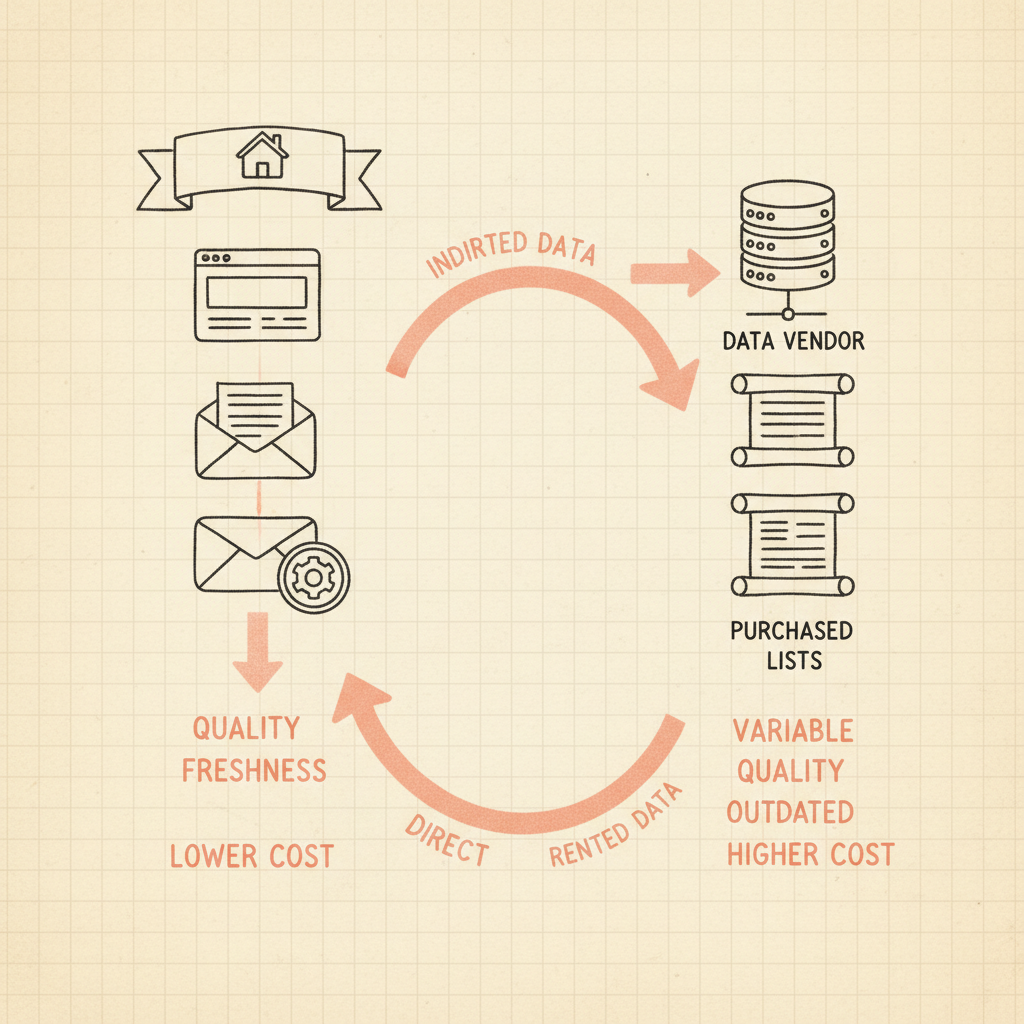
First-party intent is behavior on channels you own: site visits, content downloads, email clicks, product usage. Third-party intent is category research data bought from external providers who track browsing across the web. Most lean B2B teams buy third-party first and ignore the richer signal sitting in their own stack.
That order is backwards. First-party signals are real-time, tied to a named account you already know, and cost nothing beyond the tools you already run. Third-party signals are aggregated, 3 to 7 days stale by the time they reach you, and priced for enterprise budgets. For any team under 50 people, first-party data beats bought intent on accuracy, speed, and ROI every time.
Third-party data earns its place at enterprise scale when you need breadth across a large TAM you cannot instrument yourself. Until you hit that ceiling, building your first-party signal layer is the higher-leverage move. Start with what your site, content, and product already tell you before spending on external data. A solid marketing automation foundation is what converts those owned signals into triggered campaigns.
| Signal source | Accuracy | Freshness | Cost | Best for |
|---|---|---|---|---|
| First-party (site/content/product) | High | Real-time | Low (owned) | Lean B2B teams starting out |
| Second-party (partner/shared) | Medium-High | Days | Medium | Co-marketing + ecosystem plays |
| Third-party (bought category data) | Medium | Weekly | High | Enterprise / broad TAM coverage |
| AI-enriched (signals + AI scoring) | High | Real-time | Medium | Teams running an AI CMO |
The table above makes the tradeoff concrete. First-party wins on accuracy and freshness. Third-party wins on coverage when TAM outgrows what you can instrument. AI-enriched signals layer scoring on top of both, which is how lean teams punch above their headcount in 2026.
The gap between "we have the data" and "we act on it automatically" is where most teams stall. The next section covers the routing layer that closes that gap.
The Signal-to-Action Routing Layer (The Part Everyone Skips)
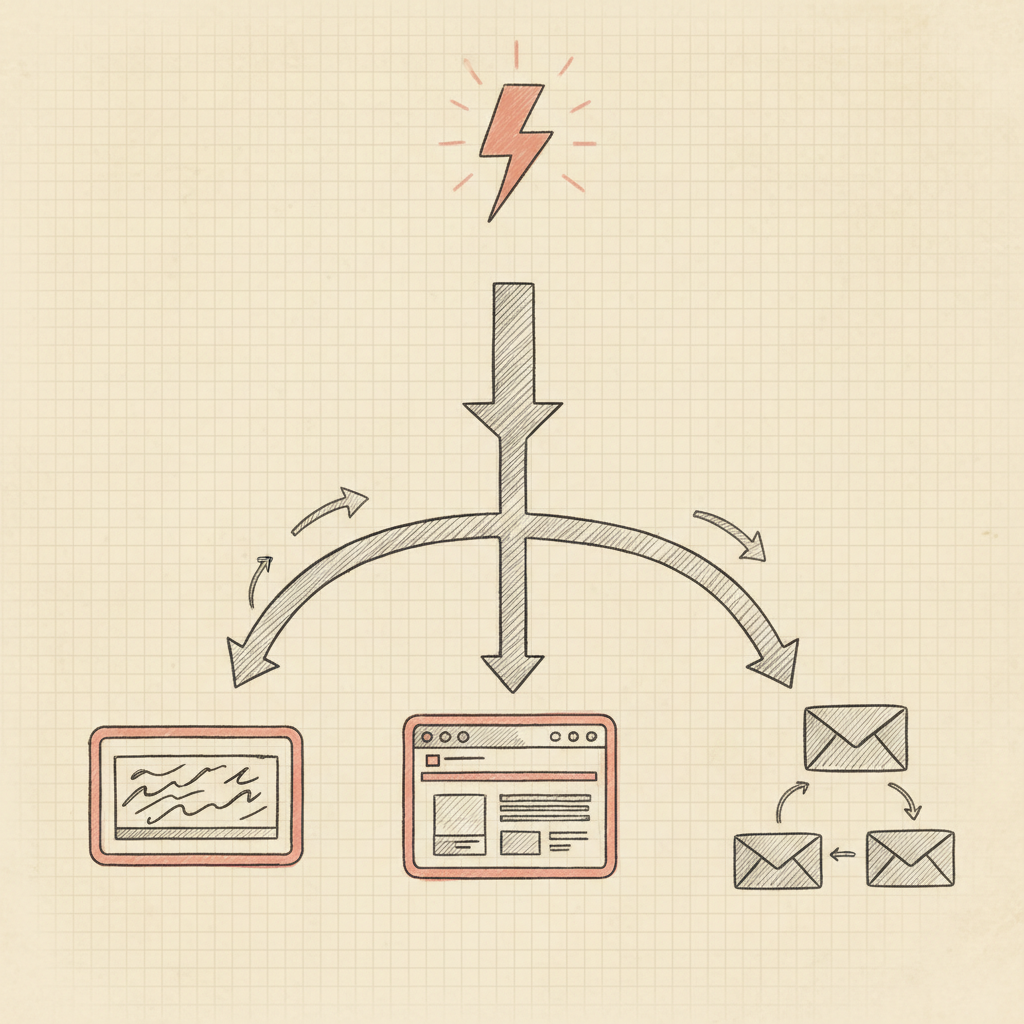
Raw signals without a routing layer are just noise. Most teams collect intent data, hand it to sales, and call it done. The leverage is not in collecting more signals. It is in mapping ONE signal to ONE specific next action, automatically, every time it fires.
Here is what that map looks like in practice:
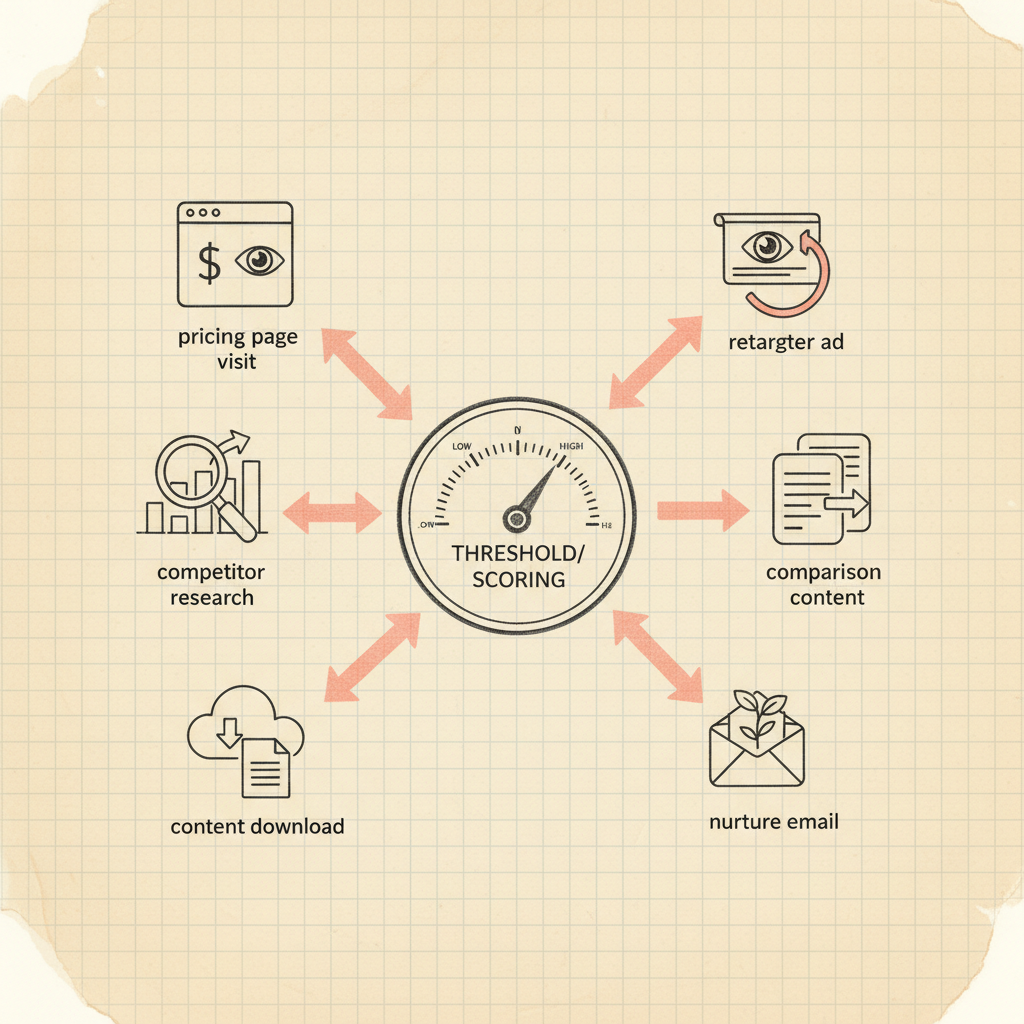
- Pricing page visit — trigger a retargeting ad sequence and fire a sales alert with the account name and visit count
- Competitor-term research (third-party intent spike) — auto-serve a comparison landing page via personalized ads or email
- Content download or gated asset — enroll in a triggered nurture sequence matched to the content topic
- Three or more high-intent visits in seven days — escalate to sales handoff; marketing's job is done
Each row is a rule. Rules run 24/7. A lean team of three can execute what a ten-person team used to staff manually.
Scoring makes the routing precise. Stack three dimensions: fit (does this account match your ICP?), intent (are they showing purchase behavior?), and timing (did a trigger event just fire?). Set a threshold, say a fit score above 70 plus two intent signals, and the routing layer fires the right action without a human in the loop. AI marketing agents are what execute these rules at scale, watching every signal source and acting the moment a threshold is crossed.
How Does the Marketing-to-Sales Handoff Work?
The handoff rule is simple: marketing owns the account until a score threshold is crossed. Below the threshold, marketing runs retargeting, personalization, and nurture. Above it, sales gets an enriched alert with the signal history attached. No more cold handoffs where a rep calls someone who looked at one blog post.
Signal-qualified leads outperform traditionally scored leads by a margin that is not close. In 2026, teams running signal-qualified routing report 47% better conversion rates, 43% larger deal sizes, and 38% more closed deals compared to teams still relying on traditional lead scoring. That gap exists because signal-qualified routing removes the lag between intent and action. The prospect is acted on while they are still in buying mode.
The teams that skip this layer treat signals as a reporting tool instead of a trigger system. They review intent dashboards in weekly standups. By then, the buying window has closed. Build the routing layer first. The signals are only as valuable as the action they fire.
Signal-Based Campaign Activation: Triggered Plays That Actually Convert
Signal-based campaign activation is auto-triggering a specific marketing play the moment a defined signal or threshold fires. Not a batch email. Not a scheduled sequence. A precise action tied to a real buying behavior, launched in real time.
The results are not close. In 2026, signal-based outreach sees roughly 18% response rates versus the 3.4% cold-outreach average. That is a 5x lift from context alone. And 76% of B2B marketers report higher ROI from intent-driven campaigns than from traditional list-based approaches.
The four triggered plays below are the ones lean marketing teams can run without a dedicated ops team. Each maps one signal to one specific action. For teams already running content and SEO on autopilot, these plays stack directly on top.
What Are the Four Triggered Campaign Plays?
1. Intent-spike retargeting. When a prospect visits your pricing page or feature pages three or more times in a week, that spike is a signal. Fire a retargeting ad immediately with a direct comparison or proof asset. Do not wait for the next campaign cycle.
2. Signal-based content personalization. When a known account researches a competitor keyword or downloads a mid-funnel asset, serve personalized content on their next site visit. Change the homepage CTA. Surface a relevant case study. The content updates based on what they just did.
3. Triggered nurture sequences. When a lead hits a score threshold or completes a high-intent action (demo replay, ROI calculator, repeat pricing visit), launch a short nurture sequence immediately. Three to five emails, specific to that signal. Not a generic drip.
4. Signal-triggered SEO and content publishing. When search demand spikes for a topic your ICP is actively researching right now, publish fast. Programmatic content layers on top of live keyword trends. The play is to be indexed before the surge peaks, not after.
Each play shares the same structure: one signal fires, one action launches, one outcome is tracked. The complexity is in the routing layer, not in the campaigns themselves. Teams that build the routing once run all four plays without adding headcount.
Running Signal-Based Marketing With a Lean Team (or an AI CMO)
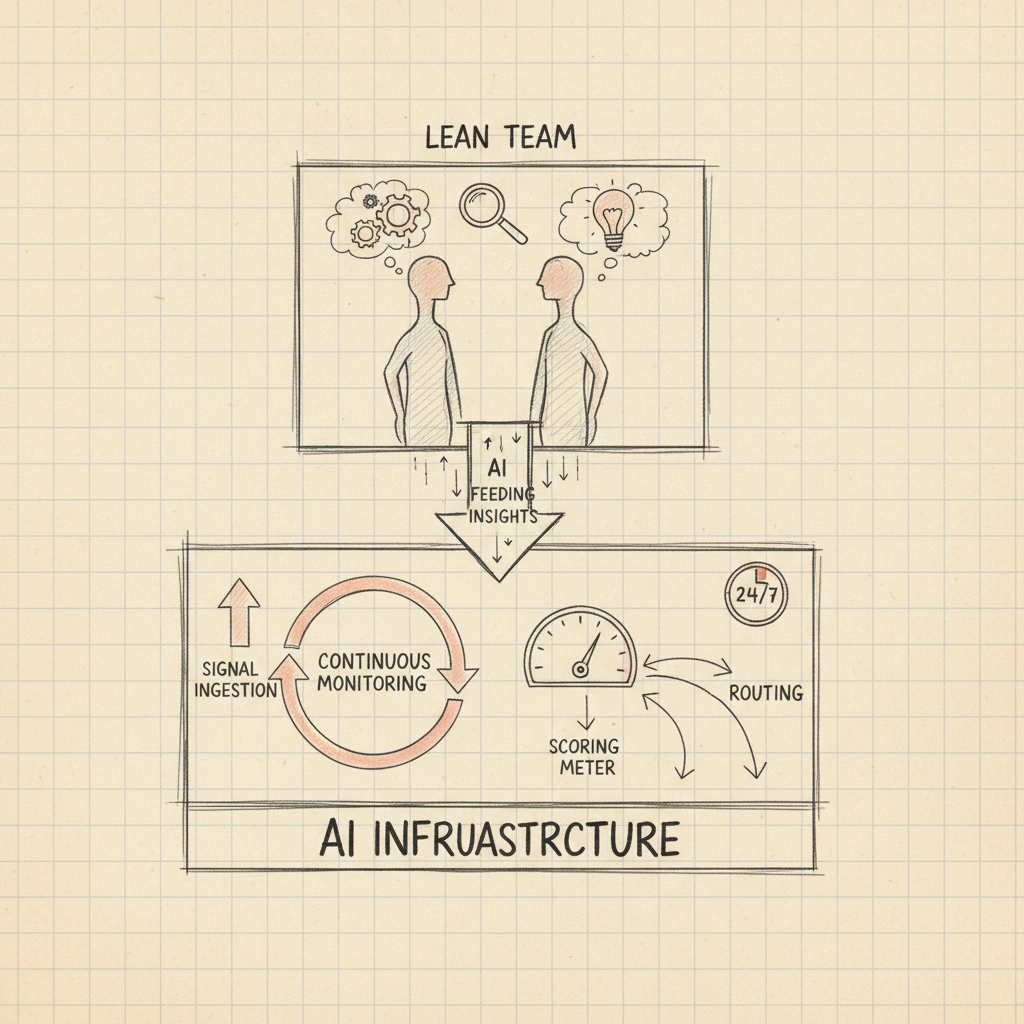
A lean marketing team cannot watch signals around the clock. Signals fire at 2am, on weekends, during holidays. If your response depends on someone checking a dashboard, you will miss the window. Automation is not a nice-to-have here. It is the only viable operating model.
The split between human and machine is straightforward. Automate the watch-score-route-trigger loop: monitor sources for signal fires, score by fit plus intent plus timing, route to the right play, and trigger the campaign without waiting for a human to log in. Keep humans on strategy, offer design, and brand judgment. Those three do not automate well. Everything else in the loop does.
AI Topia runs this as marketing infrastructure via the AI CMO platform. In 2026, the platform runs 45+ specialized marketing agents that monitor signals continuously and fire the right play at the right moment. A lean team using AI Topia runs like a full department, not a stretched headcount.
What Does the Implementation Path Look Like?
Start with one signal mapped to one play. Pick your highest-intent signal, say pricing-page visits above two minutes, and connect it to a single retargeting sequence or a direct outreach trigger. Run it for 30 days. Measure response rate and pipeline contribution. That is your pilot.
Once the pilot proves the loop works, expand to two or three more signals. Competitor-content reads trigger comparison assets. LinkedIn profile visits from target accounts trigger a personalized connection sequence. Repeat-content engagement triggers a nurture branch. Each signal gets its own defined play with a measurable outcome.
Production means the full stack is running without manual input. Signals are monitored across all sources. Scores update in real time. Plays fire automatically when thresholds hit. Your team reviews performance weekly, adjusts thresholds, and refines offers. The infrastructure runs; humans set direction.
Teams that reach production-state signal routing in 2026 are compressing a full marketing department's output into a fraction of the headcount. That is the leverage point. Not more signals, not more tools, but a system that acts on every signal the moment it fires.
Frequently Asked Questions
Is signal-based marketing the same as signal-based selling?
No. Signal-based selling is SDR outreach triggered off buyer signals, and it sits late in the funnel after a rep decides to act. Signal-based marketing uses the same signals earlier, to trigger campaigns, content, and inbound routing before a rep is involved. Marketing acts first; sales gets an enriched handoff once the account crosses a score threshold.
What are examples of buyer intent signals marketing can act on?
The highest-value first-party signals are pricing-page visits, repeat content consumption, competitor-term research, gated-asset downloads, repeat site visits, and contact-page views without a form submit. Add timing signals like funding rounds, 20%+ headcount growth, and decision-maker LinkedIn activity. Each one can trigger a specific marketing play automatically.
Do I need third-party intent data to start?
No. Most teams under 50 people get further faster with first-party signals from their own site, content, and product. First-party data is real-time, tied to named accounts, and free beyond the tools you already run. Buy third-party data later, when your TAM outgrows what you can instrument yourself.
How do you score and prioritize signals?
Stack three dimensions: fit (firmographic ICP match), intent (behavioral buying signs), and timing (trigger events). Weight each by proximity to purchase, then set a threshold that fires a specific action rather than a generic alert. A single strong signal means watch; all three stacked means act.
What is signal-based campaign activation?
Signal-based campaign activation is auto-triggering a specific marketing play the moment a defined signal or threshold fires. Instead of scheduled batch sends, a precise action launches in real time off real buying behavior, such as retargeting on an intent spike or serving a comparison page after competitor research.
Can a small marketing team run signal-based marketing?
Yes, if the watch-score-act loop is automated. A lean team cannot monitor signals 24/7 by hand, but an AI CMO can watch every source, score accounts, and fire the right play around the clock. That automation is what lets a small team run like a full marketing department.
Which is better for B2B: signal-based or account-based marketing?
They combine rather than compete. Account-based marketing picks the target accounts; signal-based marketing tells you when those accounts are in-market and fires the right asset. Signals make ABM spend efficient by adding timing, so you reach accounts in the buying window instead of on a fixed cadence.
The Bottom Line
Signal-based marketing is not a sales tool borrowed by marketing. It is the trigger layer that fires content, campaigns, and routing the moment a buyer shows intent. Stack fit, intent, and timing. Start with first-party data. Build the routing layer that maps one signal to one action. Then automate the watch-score-act loop so it runs without a human checking a dashboard at 2am. The teams winning in 2026 are not finding better signals. They are acting on every signal faster. Book a walkthrough of the AI Topia AI CMO platform to see the watch-score-act loop running live.
Ready to Automate Your Business?
Book a 30-minute call to discuss how AI can transform your Marketing, Sales, or Operations.
Book a Call