
How Our AI Avatar Video Engine Works: 8 Steps From One Recording to Every Platform
You record once. We ship every week.
This is the full system behind that line: 8 steps, 6 AI tools, and a learning loop that makes every video better than the last one.
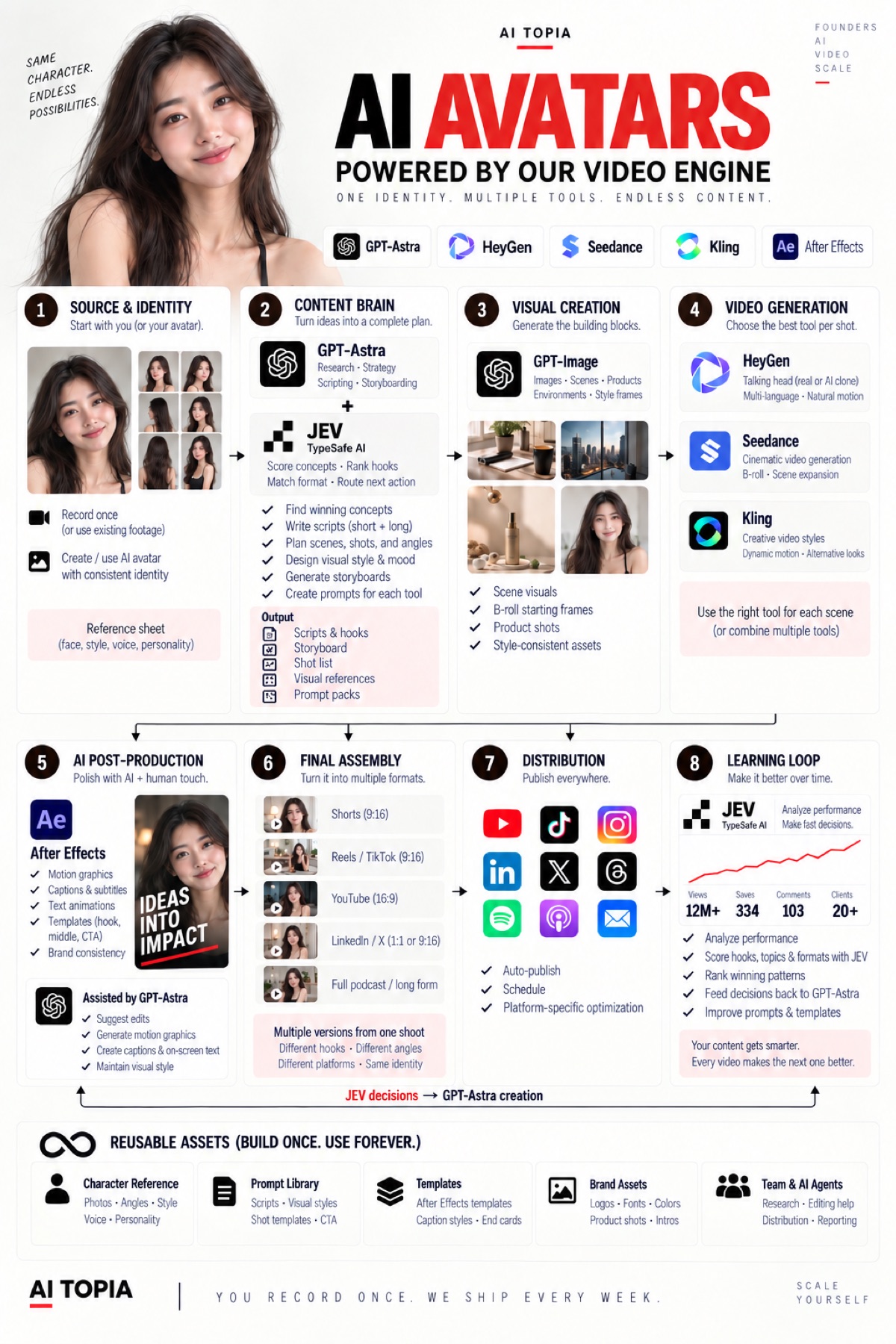
The problem: one founder, nine platforms, no editor
Every founder knows video works. That was never the gap.
The gap is production. A single short needs a script, a hook, footage, b-roll, captions, motion graphics, and a version for every platform. Multiply that by YouTube, TikTok, Instagram, LinkedIn, X, Threads, Spotify, podcasts and email.
That's not a content plan. That's a full-time media team.
So we built one out of AI tools, with humans where taste matters. Here's how each piece works.
Step 1: Source and identity
Start with you, or your avatar.
Everything starts from one identity. Two ways in:
- Record once. One 30 minute session, or footage you already have.
- Create an AI avatar with a consistent face, style and personality.
Output: a reference sheet covering face, style, voice and personality. Every later step pulls from it, so the character never drifts.
Our 22M views client filmed once, for 30 minutes, at the start. That was his entire on-camera obligation. (Read how we built it.)
Step 2: Content brain
Turn ideas into a complete plan.
Two tools work together here:
- GPT-Astra does research, strategy, scripting and storyboarding.
- JEV (TypeSafe AI) scores concepts, ranks hooks, matches formats and routes the next action.
GPT-Astra writes. JEV judges. Ideas that don't score don't get made.
This step finds winning concepts, writes scripts (short and long), plans scenes, shots and angles, designs the visual style and mood, and writes a prompt for each tool downstream.
Output: scripts and hooks, storyboard, shot list, visual references and prompt packs.
Step 3: Visual creation
Generate the building blocks.
GPT-Image creates the stills the videos are built from: scenes, products, environments and style frames, all matched to the reference sheet from step 1.
Output: scene visuals, b-roll starting frames, product shots and style-consistent assets.
Step 4: Video generation
Pick the best tool per shot.
No single video model is best at everything, so the shot list from step 2 routes each shot to the tool that fits it:
| Tool | Best at | Used for |
|---|---|---|
| HeyGen | Talking head, real or AI clone | Multi-language delivery, natural motion |
| Seedance | Cinematic video | B-roll, scene expansion |
| Kling | Creative styles | Dynamic motion, alternative looks |
One video often combines all three. Talking shots go to HeyGen, b-roll to Seedance, stylized moments to Kling.
Step 5: AI post-production
Polish with AI plus a human touch.
After Effects handles motion graphics, captions, text animations, and templates for the hook, middle and CTA. GPT-Astra assists: it suggests edits, generates motion graphics, writes captions and on-screen text, and keeps the visual style consistent.
This is where the human touch matters most. AI does the heavy lifting. A person decides when it's good.
Output: a finished, on-brand master video.
Step 6: Final assembly
One shoot, many formats.
The master becomes every format you need:
- Shorts (9:16)
- Reels and TikTok (9:16)
- YouTube (16:9)
- LinkedIn and X (1:1 or 9:16)
- Full podcast and long form
Output: multiple versions from one shoot, each with a different hook, angle or platform, all with the same identity.
Step 7: Distribution
Publish everywhere.
YouTube, TikTok, Instagram, LinkedIn, X, Threads, Spotify, podcasts and email. Every version is auto-published, scheduled, and optimized for the platform it lands on.
You don't log into nine apps. You don't upload anything.
Step 8: The learning loop
Make it better over time.
This is the step most content systems skip, and it's why most content plateaus.
JEV analyzes performance after every post and makes fast decisions:
- Scores hooks, topics and formats
- Ranks winning patterns
- Feeds those decisions back to GPT-Astra
- Improves prompts and templates
Then the loop goes back to step 2. JEV's decisions shape what GPT-Astra writes next. Every video makes the next one smarter.
Reusable assets: build once, use forever
The first month builds a library. Every month after reuses it:
| Asset | What's in it |
|---|---|
| Character reference | Photos, angles, style, voice, personality |
| Prompt library | Scripts, visual styles, shot templates, CTAs |
| Templates | After Effects templates, caption styles, end cards |
| Brand assets | Logos, fonts, colors, product shots, intros |
| Team + AI agents | Research, editing help, distribution, reporting |
This is why cost per video drops over time while quality goes up.
What you do vs. what we do
| You | Us |
|---|---|
| Record once (or approve an avatar) | Steps 1 to 8, every week |
| Approve the plan | Research, scripts, hooks |
| Give notes | Visuals, video, editing |
| Watch the inbound | Publishing, analytics, the learning loop |
That's the whole deal. You record once. We ship every week.
Want this set up for your business?
We turn these workflows into working marketing and sales systems.