
The AI Character Brief: Design an AI Character for Your Business
One page. Six decisions. A character your customers recognize themselves in, with one link back to your business.
An AI character is a made-up, AI-generated person who shows up in every video with the same look and the same running joke. It can earn attention for a business that has no face to put on camera.
This is the brief I use to sketch one. Fill it in once and you have everything a video team or an AI video tool needs to keep the character consistent.
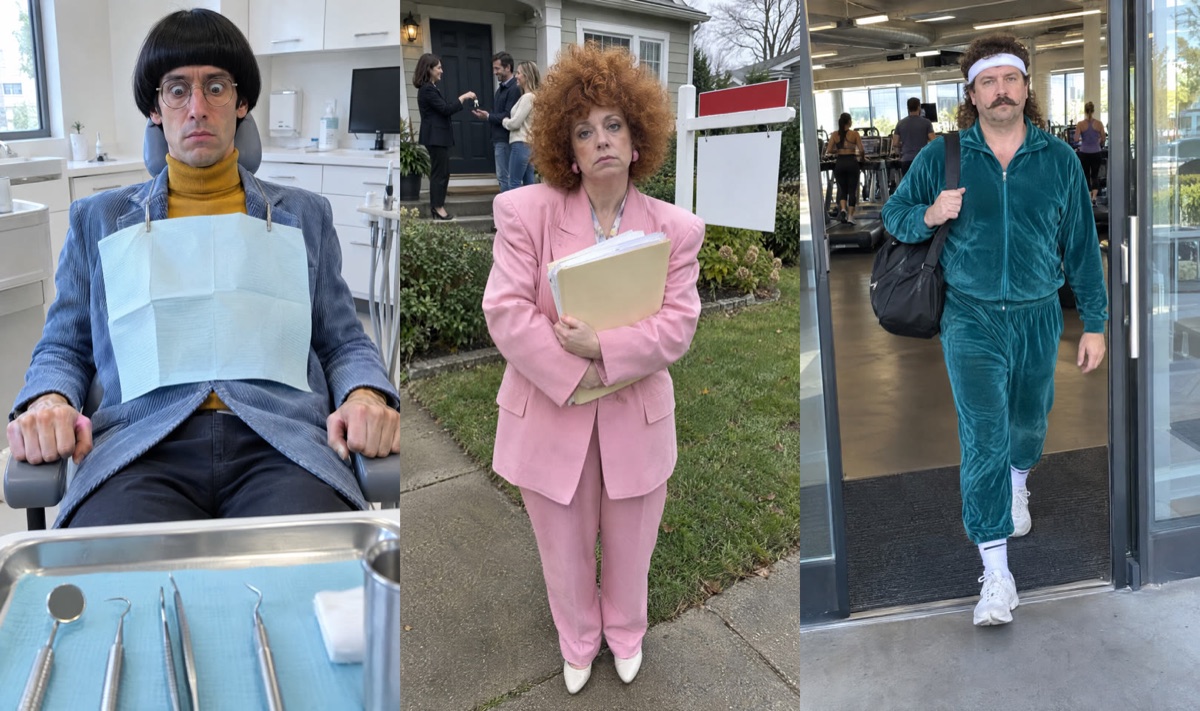
Three concept characters: a dentist's, a realtor's and a gym's. These are illustrations we generated, not client work.
Why a character works
In September 2026 an AI character called Jean Phil started posting short clips of himself shadowboxing in random places. One widely shared post on X put the account at 117 million views and more than 400,000 followers in under two weeks. Those are the poster's numbers, not ours, and other reports from the same period quote lower figures.
The exact number matters less than the pattern. Four things made the character easy to recognize and easy to share:
- One recognizable look. You know who it is in half a second.
- The same look every time. Hair, outfit and face never change.
- One behaviour. He does a single thing, and it was already a proven format.
- One variable. Only the place changes.
A business can use the same pattern with one change: the character lives your customer's story. People watch because it's funny. They keep watching because it's them.
The brief
Answer these six in order. Short answers are better than clever ones.
1. The customer's fear or frustration
What does your customer dread, avoid or keep failing at before they buy from you?
- Use their words, not yours. Reviews, sales calls and your inbox are the best sources.
- Pick one. A character with three problems has none.
Dentist example: "I've been putting off the dentist for years because I'm scared."
2. The character
Who is living that problem? Describe them like a casting note.
- Age and vibe: one line.
- Hair: one unmistakable feature.
- Outfit: the same every video.
- One prop (optional).
- Expression: the default face.
Make the look specific enough that a silhouette would be recognizable. Do not base it on a real person, a celebrity or an existing character.
Dentist example: thin man in his 30s, round black bowl haircut, round wire glasses, mustard turtleneck under a pale blue corduroy blazer, permanent wide-eyed dread.
3. The one behaviour
What does the character do in every video? One action, repeated.
- It should show the fear or frustration without a word of explanation.
- If it needs a caption to make sense, simplify it.
Dentist example: he freezes, stares at whatever reminds him of the dentist, and never quite goes in.
4. Five situations
The behaviour stays. The situation is the only thing that changes. List five to start.
Dentist example:
- In the waiting room, holding a magazine he isn't reading.
- At home, holding a toothbrush like it might bite.
- Outside the clinic door, hand hovering over the handle.
- In the chair, staring at the tool tray.
- On the phone, about to book, hanging up.
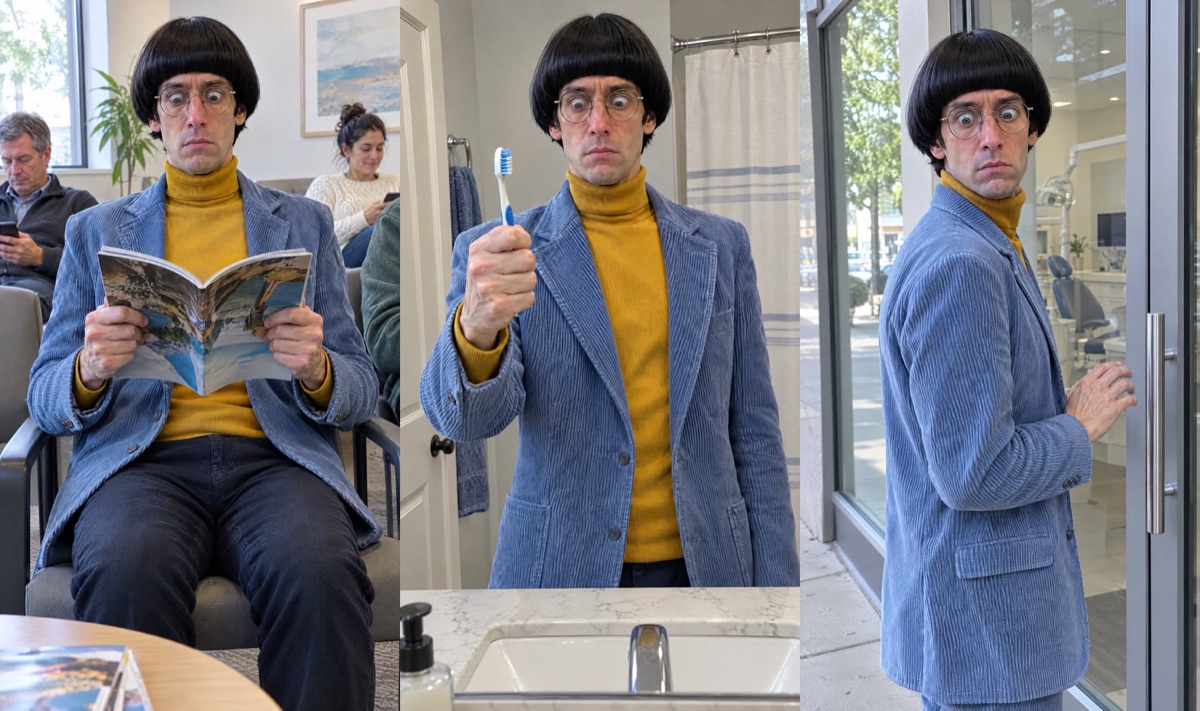
Same character, same look, three situations.
5. The link
Where does the bio send people? One link, one action.
- A booking page, a free consultation or a single offer.
- Match it to the fear. A scared-of-the-dentist character should link to something gentle, such as a "nervous patients" page, not a price list.
6. The handover to a real person
A character can earn attention. It cannot earn trust. Decide where the real human takes over.
- Who is the real face? The founder, the dentist, the agent.
- Where do they appear? The page behind the link, a pinned video or the reply to a comment.
- What do they say first? Usually an answer to the exact fear the character acts out.
A filled-in brief
| Part | The Nervous Patient (dentist concept) |
|---|---|
| Fear or frustration | "I've avoided the dentist for years because I'm scared." |
| Character | Thin man, 30s, bowl haircut, round glasses, mustard turtleneck, blue corduroy blazer, wide-eyed dread |
| One behaviour | Freezes and stares; never quite goes in |
| Five situations | Waiting room, at home with a toothbrush, outside the door, in the chair, on the phone |
| The link | "Nervous patients start here" booking page |
| Real person | The dentist, on that page, in a short video: "If you've been putting this off, here's what the first visit is actually like." |
Two more starting points
Realtor: the buyer who keeps losing. Big ginger perm, pink power suit, a folder clutched to her chest. In every video someone else gets the keys. The link goes to a "how to win in a bidding war" consult.
Gym: the Monday quitter. Moustache, mullet, teal velour tracksuit, never a drop of sweat. In every video he arrives full of plans and leaves early. The link goes to a beginner program built for people who have quit before.
Rules that keep it safe
- Say it's AI. Label the account and use the platform's AI-content label. People forgive a character. They don't forgive being fooled.
- Laugh with the customer, not at them. The joke is the situation everyone recognizes, never the person.
- No real likenesses. Not a customer, a competitor or a celebrity.
- No claims. The character doesn't promise results, give medical, legal or financial advice, or act as a testimonial.
- Regulated industries: check your advertising rules before posting. Dental, medical, legal and financial services often have specific ones.
- Keep a human reachable. Every post should make it easy to reach the real business.
What a character can't do
A character is a top-of-funnel tool. It gets attention and makes people feel seen. It does not close.
Recent surveys have found that people trust recommendations from real people more than from artificial personas. So the character is half of the system. The other half is a real person, on camera, answering the question the character raised.
If you don't have time to film that half every week, that's what a founder AI clone is for: your face and voice, from scripts you approve. See How Businesses Use AI Avatars to Scale Content.
Keeping the character consistent
Once the brief is done, the hard part is making the character look identical in every video. Build one reference sheet first and reuse it for every image and clip. The full method is in The AI Character Reference System.
Questions
Do I need to show my own face at all?
Not in the character's videos. You do need a real person somewhere in the path to purchase, even if it's one video on the page behind the link.
How many videos before I know if it works?
Treat the first ten as a test of the character, not of sales. Watch whether people comment that it's them. That reaction is the signal.
Can the character replace my founder content?
No. They do different jobs. The character earns reach. Founder content earns trust.
Is this the same as AI UGC or ads?
No. UGC and ads sell a product directly. A character tells a story over many episodes and sends people to one link.
Want this set up for your business?
We turn these workflows into working marketing and sales systems.