
What Is an AI CMO? Complete Guide (2026)
Marketing leadership costs too much, moves too slow, and cannot scale across multiple clients or product lines. In 2026, the fastest-growing companies are replacing or augmenting that layer with AI. This guide explains exactly what an AI CMO is, what it does, who needs one, and how to deploy it.
TL;DR Key Takeaways
- An AI CMO is a coordinated system of AI agents that executes marketing strategy, content, SEO, social, and reporting without a full-time executive.
- It costs a fraction of a human CMO and operates 24/7 across unlimited clients or campaigns.
- The primary use cases in 2026 are solo founders who need marketing infrastructure, agencies managing multiple clients, and enterprises that want marketing velocity without headcount.
- Deployment requires four steps: brand configuration, channel integration, workflow activation, and performance loop setup.
- Agentic marketing is the broader category; an AI CMO is the marketing leadership layer within it.
What Is an AI CMO?
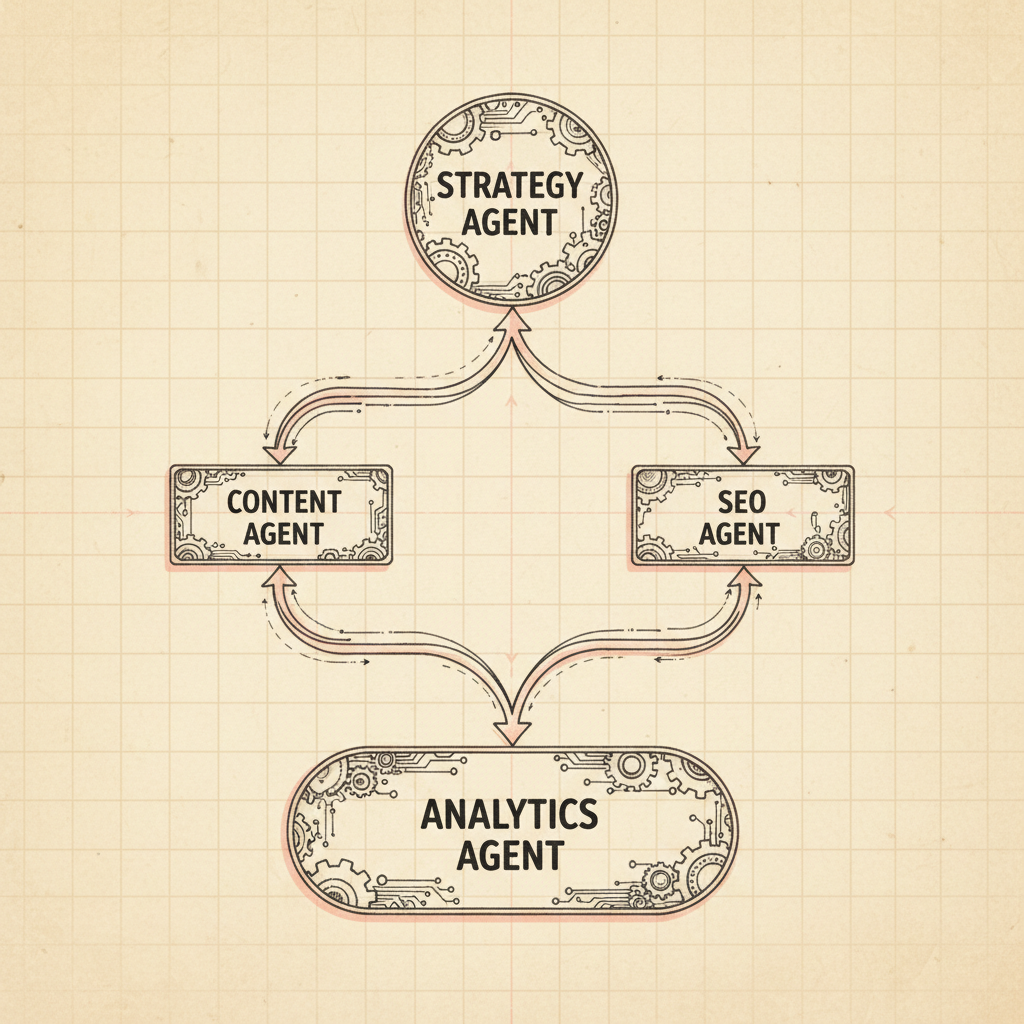
An AI CMO is a system of AI agents that performs the strategic and operational functions of a Chief Marketing Officer — including content strategy, SEO execution, social publishing, performance reporting, and answer engine optimization — without requiring a full-time human in that role. It is not a single tool or chatbot. It is a coordinated stack of specialized agents, each responsible for a specific marketing function, operating in sequence or in parallel based on defined workflows.
The term gained traction in 2025 as large language model capabilities matured enough to handle multi-step marketing tasks reliably. By 2026, platforms purpose-built for this function have made it accessible beyond enterprise budgets.
An AI CMO is distinct from a marketing automation tool. Automation executes predefined sequences. An AI CMO reasons, adapts to new information, generates original output, and surfaces strategic recommendations. The difference matters in practice: automation sends an email series; an AI CMO decides what to write, writes it, optimizes it for search, publishes it, and reports on what worked.
AI CMO vs Human CMO vs Fractional CMO
The decision between hiring, fractionalizing, or deploying AI comes down to three variables: budget, throughput, and multi-client scalability.
| Dimension | Human CMO | Fractional CMO | AI CMO |
|---|---|---|---|
| Cost | $200K–$400K/yr | $5K–$15K/mo | Scales with usage |
| Availability | 40 hrs/week | 5–15 hrs/week | 24/7 |
| Multi-client | No | 2–4 clients | Unlimited parallel |
| AEO support | Depends | Rarely | Built-in |
| Speed to output | Days | Days | Hours |
| Brand voice consistency | High | Medium | High (with voice profiles) |
A human CMO brings judgment, relationships, and leadership that AI cannot fully replicate. A fractional CMO brings senior expertise at reduced cost but with limited bandwidth. An AI CMO brings unlimited throughput, consistent execution, and a cost structure that scales down rather than up.
The right answer for most organizations in 2026 is not a replacement but a reconfiguration: a lean human team setting strategy and making calls, with an AI CMO executing the marketing surface area that would otherwise require a department.
For agencies specifically, the calculus is sharper. An AI CMO for agencies means every client gets full-stack marketing execution without proportional headcount growth.
What an AI CMO Does: The 6 Core Functions
1. Strategy
An AI CMO translates business goals into a prioritized marketing plan. It analyzes competitive positioning, identifies content gaps, maps keyword clusters to funnel stages, and generates a structured content calendar. Strategy is not a one-time output — the AI CMO refreshes its recommendations as performance data comes in and as market conditions change.
2. Content
The content function covers everything from long-form SEO articles to LinkedIn posts, email newsletters, and short-form video scripts. An AI CMO maintains a brand voice profile and applies it consistently across all formats. It also handles repurposing: a single article can be broken into social clips, carousels, and email sequences automatically. Content velocity — the rate at which a brand publishes quality material — goes from constrained to unlimited.
3. SEO
SEO execution under an AI CMO includes keyword research, topic clustering, internal link strategy, on-page optimization, and technical audit recommendations. It monitors ranking movements and adjusts content priorities accordingly. This is one of the areas where AI-native execution most clearly outperforms traditional approaches: an AI CMO can process and act on thousands of keyword signals in the time it takes a human strategist to review a spreadsheet.
4. Social
Social publishing is handled across platforms — LinkedIn, X, Instagram, Reddit — with platform-specific formatting and timing logic. An AI CMO monitors engagement, identifies which formats and topics are performing, and applies those learnings to future scheduling. It also handles warm engagement strategies: commenting on relevant posts, identifying prospect content to engage with, and building audience through interaction rather than just broadcasting.
5. Reporting
Performance reporting is automated and structured. An AI CMO tracks traffic, rankings, engagement, lead attribution, and content ROI across a single dashboard. It surfaces the highest-leverage actions each week based on what the data shows, not what the team remembered to check. The reporting layer closes the loop between strategy and execution — every decision is grounded in current performance rather than intuition.
6. AEO (Answer Engine Optimization)
Answer Engine Optimization is built into the AI CMO by design. As AI-powered search (ChatGPT, Perplexity, Google AI Overview) becomes the primary discovery surface for B2B buyers, content needs to be structured to answer specific questions in specific formats. An AI CMO formats content with clear definitions, structured headers, and FAQ sections — the patterns that answer engines extract and cite. This is rarely part of a human or fractional CMO's skillset, and even less common in vs traditional marketing automation platforms.
Who Needs an AI CMO in 2026
Solo Founders
A solo founder running a SaaS product, consulting practice, or community business cannot afford a marketing department. They need consistent publishing, SEO execution, and social presence without the overhead. An AI CMO gives them the infrastructure of a full marketing team at a fraction of the cost. The founder defines the strategy and approves key content; the AI CMO handles everything else.
The specific win for solo founders is compounding: an AI CMO builds organic search presence, maintains social consistency, and generates lead-capture content every week without requiring daily attention. Six months in, the founder has an SEO moat that would have taken a team years to build manually.
Agencies
Agencies are the highest-leverage use case for an AI CMO. The core agency problem is margin compression: client expectations increase faster than pricing allows, and adding headcount to cover the gap destroys profitability. An AI CMO solves this by handling the execution layer — research, writing, optimization, scheduling, reporting — across every client simultaneously.
An agency using an AI CMO can take on more clients without growing their team proportionally. It can also offer more comprehensive services: full SEO programs, multi-platform social management, and monthly performance reporting become standard inclusions rather than upsells. Reviewing the available AI CMO alternatives makes clear that agency-native platforms offer significantly more value than repurposed general AI tools.
Enterprise Teams
Enterprise marketing teams face a different version of the same problem: too many channels, too many markets, and too many stakeholders to execute efficiently with human teams alone. An AI CMO at the enterprise level functions as an execution layer below the human team — handling content production, localization, social scheduling, and reporting while senior marketers focus on positioning, partnerships, and high-stakes campaigns.
Enterprises also benefit from the brand voice consistency an AI CMO maintains across large teams and multiple regions. When every piece of content is generated through the same voice profile, brand integrity holds even at scale.
How to Deploy an AI CMO
Step 1: Brand Configuration
Before anything executes, the AI CMO needs to understand the brand. This means defining the target audience, value proposition, tone of voice, competitor positioning, and topic authority areas. Most platforms handle this through an onboarding sequence. The output is a brand profile that every agent references when generating content or making strategic recommendations. Do not skip this step — a misconfigured brand profile produces content that is technically correct but tonally wrong.
Step 2: Channel Integration
Connect the publishing channels the brand uses: WordPress or the CMS for articles, LinkedIn and Instagram for social, Google Search Console for SEO tracking. Channel integration determines where the AI CMO can act autonomously and where it queues content for human review. Start with two or three channels rather than all of them — it is easier to expand a working system than to debug a broken one.
Step 3: Workflow Activation
Activate the specific workflows that match current priorities. For most teams starting out, this means the content workflow (article production and SEO) and the social workflow (scheduled publishing and engagement). More advanced workflows — competitive intelligence, AEO scanning, lead nurture sequences — can be added once the core loops are running. Each workflow should have a defined review checkpoint so a human can approve output before it publishes.
Step 4: Performance Loop Setup
Set up the reporting cadence that closes the feedback loop. This means configuring which metrics the AI CMO tracks, how often it surfaces recommendations, and what thresholds trigger alerts. A weekly performance digest — top-performing content, keyword movement, next priority actions — is the minimum viable loop. With this in place, the AI CMO self-improves over time: what works gets amplified, what does not gets deprioritized.
AI Topia: The AI CMO Platform Built for Agencies
AI Topia is an AI CMO platform built specifically for marketing agencies and founder-led businesses. It covers the full stack: keyword research and topic clusters, article writing with AEO formatting, social publishing across LinkedIn and Instagram, competitive intelligence scanning, and automated performance reporting.
The platform includes Cowork, a multi-agent orchestration layer that lets teams assign marketing tasks to specialized AI agents — a content agent, an SEO agent, a social agent, a reporting agent — and coordinate their output through a single dashboard. Agencies use Cowork to manage multiple clients from one workspace without context-switching or manual handoffs.
AI Topia is also home to the AI Topia Skool community, where founders and agency operators share playbooks, campaign templates, and implementation strategies for AI-driven marketing.
The difference between AI Topia and general-purpose AI tools is specialization. General AI tools require a skilled operator to prompt them correctly for every task. AI Topia encodes marketing expertise into the platform — the prompts, the workflows, and the output formats are already optimized for marketing outcomes. The operator focuses on strategy; the platform handles execution.
Frequently Asked Questions
What is the difference between an AI CMO and a marketing AI tool?
A marketing AI tool handles one task — writing a post, generating an image, suggesting keywords. An AI CMO coordinates multiple tools and agents across the full marketing function: strategy, content, SEO, social, and reporting. It is a system, not a feature.
Can an AI CMO replace a human CMO entirely?
For most small businesses and agencies, yes — in terms of marketing execution. An AI CMO cannot replace the relationship-building, board-level communication, or organizational leadership a human CMO provides. But for the content, SEO, social, and reporting functions that take up most of a CMO's time, an AI CMO executes those reliably and at higher throughput.
How long does it take to set up an AI CMO?
Initial setup on a purpose-built platform takes one to three days. Brand configuration is the longest step. Once the brand profile is set and channels are connected, the first content outputs are usually ready within 24 hours.
What does an AI CMO cost?
Pricing varies by platform and usage tier. As of 2026, agency-focused AI CMO platforms range from $300 to $2,000 per month depending on the number of clients, content volume, and features included. Compared to a fractional CMO at $5,000 to $15,000 per month, the cost difference is significant even at the high end.
Does an AI CMO work for niche industries?
Yes, with proper brand configuration. The brand profile step is where niche expertise gets encoded — audience-specific language, relevant topic clusters, industry-specific competitors. An AI CMO operating on a well-configured brand profile produces content that reads as industry-native, not generic.
How does an AI CMO handle AEO (Answer Engine Optimization)?
AEO-capable AI CMOs structure content with direct answer sentences at the top of each section, FAQ blocks, structured definitions, and clear headers — the patterns that AI search engines extract and cite. This is built into the content generation workflow rather than applied as a post-production edit. It requires no additional configuration once the workflow is active.
Want Weekly Founder Video Without Filming Weekly?
We run the Video Engine for you, or install it in your team. AI avatar, real footage, or both.