
Agentic Marketing vs Marketing Automation: Key Differences (2026)
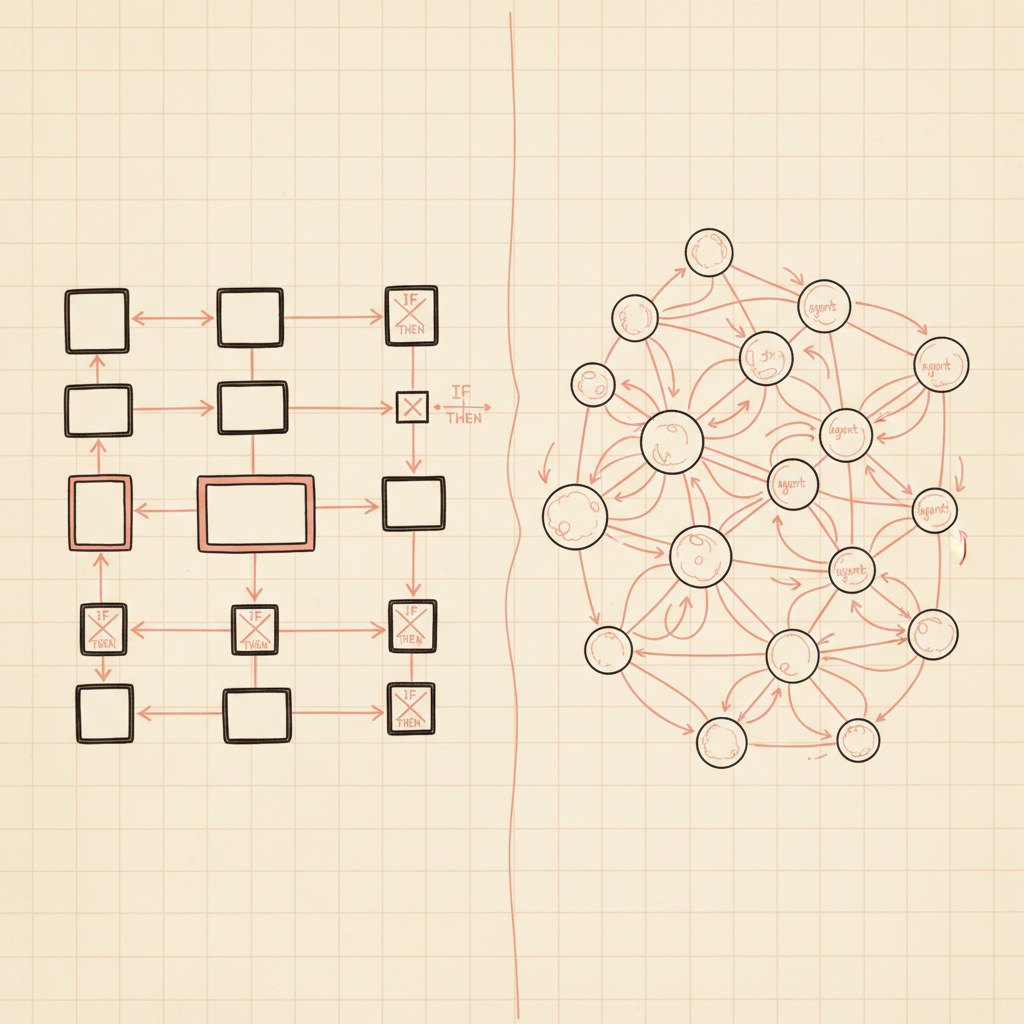
Marketing automation is not going away — it is being replaced. The tools that ran email drips and lead scoring in 2020 are now a foundation that a new category, agentic marketing, is being built on top of. The difference matters because choosing the wrong category shapes your hiring, your tech stack, and how fast you can actually scale.
TL;DR Key Takeaways
- Marketing automation runs rules. Agentic marketing runs reasoning.
- Automation requires you to define every workflow in advance. Agentic systems adapt in real time.
- Agentic marketing handles multi-step, multi-channel work without human handoffs per task.
- The shift is being driven by LLM capability, AEO demand, and agency scale pressure.
- Most teams should be running automation for stable, high-volume processes and agentic systems for dynamic, judgment-intensive work.
What Is Marketing Automation?
Marketing automation is software that executes predefined rules on marketing data to trigger actions at scale. It was built to solve one problem: removing the manual work of sending the right message to the right person at the right time based on known conditions.
The core mechanic is if/then logic. If a contact opens an email, add them to a nurture sequence. If a lead reaches a score threshold, notify sales. If a page is visited three times, fire a retargeting pixel. The system does exactly what you tell it, every time, without deviation.
Platforms like HubSpot, Marketo, Pardot, and ActiveCampaign built billion-dollar businesses on this model — HubSpot reached $2.63 billion in annual revenue in 2024, Adobe acquired Marketo for $4.75 billion in 2018, and Salesforce Marketing Cloud (which includes Pardot) generates over $5 billion annually. They gave marketing teams leverage — one person could do the work of ten if they knew how to configure workflows correctly.
The limitation is structural. Every output that marketing automation produces has to be designed by a human first. You define the segments, write the templates, build the branches, and maintain the logic as conditions change. The system executes. You think.
What Is Agentic Marketing?
Agentic marketing is a marketing approach where AI agents plan, execute, and optimize campaigns with minimal human direction per task. Rather than following a fixed workflow, agents reason about their goal, select the tools they need, and act across multiple steps and channels until the objective is met.
The key distinction is decision-making. A marketing automation workflow checks a condition and fires a rule. An agentic system reads context, forms a plan, executes actions, evaluates results, and adjusts — all within a single run.
This is not chatbot marketing or AI-assisted copywriting. Agentic marketing involves systems that handle an entire workflow end to end: research, write, optimize, publish, report, and iterate without a human in the loop for each step.
The category is new enough that there is no dominant platform yet. What exists today are early implementations built on foundation models, tool-calling frameworks, and purpose-built infrastructure. The AI CMO for agencies model is one concrete instantiation of this approach.
The 7 Key Differences
1. Decision-making logic
Marketing automation decisions are binary and predetermined. A trigger fires or it does not. Agentic marketing decisions involve reasoning — the agent evaluates the current state, considers multiple options, weighs tradeoffs, and chooses an action. This means agentic systems can handle situations that were never explicitly anticipated at build time.
2. Adaptability
Automation workflows are static. A sequence that was configured six months ago runs the same way today unless someone goes in and changes it. Agentic systems update their behavior based on results. If a content angle is underperforming, the agent adjusts the approach on the next run without a human identifying the problem and rebuilding the workflow.
3. Multi-step reasoning
A marketing automation platform can chain triggers and actions, but each node in that chain does one defined thing. An agentic system can execute a plan that spans research, drafting, optimization, and publishing — holding context across all steps and adjusting when earlier steps produce unexpected results.
4. Parallelization
Running automation for multiple clients means replicating the same workflow structure, often manually, for each account. Agentic marketing systems can run parallel agent stacks — each calibrated to a client's brand, audience, and goals — with minimal overhead per additional account. This is why agentic marketing for B2B SaaS and agency models are moving toward it as a scale strategy.
5. AEO capability
Answer Engine Optimization requires continuous, structured content updates across a topic cluster. Marketing automation has no mechanism for this — it can schedule posts but cannot monitor AI engine coverage, identify answer gaps, and generate targeted content to fill them. Agentic systems can run this loop autonomously.
6. Human oversight requirement
Building and maintaining a marketing automation stack is high-supervision work. Every new scenario requires a new workflow. Every edge case breaks something. Agentic marketing shifts the human role from builder to reviewer. You set objectives and review outputs — you do not design every execution path. Understanding what an AI CMO does illustrates how this changes the team structure.
7. Cost model
Marketing automation scales linearly — more contacts, more sending volume, more triggers means higher cost. The value comes from amortizing human time across a large database. Agentic marketing has a different cost structure: heavier upfront on model inference and setup, but the marginal cost of adding complexity or new channels does not increase proportionally with headcount.
Side-by-Side Comparison
| Dimension | Marketing Automation | Agentic Marketing |
|---|---|---|
| Decision logic | If/then rules | AI reasoning and judgment |
| Adaptability | Static workflows | Self-adjusting based on results |
| Content creation | Templates | Agent-generated, personalized |
| SEO/AEO | Keyword scheduling | Continuous optimization |
| Multi-client support | Manual setup per client | Parallel agent stacks |
| Human oversight | High (build every rule) | Low (review outputs) |
| Setup time | Weeks | Days |
| Best for | Volume at scale (known workflows) | Dynamic, multi-channel campaigns |
Why the Shift Is Happening Now
LLM capability crossed the threshold
For agentic systems to work in marketing, the underlying model needs to produce output that is good enough to publish with light review. That bar was not reliably met before 2023. By 2025, models capable of writing on-brand, factually accurate, SEO-optimized content at scale became accessible through APIs. The bottleneck moved from model quality to workflow design.
AEO emerged as a real channel
Search behavior is shifting. According to Semrush's 2025 AI Overviews study, approximately 16% of Google queries now trigger AI Overviews that answer the query directly — without the user clicking through to a page. Gartner predicts traditional search engine volume will drop 25% by 2026 as buyers shift to AI-powered answer engines. Ranking in these surfaces requires structured, authoritative content across a topic cluster, updated continuously. Marketing automation has no answer to this. Agentic systems designed around AEO do.
Agency scale demands forced the issue
Marketing agencies running 10, 20, or 50 client accounts face a structural problem. Automation helped them execute faster, but every client still required manual configuration, custom templates, and dedicated attention. Agentic marketing is the first architecture that makes true multi-client scale possible without proportional headcount growth. Agencies that understand this are moving first.
When to Use Each (Decision Framework)
Use marketing automation when:
- Your workflows are stable and well-defined
- Volume is the primary lever (email sends, lead scoring, basic segmentation)
- You have an established audience and know exactly what triggers to fire
- Compliance or auditability requires deterministic, documented logic
- Your team has limited AI operations experience
Use agentic marketing when:
- You need content production at scale across multiple channels
- Your campaigns require judgment calls — audience targeting, angle selection, format variation
- You are competing for AEO visibility and need continuous topic coverage
- You run multiple client accounts and need parallel execution
- You want marketing to run while your team is focused on strategy, not execution
Both together: The most effective implementations use automation for what it is good at — database management, transactional triggers, CRM sync — and agentic systems for what requires intelligence — content creation, competitive monitoring, AEO optimization, and campaign adaptation.
How to Migrate From Automation to Agentic Marketing
Step 1: Audit your current automation for complexity
Not all workflows are worth migrating. Map what you have into two buckets: deterministic processes (transactional emails, lead routing, CRM updates) and judgment-intensive processes (content calendars, campaign optimization, competitive response). The second bucket is your migration priority.
Step 2: Define your agent objectives before choosing tools
Agentic systems fail when they are set up before the objective is clear. Before deploying any agent, define: what is the goal, what does success look like, what inputs does the agent need, and what outputs will a human review. Start with one workflow — content production or AEO monitoring — not everything at once.
Step 3: Run parallel for 30 days
Keep your automation running while you test agentic outputs. This gives you a quality baseline and reduces risk. Compare outputs on the metrics that matter: content quality, ranking movement, time-to-publish. Do not rely on intuition — use data to decide what transitions.
Step 4: Shift human roles from builders to reviewers
The most common failure mode in migration is keeping the same team structure. If your team is still spending 80% of their time building workflows, you have not actually migrated — you have added complexity. Agentic marketing requires a different operating model: agents do the execution, humans set direction and approve outputs. Use an agentic marketing platform designed for this workflow from the start rather than retrofitting automation tools.
Connect with the AI Topia community for implementation frameworks and case studies from teams that have made this transition.
FAQ
Is marketing automation obsolete?
No. Marketing automation handles deterministic, high-volume workflows better than agentic systems for now. The right answer is not replacement — it is knowing which category of problem each approach is designed to solve. Transactional email and lead scoring still belong in automation. Dynamic content production and AEO belong in agentic systems.
Can small marketing teams use agentic marketing?
Yes, and the ROI is often higher for smaller teams because they have less capacity to spare. A team of three running an agentic content system can produce output that previously required a team of ten. The setup cost is real, but the leverage is disproportionate at small scale.
How long does it take to implement agentic marketing?
A basic agentic content workflow — research, draft, optimize, publish — can be operational in days with the right platform. A full multi-channel agentic system covering SEO, AEO, social, and email typically takes two to four weeks to configure and calibrate to brand voice.
Does agentic marketing work for regulated industries?
With the right oversight structure, yes. The human review step in an agentic workflow can include compliance checks. The output still requires human approval before publishing in regulated contexts, which is true of any AI-generated content. The difference is that agentic systems reduce the volume of decisions a human needs to make — not the accountability for the final output.
What is the biggest mistake teams make when adopting agentic marketing?
Treating it like a faster version of marketing automation. Agentic marketing requires a different mental model: you are not building workflows, you are defining objectives and reviewing outcomes. Teams that approach it like automation end up over-engineering the agent's instructions and under-investing in output review. The shift in mindset — from builder to director — is harder than the technical implementation.
Want Weekly Founder Video Without Filming Weekly?
We run the Video Engine for you, or install it in your team. AI avatar, real footage, or both.