
What Is Agentic Marketing? Complete Guide (2026)
Most marketing teams are still running campaigns the same way they did five years ago: scheduling posts, building workflows, and waiting for weekly reports. Agentic marketing changes the entire operating model. According to McKinsey, agentic AI systems accelerate the creation and execution of marketing campaigns by 10 to 15 times. In 2026, the gap between agencies that run agentic systems and those that don't is compounding fast.
TL;DR Key Takeaways
- Agentic marketing uses autonomous AI agents that plan, execute, and optimize campaigns without requiring step-by-step human instruction.
- It is fundamentally different from marketing automation, which follows fixed rule-based workflows with no decision-making capability.
- A complete agentic marketing system has five core components: an orchestrator, specialized agents, memory, tool integrations, and a feedback loop.
- Agencies using agentic systems are running parallel campaign stacks per client, reducing execution time by 60-80% while maintaining strategic control (AI Topia customer data; industry average: 37% faster project completion).
- The fastest path to implementation is adopting a purpose-built AI CMO platform rather than building custom agent infrastructure from scratch.
What Is Agentic Marketing?
Agentic marketing is a model where AI agents autonomously execute marketing tasks, make decisions, and adapt strategy based on real-time data, without waiting for human instructions at each step. Unlike tools that assist marketers, agents act as operators: they receive a goal, break it into subtasks, use tools to complete those tasks, evaluate results, and iterate.
The word "agentic" comes from the AI architecture concept of an agent, a system that perceives its environment, selects actions, and works toward an objective over multiple steps. Applied to marketing, this means an agent assigned to grow organic traffic does not just generate one article. It researches keywords, identifies gaps, writes briefs, publishes content, monitors rankings, and adjusts based on what works.
Agentic marketing is not a single product or feature. It is an operating architecture. A team running agentic marketing has replaced many of its manual execution processes with autonomous agent loops, while humans focus on strategy, brand direction, and final approval gates.
The shift matters because the output ceiling of traditional marketing is headcount. The output ceiling of agentic marketing is compute. That asymmetry is why the model is expanding rapidly across agencies and in-house teams in 2026. Gartner predicts that 40% of enterprise applications will include task-specific AI agents by end of 2026, up from less than 5% in 2025. For marketing, that shift is already underway: 87% of marketers now use generative AI in at least one recurring workflow, up from 51% in 2024.
How Agentic Marketing Differs From Marketing Automation
Agentic marketing is not a better version of marketing automation. It is a different category.
Marketing automation executes instructions. You define a trigger, specify actions, and the system runs them. If a contact opens an email, send them a follow-up in three days. If a form is submitted, add the contact to a sequence. Every step is predetermined. The system has no awareness of context, no ability to improvise, and no way to handle novel situations.
Agentic marketing reasons toward outcomes. An agent given the goal of "book five qualified demos this week" will determine which channels to activate, write personalized outreach, analyze responses, escalate warm leads, and revise messaging based on reply rates, all without being told exactly what to do at each step.
The practical difference shows up immediately when things deviate from the expected path. Automation breaks or falls through branches. Agents adapt.
There are four dimensions where the gap is clearest:
Decision-making. Automation follows logic trees. Agents evaluate context and choose actions dynamically.
Goal orientation. Automation executes tasks. Agents pursue outcomes.
Error recovery. Automation stalls on exceptions. Agents diagnose issues and route around them.
Multi-step reasoning. Automation is one-to-one trigger-action. Agents plan sequences, adjust mid-execution, and learn across runs.
For a detailed comparison of both models, read the full breakdown in agentic marketing vs marketing automation.
The 5 Core Components of an Agentic Marketing System
A working agentic marketing system has five components. Missing any one of them degrades the system from autonomous to semi-manual.
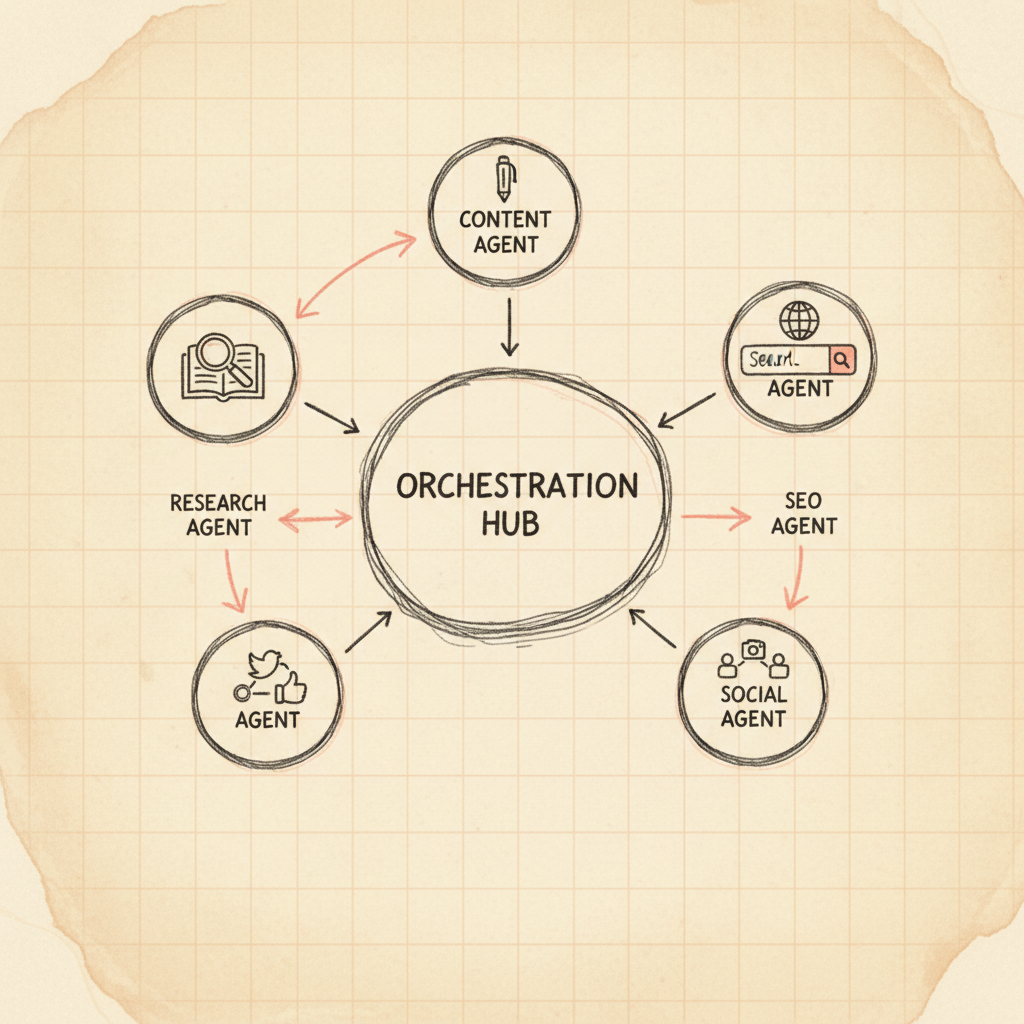
1. Orchestrator The orchestrator is the top-level agent that receives goals and decomposes them into tasks assigned to specialized sub-agents. It tracks overall progress, resolves conflicts between agent outputs, and decides when to escalate to a human. In practice, the orchestrator is what makes multi-agent coordination work rather than producing redundant or contradictory outputs.
2. Specialized Agents Each specialized agent owns one domain: content, SEO, paid media, social, email, or reporting. Specialization matters because generalist agents produce generalist outputs. A content agent trained on editorial workflows produces better articles than an all-purpose agent asked to write a blog post. Agencies running AI CMO for agencies deployments typically run five to eight specialized agents per client stack.
3. Memory Agents without memory repeat themselves. Memory in an agentic marketing system has three layers: short-term context (the current task), mid-term episodic memory (recent campaign results), and long-term knowledge (brand voice, audience profiles, past learnings). Without persistent memory, agents cannot improve across runs or maintain consistent brand output across channels.
4. Tool Integrations Agents need tools to act in the real world. These include search APIs, CMS access, analytics platforms, social media APIs, ad platforms, CRM connections, and image generation services. The breadth and reliability of tool integrations directly determines how much of the campaign lifecycle an agent can execute without human handoff.
5. Feedback Loop The feedback loop closes the system. Agents monitor results from executed actions, compare them against goals, and feed that data back into future decisions. Without a feedback loop, agentic marketing is just fast task execution. With one, it becomes a self-improving system that gets better with each campaign cycle.
How AI Agents Run Marketing Campaigns
In a production agentic marketing system, campaigns run as coordinated agent loops with defined checkpoints for human review.
The process starts when the orchestrator receives a campaign goal, for example: "Generate 30 qualified leads this month from organic content and LinkedIn." The orchestrator decomposes this into parallel workstreams: keyword research, content production, social distribution, and lead capture optimization.
Each specialized agent takes its workstream. The SEO agent audits current rankings, identifies keyword gaps, and queues briefs. The content agent picks up briefs, drafts articles, checks them against brand guidelines and internal linking requirements, and outputs final drafts for review. The social agent monitors platform signals, identifies trending topics adjacent to the campaign, and schedules posts timed to peak engagement windows.
These agents run concurrently. While the content agent is drafting, the SEO agent is already monitoring early ranking signals from last week's output. While the social agent is publishing, the reporting agent is updating campaign dashboards and flagging any anomaly that warrants attention.
Human checkpoints sit at defined stages: strategy approval at the start, content review before publication, and performance review at weekly intervals. Everything between those gates runs autonomously.
At scale, this architecture allows a single strategist to oversee campaigns for multiple clients simultaneously, because agent loops handle execution. This is what what an AI CMO does in an agency context: strategic direction backed by a coordinated agent workforce.
Agentic Marketing Use Cases in 2026
Agentic marketing is being applied across four primary domains in 2026. Each demonstrates a different pattern of how agents replace previously manual execution work.
Content Marketing Content agents receive a keyword brief and produce full-length, on-brand articles with internal links, meta descriptions, and image prompts. They run editorial checks against brand guidelines before outputting drafts. Some systems include a second-pass agent that reviews the draft for AEO structure, semantic coverage, and tone before flagging it for human review. Agencies that previously produced 8-10 articles per month per client are producing 25-40 with the same headcount (AI Topia customer data). This tracks with industry findings: AI content tools enable teams to complete content projects 37% faster, and 44% of traditional content teams publish only 3-6 pieces per month — a ceiling that agentic workflows remove.
SEO Operations SEO agents monitor client sites continuously. When ranking drops are detected, the agent identifies the cause (content gap, backlink loss, algorithm shift), generates a remediation brief, and queues it for the content agent. Ongoing technical audits, internal link optimization, and competitor gap analysis run on scheduled agent loops without requiring a human to initiate each task. The AI marketing platform category was built largely around automating this workflow.
Social Media Execution Social agents monitor platform signals, track competitor activity, and schedule posts aligned to audience engagement data. More advanced implementations include reactive agents that identify trending conversations in a client's niche and draft response posts within minutes, not days. Social agents also handle comment monitoring and flag high-value engagement opportunities for human response.
Reporting and Analytics Reporting agents replace the weekly "pull data and paste into a deck" task. They monitor key metrics continuously, generate narrative summaries of performance, and send anomaly alerts when metrics deviate from expected ranges. Client-facing reports are generated automatically with commentary that contextualizes results. This alone recovers 5-8 hours per week per account manager (AI Topia customer data), which aligns with broader research: HubSpot's 2026 State of Marketing report finds about one-third of marketers say AI saves their team 10-14 hours per week, with an average recovery of 6.1 hours weekly.
| Capability | Traditional Automation | Agentic Marketing |
|---|---|---|
| Content creation | Template-based | Agent generates + optimizes per audience |
| SEO | Scheduled audits | Continuous agent monitoring |
| Social | Queued posts | Real-time signal response |
| Reporting | Weekly dashboard | Continuous + anomaly alerts |
| Multi-client | Manual switching | Parallel agent stacks per client |
How to Implement Agentic Marketing at Your Company
Implementation works in phases. Trying to replace everything at once causes chaos. A staged rollout produces durable results.
Step 1: Audit Your Current Execution Map List every recurring marketing task across your team. Categorize each as strategic (requires judgment), creative (requires taste), or operational (follows a defined process). Operational tasks are your first automation targets. Start with the highest-volume, most rule-bound tasks: social scheduling, reporting, and content briefing.
Step 2: Pick One Agent Use Case to Pilot The most common successful starting point is a content agent. The workflow is well-defined, the output is reviewable before it reaches an audience, and the volume gains are immediately visible. Define the goal, configure the agent with your brand guidelines and style preferences, and run it for 30 days before expanding.
Step 3: Establish Human Checkpoints Agentic systems work best with clear escalation rules. Define exactly which decisions require human approval, which the agent can make autonomously, and which require a human review within a defined time window. Document these rules explicitly. Agents without governance degrade brand consistency.
Step 4: Add Memory and Feedback Once the agent is running, ensure it has access to performance data. Connect your analytics platform. Configure the feedback loop so the agent is learning from what it produces. An agent without feedback is running blind. With it, output quality compounds week over week.
Step 5: Expand to Multi-Agent Coordination After the first agent is stable, add a second. Then an orchestrator to coordinate both. This is where the full model starts delivering asymmetric output. Most teams reach a stable multi-agent configuration within 60-90 days of their first pilot.
Step 6: Integrate Across the Client Stack (For Agencies) Agencies unlock the biggest gains by running parallel agent stacks per client. Each client has their own orchestrator, specialized agents, and memory store. A strategist manages the stack across all clients, reviewing outputs and adjusting strategy rather than executing tasks. This is the operational model that purpose-built platforms are designed to enable.
AI Topia: Agentic Marketing Built for Agencies
AI Topia is an AI CMO platform built specifically for marketing agencies running multi-client agentic systems. Rather than asking agencies to stitch together general-purpose AI tools, AI Topia provides a pre-built agent infrastructure: orchestrator, specialized agents for content, SEO, social, and reporting, and a memory layer that maintains brand context across all client accounts.
The platform runs on a Cowork architecture, where each client account is an isolated agent workspace with its own configuration, memory, and execution history. This means an agency managing 15 clients can run parallel campaigns for all 15 simultaneously without context bleeding between accounts.
Key capabilities include:
- AI-driven content production with brand voice enforcement
- Continuous SEO monitoring with automated remediation queuing
- Social signal monitoring and reactive post drafting
- Automated client reporting with narrative commentary
- Multi-client orchestration from a single strategist interface
Agencies using AI Topia are scaling content output 3-5x, recovering 15-20 hours of execution work per week per account manager, and reducing time-to-publish from days to hours (AI Topia customer data). McKinsey estimates agentic marketing systems can power up to two-thirds of current marketing activities and unlock 10-30% revenue growth from hyper-personalized campaigns.
For a full overview of how the platform works, visit the AI Topia community or read the complete guide on AI CMO for agencies.
FAQ
How much does it cost to implement agentic marketing? Implementation costs vary widely depending on whether you build custom infrastructure or adopt a platform. Custom builds using general-purpose agent frameworks (LangGraph, AutoGen, CrewAI) typically require 200-400 hours of engineering time before the first production agent is stable. Platform-based implementations like AI Topia start running within days and eliminate infrastructure overhead entirely. For context on what companies are spending: the median mid-market marketing team spent $3,400/month on AI tools in Q1 2026, up from $1,200/month in Q1 2025. For most agencies, the platform path delivers faster ROI.
Do you need technical staff to run agentic marketing systems? Not with purpose-built platforms. Platform-based agentic systems are configured through natural language and structured settings, not code. Strategists, account managers, and content leads can operate agent stacks without engineering support. Custom implementations require ongoing technical involvement for maintenance, monitoring, and updates.
What is the difference between an AI agent and an AI assistant? An AI assistant responds to prompts. You ask it something and it answers. An AI agent pursues goals over multiple steps using tools and its own reasoning. The distinction is autonomy and scope: an assistant helps you do a task, an agent completes the task on its own. Agentic marketing systems use agents, not assistants, because execution requires sustained action across multiple steps and channels.
How do agentic marketing systems maintain brand consistency? Brand consistency in agentic systems is enforced through the memory layer. Brand guidelines, tone of voice documents, style preferences, and past approved content are stored in the agent's long-term memory. Before generating output, the agent retrieves relevant context and applies it. Some platforms add a second-pass reviewer agent that checks outputs against brand standards before flagging for human review. Consistency improves over time as the memory store grows.
Can agentic marketing systems handle crisis situations or off-brand requests? Well-configured systems include guardrails for high-risk actions. Typical implementations pause agent execution on certain triggers, escalate to a human reviewer, and require explicit approval before publishing sensitive content or making large budget changes. Crisis communication and reactive PR are areas where human oversight remains essential. Agents handle the execution workflow once a human has set the response strategy.
How do you measure ROI from agentic marketing? Measure ROI across three dimensions: output volume (articles, posts, reports produced per headcount), time recovery (hours per week saved across your team), and campaign performance (traffic, leads, and revenue attributed to agent-driven campaigns). Industry benchmarks: companies using AI marketing automation report average ROI of 544% ($5.44 return per dollar spent), and HubSpot finds one-third of marketers recover 10-14 hours per week from AI tools. Content output volume increases of 2-5x are typical in the first 90 days, with performance improvements compounding as the feedback loop matures.
Want Weekly Founder Video Without Filming Weekly?
We run the Video Engine for you, or install it in your team. AI avatar, real footage, or both.