
Agentic Marketing for B2B SaaS: Complete Guide (2026)
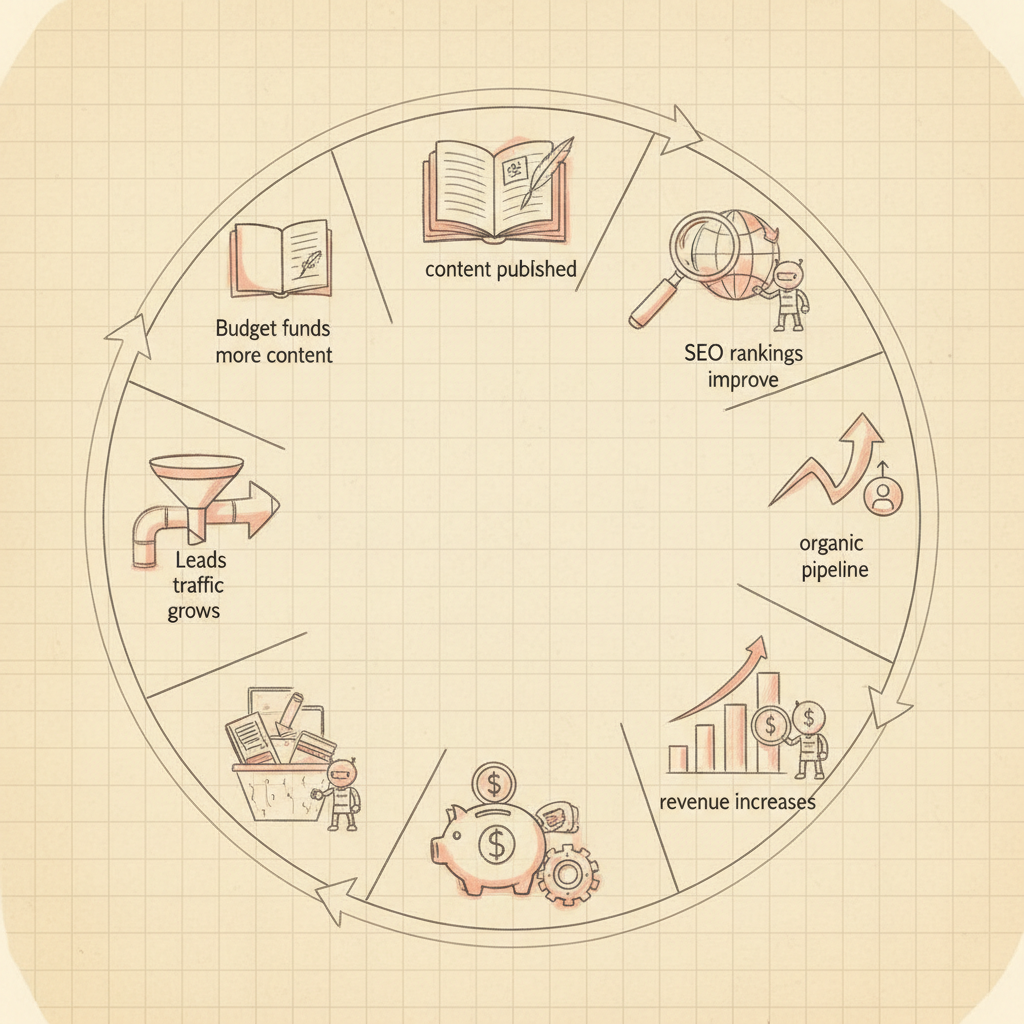
B2B SaaS companies face a specific marketing problem: long sales cycles demand constant content, technical buyers ignore generic messaging, and pipeline attribution is nearly impossible with small teams. Agentic marketing solves all three simultaneously by deploying autonomous AI agents that research, write, optimize, distribute, and measure — without a proportional headcount increase.
This guide covers exactly how B2B SaaS teams are using agentic marketing in 2026 to compound their content advantage, appear in AI-generated answers, and accelerate pipeline from organic.
TL;DR Key Takeaways
- B2B SaaS content requirements (high volume, technical depth, long-tail SEO) are structurally suited to agentic marketing
- AI agents eliminate the four core bottlenecks: content velocity, SEO compounding, AEO visibility, and pipeline attribution
- Agentic content strategy builds topic clusters automatically, with internal linking and freshness signals maintained by agents
- B2B buyers now research in ChatGPT before talking to sales — AEO (Answer Engine Optimization) is a first-class channel in 2026
- A full agentic stack can be operational in 90 days with a phased implementation approach
Why B2B SaaS Is the Perfect Use Case for Agentic Marketing
B2B SaaS is the ideal environment for agentic marketing because the structural demands of the category align precisely with what AI agents do best.
Long sales cycles require sustained content volume. The median B2B SaaS deal takes 84 days to close, according to Optifai's 2025 benchmarks. FocusVision research, reported by MarTech, found that B2B buyers consume an average of 13 pieces of content before deciding on a vendor. Maintaining that content surface across the full funnel — awareness, consideration, evaluation, decision — requires more production capacity than most marketing teams can sustain manually. Agents produce and refresh content continuously, with no throughput ceiling.
Pipeline is content-driven. Unlike B2C or transactional B2B, SaaS pipeline is predominantly inbound. Demo requests, trial signups, and qualified leads flow from organic search, content syndication, and referral. The quality and volume of content output is the primary lever on pipeline — which means anything that accelerates content output directly accelerates revenue. Agents do exactly this.
Technical ICPs reward specificity. B2B SaaS buyers are often technical: developers, CTOs, RevOps leads, and data engineers who can detect shallow content instantly. They search for exact-match terms, compare alternatives in detail, and read long-form guides before making decisions. Agentic content pipelines can produce depth at scale — 3,000-word technical guides, comparison tables, integration walkthroughs — matching what buyers actually need rather than publishing lowest-common-denominator posts.
The 4 B2B SaaS Marketing Problems AI Agents Solve
1. Content Velocity
Most B2B SaaS teams publish 4 to 8 articles per month. Their best-performing competitors — those investing heavily in organic as a pipeline channel — can publish at significantly higher volumes with AI assistance. The gap compounds: more content means more indexed pages, more keyword coverage, more topical authority signals, and more inbound links. Teams that cannot close this gap fall further behind every quarter.
AI agents eliminate the velocity bottleneck. A research agent monitors search trends and competitor content daily. A brief agent structures articles from that research. A writer agent produces AEO-structured drafts. An SEO agent adds internal links and optimizes meta. The entire pipeline runs autonomously on a schedule — not when a human has time.
2. SEO Compound Interest
SEO does not work on a linear curve. Domain authority, topical depth signals, and backlink accumulation compound over time. Teams that publish consistently for 12 to 24 months own dramatically more organic real estate than teams that publish sporadically. The challenge is that most teams cannot maintain the consistency required to realize compounding — capacity fluctuates, priorities shift, and content production pauses.
Agents do not have off-weeks. They maintain publishing cadence regardless of team bandwidth, ensuring that topical clusters are built completely, that existing content is refreshed when rankings decline, and that new keyword opportunities are captured before competitors rank. This is vs traditional marketing automation in the most fundamental sense: automation executes predefined workflows; agents reason about what needs to happen and execute it.
3. AEO Visibility
In 2026, a significant portion of B2B SaaS research happens in ChatGPT, Perplexity, and Google AI Overviews before buyers ever visit a website. 73% of B2B buyers now use AI tools like ChatGPT and Perplexity in their vendor research process, and 61% of the B2B buying journey completes before a buyer ever contacts a vendor. When a VP of Sales asks "what is the best outreach automation tool for mid-market SaaS," they expect a direct answer with named tools — and the tools that get named are the ones with AEO-optimized content.
Traditional SEO optimizes for ranking position. AEO optimizes for citation in AI-generated answers. This requires structured content with direct answers in the first sentence of every section, FAQ schemas, clear entity associations, and content that answers the specific question a buyer would ask an AI. Agents that understand AEO structure can produce this content systematically — ensuring your brand appears in LLM responses across your entire ICP's question set.
4. Pipeline Attribution
B2B SaaS marketers struggle to connect content consumption to pipeline contribution. A buyer reads three blog posts over 90 days, attends a webinar, then books a demo after a LinkedIn ad — the content contribution is invisible. This makes it difficult to justify content investment and impossible to optimize the content strategy against revenue outcomes.
Agentic platforms that track content performance against pipeline outcomes can surface which topics, formats, and keywords are generating actual qualified leads — not just pageviews. This attribution loop closes the feedback cycle, allowing agents to prioritize the content types that generate pipeline over those that generate traffic.
Agentic Content Strategy for B2B SaaS
An agentic content strategy is not a content calendar managed by AI. It is a self-organizing content system that builds topical authority through coordinated cluster development, internal linking, and continuous freshness management.
The foundation is a topic cluster architecture. A research agent identifies the core topics your ICP searches — the problems they have, the solutions they evaluate, the comparisons they make. It maps these topics into a semantic cluster: a pillar page that covers the broad topic, surrounded by supporting pages that answer specific sub-questions. This structure signals topical depth to search engines and to LLMs.
Once the cluster architecture is set, the content agent builds it out systematically. Pillar pages come first, establishing topical authority. Supporting pages follow, targeting long-tail variations and specific buyer questions. Each piece is internally linked to the pillar and to adjacent supporting pages — creating a web of semantic relevance that reinforces the cluster signal.
The agent does not stop after initial publication. It monitors content performance, identifies pages where rankings are declining or traffic is flat, and queues those pages for refresh. It surfaces gaps in the cluster — topics competitors rank for that your site does not cover — and adds them to the production queue. The content strategy executes itself, rather than depending on a human editor to manage the backlog.
For B2B SaaS specifically, cluster topics map directly to the buyer journey. Awareness clusters cover problems: "why is our CAC increasing," "how do we scale content without headcount." Consideration clusters cover categories: "best content marketing tools for SaaS," "AI writing tools comparison 2026." Decision clusters cover your product specifically: "AI CMO platform review," "getaitopia vs [competitor]." Agents populate all three layers continuously.
Internal linking is handled automatically by the SEO agent, which understands the cluster architecture and places contextually relevant links within new content. This replaces the manual internal linking audit — a process most teams do once per year at best.
Agentic SEO for B2B SaaS: Beyond Keywords
Agentic SEO for B2B SaaS goes beyond keyword research and on-page optimization. The frontier in 2026 is LLM citation strategy — getting your brand named in AI-generated answers to buyer research questions.
B2B buyers now begin their vendor research with AI. A query like "what tools does a 10-person SaaS marketing team need" generates a structured answer in ChatGPT. The tools named in that answer receive implicit endorsement. The tools not named are invisible to that buyer in that moment. Gartner predicts traditional search engine volume will drop 25% by 2026 as AI chatbots become substitute answer engines — this is the new first page of search, and it operates by different rules than traditional SERP rankings.
To rank in AI-generated answers, content must be structured around the exact question a buyer would ask. The answer must appear in the first sentence of the relevant section. The content must comprehensively cover the topic entity, with clear associations between the brand, the category, and the use case. Schema markup, FAQ blocks, and structured data all contribute to LLM citation probability.
An AEO pipeline built on agentic infrastructure monitors which LLM queries your brand is being cited in, which competitors are appearing instead, and which content changes improve citation rates. This is a continuous optimization loop — not a one-time audit.
For B2B SaaS, the highest-value AEO targets are category comparison queries ("best [category] tools for [ICP]"), problem-solution queries ("how to [solve ICP problem]"), and use case queries ("how does [tool category] work for [company size/vertical]"). A content agent that systematically answers all three query types across your ICP's full question set builds the citation surface required to appear in AI-generated answers consistently.
The SEO agent also handles technical optimization: meta title and description generation, canonical tag management, schema markup injection, and XML sitemap updates. These tasks are consistently done when an agent handles them — not deferred to the next sprint.
Agentic Sales Outreach for B2B SaaS
Agentic sales outreach closes the gap between content consumption and pipeline entry. In B2B SaaS, most inbound intent signals go unanswered — a prospect visits the pricing page twice, reads the integration documentation, and then disappears because no one followed up before their attention window closed.
AI sales agents monitor intent signals in real time: page visits, content downloads, trial signups, email opens, LinkedIn profile views. When a signal indicates buying intent — high-value pages visited, return visits within a short window, ICP-matched company — the agent drafts and sends a personalized outreach message within minutes. Human SDRs typically respond to these signals hours or days later, if at all.
For B2B SaaS with technical ICPs, personalization is critical. Generic outreach is ignored. An agentic sales layer researches the prospect — their role, recent activity, company tech stack, hiring signals — and generates outreach that references their specific context. The message is not a template. It reflects what the agent knows about this specific buyer at this specific moment in their research.
The full approach is documented in the agentic sales playbook, which covers intent signal taxonomy, agent response logic, and how to integrate agentic outreach with your existing CRM and sales workflow without disrupting human reps.
The net effect in B2B SaaS: more of the inbound pipeline that organic content generates actually enters a sales conversation, because the gap between intent and follow-up disappears.
B2B SaaS Agentic Marketing Stack: What You Actually Need
| Component | What It Does | Tool Category |
|---|---|---|
| Research agent | Monitors SERP + competitor content daily | AI CMO platform |
| Brief agent | Structures articles from research | AI CMO platform |
| Writer agent | Produces AEO-structured drafts | AI CMO platform |
| SEO agent | Internal linking + meta optimization | AI CMO platform |
| AEO monitor | Tracks LLM citations for your brand | AI CMO platform |
| Social agent | Atomizes content to LinkedIn/X | AI CMO platform |
| Sales agent | Responds to intent signals with outreach | AI CMO platform |
Most B2B SaaS teams attempt to assemble this stack from point solutions: one tool for content, another for SEO, another for social scheduling, another for sales sequences. This creates integration debt, attribution gaps, and workflow fragmentation that reduces the actual output of each tool.
An integrated AI marketing platform comparison shows that unified agentic platforms outperform point-solution stacks on both output volume and pipeline contribution — primarily because the agents share context across the content, SEO, and sales layers. A writer agent that knows which content is generating pipeline produces more of that content. A sales agent that knows which blog post a prospect read before visiting the pricing page writes a better first message.
The integration layer is where compounding happens. Disconnected tools produce disconnected outputs. Agents that share a unified knowledge base about your ICP, your product, and your content performance produce coordinated outputs that reinforce each other.
Implementation Roadmap: 90 Days to Agentic B2B Marketing
Day 1 to 30: Foundation
The first 30 days establish the infrastructure that everything else runs on.
Set up your ICP definition in the agentic platform: company size, vertical, role, pain points, and the specific language your buyers use. This is the input that shapes every piece of content the agents produce. Get it wrong and agents produce high-volume output that misses the ICP. Get it right and every piece resonates.
Audit your existing content against your target keyword clusters. Identify gaps — topics your ICP searches that you do not rank for — and prioritize them as the initial content production queue. Connect your domain analytics, search console data, and CRM so the agents have performance signals from day one.
Configure your research agent to monitor your top five competitors daily. This surfaces new content opportunities as competitors publish, allows you to respond to competitive content within days rather than months, and identifies the topics driving their traffic that you are not yet covering.
Day 31 to 60: Content Engine
With the foundation in place, activate the content production pipeline at scale.
The writer agent begins producing from the prioritized queue. Target two to four pieces per week minimum — a pace that most teams cannot sustain manually but that agents handle without friction. Each piece goes through the SEO agent for internal linking and meta optimization before publishing.
Activate the social agent to atomize published content into LinkedIn posts, X threads, and short-form pieces. This extends the reach of each content investment without additional production effort. The social agent surfaces insights from each article as standalone posts — generating engagement signals that contribute to domain authority over time.
Begin tracking content-to-pipeline attribution in your CRM. Tag all inbound leads that engaged with content before converting, identify which pieces are appearing in the research paths of qualified leads, and feed this signal back to the content prioritization queue.
Day 61 to 90: AEO and Sales Integration
The final phase activates the LLM citation layer and connects content to sales outreach.
Audit your published content for AEO compliance: direct answers in first sentences, FAQ blocks, structured data markup, entity associations. The AEO monitor begins tracking your brand's citation rate across relevant LLM queries. Optimize the lowest-performing pieces first.
Activate the sales agent on intent signals. Define the trigger conditions — which pages visited, in which sequence, with what company profile — that indicate buying intent. The agent begins responding to these signals with personalized outreach. Monitor response rates and booking rates to calibrate trigger thresholds.
By day 90, the full agentic stack is operational: content is publishing on a consistent schedule, the AEO monitor is tracking LLM citations, and intent-triggered outreach is converting inbound interest into sales conversations. The compounding starts from day one but becomes measurable around the 60-day mark.
AI Topia for B2B SaaS Marketing Teams
AI Topia is an AI CMO platform built specifically for teams that need to run agentic marketing without a large in-house team. It includes every component in the stack above: research, brief, writer, SEO, AEO monitor, social, and sales agents — integrated into a single platform with shared context across all layers.
B2B SaaS teams use AI Topia to publish 10x more content than their previous capacity, rank for 3x more keywords within 90 days, and appear in ChatGPT and Perplexity answers for their target ICP queries. The platform is configured around your specific ICP, product, and content goals — not a generic one-size-fits-all content tool.
The AI Topia Skool community includes playbooks, implementation guides, and live workshops specifically for B2B SaaS marketing leaders building agentic stacks. Members share what is working in their specific verticals, which significantly accelerates the learning curve for new implementations.
If you are a B2B SaaS marketing leader evaluating whether agentic marketing is the right move in 2026, the answer is: your competitors are already doing it. The question is whether you start now or catch up later.
FAQ
What is agentic marketing specifically for B2B SaaS, and how is it different from general AI marketing?
Agentic marketing for B2B SaaS is the deployment of autonomous AI agents configured around the specific demands of the B2B SaaS buyer journey: long sales cycles, technical ICPs, content-driven pipeline, and high content volume requirements. General AI marketing tools assist human marketers with specific tasks. Agentic marketing systems operate end-to-end with minimal human intervention — from research through publication through distribution through pipeline tracking — and are configured around your specific ICP, product, and content goals rather than generic use cases.
How long before agentic marketing shows measurable pipeline impact for a B2B SaaS company?
Most B2B SaaS teams see the first measurable signals — ranking improvements for new content, increases in organic traffic, first LLM citation appearances — within 45 to 60 days of activating a full agentic stack. Pipeline impact, measured as content-attributed demo requests or trial signups, typically becomes statistically significant in the 90-to-120-day range, as the content volume builds and AEO optimization takes effect. The compounding nature of SEO and AEO means that impact accelerates significantly in months three through six.
Can a small B2B SaaS marketing team (2 to 3 people) realistically run an agentic marketing system?
Yes — this is precisely the use case agentic marketing is designed for. A team of two to three people cannot produce the content volume, SEO optimization depth, or AEO coverage that competitive B2B SaaS marketing requires. Agents handle the production and optimization layers, leaving the small team to handle strategy, ICP definition, product positioning, and high-level oversight. Most AI Topia customers are teams of this size who were previously losing the content volume game against better-resourced competitors.
Does agentic content perform as well as human-written content in B2B SaaS, where buyers are sophisticated and technical?
Yes, when agents are properly configured with your ICP context, product details, and technical knowledge base. The key differentiator is input quality: agents configured with deep ICP context produce content that matches what sophisticated technical buyers expect. Agents working from generic inputs produce generic content. The platform configuration — ICP definition, product context, content examples, and style guidelines — is what determines output quality, not the agent itself.
How does agentic marketing handle the compliance and brand voice requirements typical in B2B SaaS?
Agentic platforms include brand voice configuration and compliance guardrails that apply to every piece of content the agents produce. Voice guidelines — tone, vocabulary, banned phrases, required disclaimers — are set at the platform level and enforced automatically. For regulated B2B SaaS verticals (fintech, healthtech, legaltech), additional compliance review steps can be inserted into the workflow before publication. The human review layer is configurable: some teams require approval on every piece; others set approval workflows only for content that makes specific product claims or references regulatory topics.
What is the ROI calculation for agentic marketing investment in a B2B SaaS context?
The primary ROI driver is pipeline contribution from organic content, measured as content-attributed ARR divided by total agentic marketing platform cost. Research from Powered by Search found that organic search generates 44.6% of all B2B revenue, but for most teams this channel is constrained by content production capacity rather than by demand. Agentic marketing expands that contribution without proportional cost increase. Secondary ROI drivers include reduced agency and freelancer spend (agents replace production outsourcing), faster competitive response (agents can produce counter-content within 48 hours of a competitor publishing), and AEO citation value — which does not have a direct cost equivalent since there is no paid equivalent to appearing in an LLM answer.
Want Weekly Founder Video Without Filming Weekly?
We run the Video Engine for you, or install it in your team. AI avatar, real footage, or both.