
AI for Sales Teams: The Agentic Playbook (2026)
Introduction
Manual sales work is a tax on revenue. In 2026, every hour a human SDR spends on prospecting, CRM updates, or follow-up sequences is an hour a competitor's AI agent does it faster, at scale, with better data. The teams winning in this environment are not hiring more reps — they are deploying specialized AI agents across every stage of the sales funnel and reserving human judgment for the deals that actually require it.
TL;DR Key Takeaways
- AI agents now handle the top of the funnel end-to-end: prospecting, scoring, sequencing, and CRM hygiene run without human intervention.
- Human SDRs are shifting from execution to strategy — managing AI outputs, handling complex objections, and closing relationship-sensitive deals.
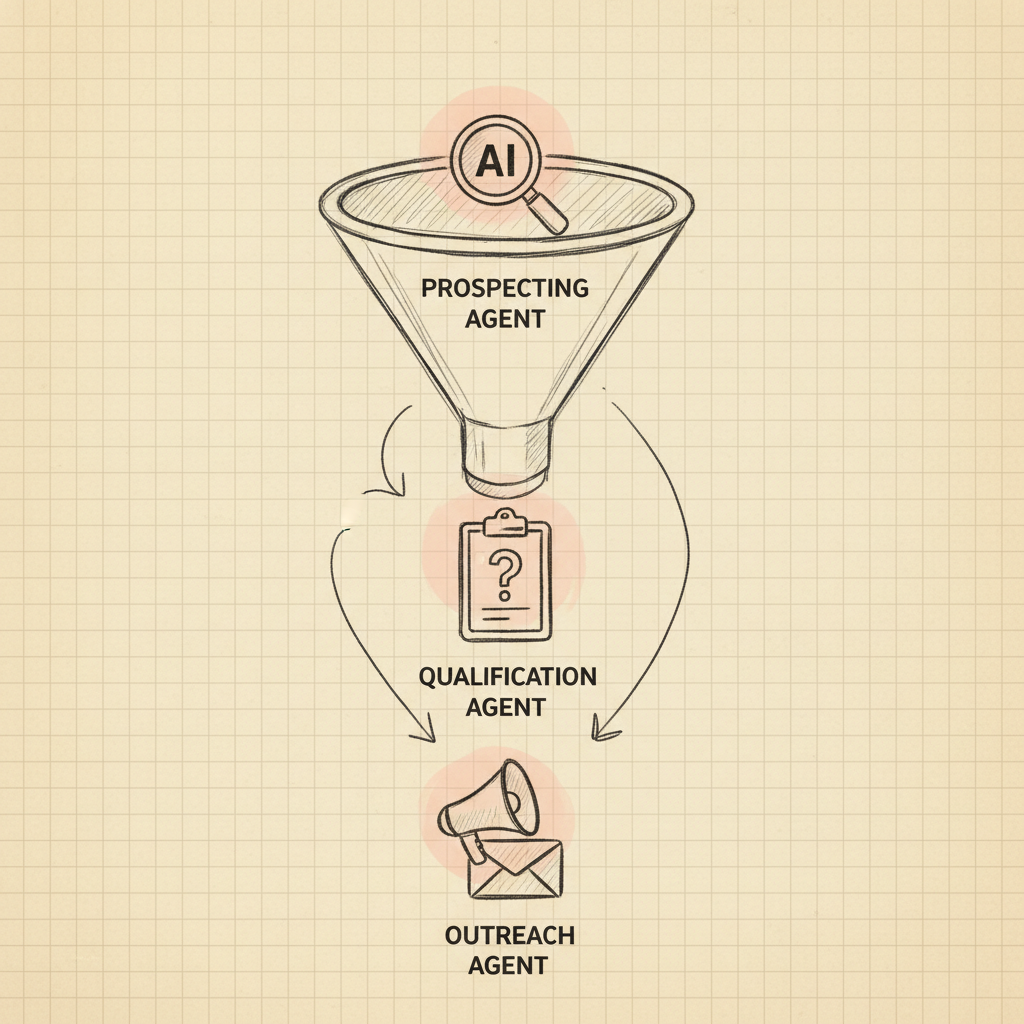
- The agentic sales stack is not one tool. It is five to seven purpose-built agents coordinated across your pipeline.
- Buyers in 2026 research in AI tools before they ever talk to a rep — FocusVision research found B2B buyers consume an average of 13 pieces of content before selecting a vendor. Your content must be cited by those AI systems or you are invisible before the first call.
- Teams that deploy AI agents across the full funnel report 3x more pipeline activity with the same headcount.
The State of AI in Sales Teams (2026)
AI in sales has crossed from automation into agency. The shift that matters most in 2026 is not that AI can draft an email — it is that AI agents can now own entire workflow segments autonomously, make decisions at each step, and hand off to humans only when context or relationship complexity demands it.
Until 2024, most "AI for sales" meant CRM autocomplete, email subject line suggestions, and call transcription. Useful, but supplementary. Starting in 2025, purpose-built AI SDRs entered the market — agents that could prospect from signals, score leads against ICP criteria, generate personalized sequences, and trigger follow-ups based on buyer behavior. The results were not incremental. Teams deploying these agents have reported substantial pipeline growth without adding headcount — Salesforce's 2024 State of Sales report found that 83% of sales teams using AI saw revenue growth, versus 66% of teams without it, and early adopters report 10–15% efficiency gains according to McKinsey.
The underlying enablers are now mature: large language models with long-context reasoning, real-time intent data from tools like Bombora and G2, LinkedIn automation layers, and CRM APIs that support bidirectional sync. These components connect into coherent agent workflows. A signal fires — a target company posts a job for a CMO, or a prospect visits your pricing page three times in a week — and an agent interprets that signal, builds a personalized outreach, and sends it within minutes. No human in the loop.
This is what agentic marketing looks like applied to revenue. The same principles that transformed content operations are now transforming sales pipelines. The organizations that treat AI as a tool are losing to organizations that treat AI as a team member.
10 Sales Tasks AI Agents Handle Better Than Humans
1. Prospecting AI agents scan company databases, LinkedIn, job boards, news feeds, and intent data platforms simultaneously, applying ICP filters in real time. A human researcher working a full day might surface 50 qualified prospects. An agent surfaces 500 in an hour, scored and enriched. McKinsey research estimates that companies using AI in sales see a nearly 50% increase in leads and appointments.
2. Lead Scoring Scoring models trained on your closed-won data evaluate every inbound lead against dozens of behavioral and firmographic signals. AI scores are updated continuously as new data arrives. Human scoring relies on gut feel and happens inconsistently.
3. Email Personalization AI agents pull LinkedIn activity, company news, job changes, and product usage signals to write opening lines that reference something real and specific. Personalization at scale — 1,000 emails that each feel individually researched — is only possible with AI.
4. Follow-up Sequences Timing, channel selection, and message variation in follow-up sequences are optimization problems. AI agents A/B test sequences continuously, learn which cadences perform best for which segments, and adjust automatically. A human rep runs whatever sequence they remember to run.
5. LinkedIn Outreach Connection request copy, InMail sequencing, and comment-based warming strategies are all AI-executable. Agents monitor prospect activity, identify optimal engagement moments, and execute outreach within compliance guardrails.
6. Call Prep Before every discovery call, an agent pulls the prospect's recent LinkedIn activity, their company's latest funding or hiring news, common objections from similar accounts, and a briefing sheet. This takes an agent 90 seconds and a human 20 minutes — if they do it at all.
7. Objection Research AI agents trained on call transcripts and win/loss data build objection libraries specific to your product and competitive landscape. Reps get pre-call briefings that include likely objections and tested responses.
8. CRM Updates After every call, meeting, or email exchange, an AI agent logs the interaction, updates deal stage, extracts action items, and schedules follow-up tasks. CRM hygiene, which most reps treat as optional, becomes automatic.
9. Pipeline Forecasting AI models trained on historical pipeline data provide accuracy that manual forecast calls cannot match. The median B2B SaaS sales cycle is 84 days and has lengthened 22% since 2022 — agents that flag decay signals early have a real impact on quarterly numbers. Agents flag deals showing decay signals — no activity for 14 days, decision-maker gone dark, timeline slip — before they fall out of the quarter.
10. Win/Loss Analysis AI agents process call transcripts, email threads, and deal timelines to identify the patterns in won versus lost deals. This analysis, which most sales teams never do systematically, becomes a continuous feedback loop that improves every future rep interaction.
AI SDR vs Human SDR: What Actually Replaces What
AI does not replace sales. It replaces the manual, repetitive work that prevented salespeople from doing actual sales.
| Task | AI Agent | Human SDR |
|---|---|---|
| Prospecting at scale | Handles | Time-limited |
| Personalized email sequencing | Handles | Slow |
| Real-time intent signal response | Handles | Missed |
| Complex objection handling | AI-assisted | Owns |
| Relationship building | AI-assisted | Owns |
| Strategic deal navigation | AI-assisted | Owns |
| CRM hygiene | Handles | Often skipped |
The practical split: AI owns everything at the top of funnel and everything administrative. Humans own everything that requires judgment, persuasion, and trust.
What this means for headcount is not that you fire your SDR team. It means one SDR managing AI agents can carry a pipeline that previously required four. The human becomes the operator and quality controller of an AI-powered prospecting engine, while spending their actual hours on calls and deals.
The worst mistake sales leaders make is deploying AI agents without redesigning the human role alongside it. AI without a clear human handoff creates pipeline that no one closes. Human reps without AI support get crushed by the volume gap competitors are running.
For B2B SaaS sales workflows in particular, the agent-human split is the defining architectural decision of the year.
How to Build an Agentic Sales Stack
Step 1: Audit your current funnel for automation candidates Map every step in your sales process from lead identification to closed-won. Mark each step as: fully automatable (no judgment required), AI-assisted (AI does the work, human reviews), or human-only (requires relationship or complex judgment). Most teams find 60 to 70 percent of current sales work falls in the first two categories — consistent with Salesforce research showing sales reps spend 70% of their time on non-selling tasks.
Step 2: Select purpose-built agents, not generic AI tools A general-purpose AI assistant is not an AI SDR. Look for agents built specifically for sales functions: dedicated prospecting agents (Clay, Apollo AI), outreach agents (Instantly, Smartlead with AI personalization), call intelligence agents (Gong, Grain), and CRM automation agents (HubSpot AI, Salesforce Einstein). Layer them — do not try to find one tool that does everything.
Step 3: Connect your intent data layer Agents are only as good as the signals they act on. Connect your stack to intent data sources — G2 buyer intent, Bombora, LinkedIn Sales Navigator signal feeds, and your own website behavioral data. Agents that fire on real buying signals outperform agents running on static lists by a wide margin.
Step 4: Build human handoff protocols Define the exact criteria that trigger a human takeover: prospect replies, demo requests, multi-stakeholder deals, deal values above a threshold. Build these handoffs into your CRM workflow so no qualified response falls through. The AI-to-human handoff is where most agentic sales stacks fail.
Step 5: Measure agent performance like you measure rep performance Track open rate, reply rate, meeting booked rate, and pipeline generated per agent, per sequence, per ICP segment. Treat your agents as team members with quotas and run weekly performance reviews. Agents that underperform get their prompts and sequences updated, not ignored.
AEO and Sales: Why AI-Cited Content Closes More Deals
AI citation is the new SEO. Buyers in 2026 are researching vendors in ChatGPT, Perplexity, and Google AI Overviews before they ever talk to a sales rep. G2's 2026 Answer Economy report found that 51% of B2B software buyers now begin their purchasing process in an AI chatbot rather than a traditional search engine. The question is not whether your prospects use AI to research purchases — they do. The question is whether your content appears in those AI-generated answers.
Answer Engine Optimization (AEO) is the practice of structuring content so AI systems cite it when buyers ask relevant questions. When a prospect asks ChatGPT "what is the best AI tool for B2B sales prospecting," you want your content in that answer. If it is not there, you are invisible before the first call even happens.
This connects directly to sales pipeline. Buyers who encounter your brand in an AI-generated answer arrive on sales calls pre-educated and pre-warmed. They already have a mental model of your positioning. Deals move faster. Objections are fewer. Close rates are higher.
The content strategies that drive AEO performance — direct answers, structured data, FAQ sections, specific expert claims — are also the content strategies that build brand authority at scale. An AI CMO running AEO-optimized content production creates a compounding sales advantage: every piece of cited content is a silent sales rep working the top of funnel around the clock.
For sales teams, the action item is clear: treat content as a sales asset. Know which AI tools your buyers use for research. Build content specifically structured to answer the questions those buyers are asking at each stage of the buying journey. Measure AI citation the same way you measure organic search ranking.
AI Topia's Sales Agent Architecture
At AI Topia, we built our sales stack around the same agentic architecture we deploy for clients on our AI-powered sales and marketing platform. The architecture has four layers.
Signal layer: Continuous monitoring of intent signals across LinkedIn, G2, Bombora, and website behavioral data. Agents score every signal against ICP criteria in real time.
Outreach layer: When a signal crosses threshold, a personalized outreach sequence fires automatically. The first touch references the specific signal. Follow-up touches vary by channel and timing based on previous sequence performance data.
Enrichment layer: Every prospect entering the pipeline is enriched with firmographic data, tech stack information, recent company news, and decision-maker mapping. This enrichment runs in the background and populates the CRM automatically.
Handoff layer: When a prospect replies or books a demo, a human notification fires with a full context brief — who they are, what signals triggered outreach, their tech stack, likely objections based on similar accounts, and a suggested discovery call agenda.
The result: our SDR capacity multiplied without adding headcount, and our reps spend their time exclusively on calls and relationship development — the work that actually requires a human.
For agencies and B2B teams wanting to replicate this architecture, the AI Topia community has implementation guides and templates for each layer.
Common Mistakes When Deploying AI for Sales
Mistake 1: Deploying AI on a bad ICP AI agents amplify your targeting, for better or worse. If your ICP definition is vague or wrong, AI will prospect at scale into the wrong accounts. Fix your ICP criteria before deploying agents, not after. The right ICP is a prerequisite, not a nice-to-have.
Mistake 2: Skipping the human handoff design Most agentic sales stacks fail at the moment of reply. The agent books a meeting, or a prospect responds, and no human is ready to take over. Define handoff triggers, assign handoff owners, and build SLAs for response time. A 48-hour delay on a warm reply destroys the momentum the agent created.
Mistake 3: Treating AI output as final AI-generated emails and sequences are starting points, not finished products. Review agent output regularly. The personalization that works in month one degrades as patterns become recognizable. Refresh prompts, test new angles, and treat your agent configuration as an ongoing product.
Mistake 4: Ignoring compliance and platform rules LinkedIn, email providers, and CRMs all have policies on automated outreach volume, connection request rates, and data handling. Agents that ignore these limits get accounts banned and domains blacklisted. Build compliance guardrails into your stack from day one. The short-term volume gains from ignoring limits are not worth the long-term cost of a burned domain or suspended account.
FAQ
What is the best AI tool for sales prospecting in 2026? The best tools depend on your stack, but the highest-performing sales teams in 2026 use Clay for data enrichment and prospect building, Apollo or LinkedIn Sales Navigator for database access, and Instantly or Smartlead for AI-personalized sequencing. These tools work together as a stack, not as standalone solutions.
Can AI replace an entire SDR team? No. AI can replace the prospecting, sequencing, and administrative work that SDRs do, which is roughly 60 to 70 percent of current SDR time — Salesforce's State of Sales puts non-selling tasks at 70% of a rep's week. What remains — complex objection handling, multi-stakeholder navigation, and relationship-based deal closing — still requires human judgment. The teams getting the best results are redesigning the SDR role around managing AI output rather than eliminating the role.
How do I measure AI agent ROI in sales? Track pipeline generated per agent, meeting booked rate per sequence, deal velocity for AI-sourced versus human-sourced leads, and cost per qualified opportunity. Compare these metrics against your previous baseline and against the fully-loaded cost of human SDR capacity. Most teams see ROI within 60 to 90 days of full deployment.
What is the difference between an AI SDR and a sales AI tool? A sales AI tool augments a human — it provides suggestions, drafts copy, or transcribes calls. An AI SDR is an autonomous agent that executes end-to-end workflows: prospecting, enrichment, outreach, and follow-up without requiring a human to initiate each step. The distinction matters because AI SDRs scale independently of headcount while AI tools only scale with the humans using them.
How do AI agents handle personalization at scale without feeling generic? The best agents use a tiered personalization approach: firmographic customization (industry, company size, growth stage) at the base layer, signal-based personalization (recent news, job changes, content engagement) in the opening, and product-specific relevance in the call to action. Personalization that references something specific and real — a recent funding announcement, a LinkedIn post they published — performs dramatically better than personalization that is just the prospect's name and title.
Does our content strategy need to change for AI-researched buyers? Yes. Buyers who research in AI tools are looking for direct answers, clear comparisons, and expert positioning — not long-form content designed for SEO keyword density. Structure your content with explicit answers in the first sentence of each section, use comparison tables and FAQ sections that AI can cite directly, and publish content that addresses the specific questions your buyers ask at each stage of the buying journey. An AI marketing platform that includes AEO tracking helps you monitor whether your content is actually being cited.
Want Weekly Founder Video Without Filming Weekly?
We run the Video Engine for you, or install it in your team. AI avatar, real footage, or both.