
Agentic Marketing Strategy for B2B SaaS: The 5-Step Playbook (2026)
Agentic marketing replaces manual marketing execution with AI employees that operate autonomously across research, content, outreach, and optimization. For B2B SaaS teams in 2026, this is not a future trend. It is the operating model separating companies that compound their pipeline from those that plateau.
Most B2B SaaS marketing teams are still running the same playbook from 2022: hire content writers, run LinkedIn campaigns manually, watch analytics dashboards, and hope the funnel converts. That playbook is now a competitive liability. The teams winning in 2026 have deployed AI employee systems that execute 24/7, act on real-time signals, and get smarter with every cycle.
This playbook gives you the five concrete steps to build that system.
TL;DR Key Takeaways
- B2B SaaS teams that audit their marketing stack find 60-70% of tasks are repeatable and ready for AI employees today
- G2 research shows 51% of B2B software buyers now start their research with AI chatbots — if your brand is not in those answers, you are invisible
- Agentic marketing is not marketing automation. AI employees make decisions. Automation follows rules.
- The five steps are Audit, Signal, Content at Scale, AEO Loop, and Measure and Compound
- B2B SaaS teams using AI employee systems report 40-60% reductions in content production time and significant improvements in qualified pipeline from organic
Why B2B SaaS Needs a Different Marketing Strategy in 2026
The search landscape has broken. Gartner predicts a 25% drop in traditional search engine volume by 2026 due to AI chatbots and virtual agents handling queries that previously drove clicks. At the same time, B2B buyers consume an average of 13 pieces of content before selecting a vendor. That content increasingly surfaces through AI answer engines, not search results pages.
The math has changed. You need more content, more topical coverage, and presence in AI-generated answers. No human content team can produce at that volume while maintaining quality.
Manual marketing is a tax on revenue. In 2026, every hour a human marketer spends on drafting, formatting, scheduling, or reporting is an hour a competitor's AI employee does it faster, at scale, with better data.
B2B SaaS companies have always been resource-constrained. Most teams are three to five people handling product, sales, and marketing simultaneously. That constraint used to be a disadvantage. With agentic marketing for B2B SaaS, it becomes leverage. Small teams can now operate with the output of a 20-person marketing department by deploying AI employees correctly.
What Is an Agentic Marketing Strategy for B2B SaaS?
An agentic marketing strategy is a system where AI employees handle the execution layer of marketing, not just individual tasks. This is the core distinction from vs traditional marketing automation: automation runs fixed rules on triggers, while AI employees apply judgment, adapt to new information, and initiate actions without human instruction.
For a practical definition of what agentic marketing is, think of it this way: you set the strategy, brand voice, and goals. Your AI employee team handles research, content creation, optimization, outreach, and reporting. They coordinate with each other, flag exceptions for human review, and improve with every campaign cycle.
Across our client base, we have documented 45 distinct AI employee roles that fit inside a B2B SaaS marketing function. These range from keyword research analysts and content strategists to AEO gap detectors and pipeline attribution reporters.
The key principle: AI employees are not tools. They are autonomous team members with defined responsibilities, access to relevant data, and the ability to complete multi-step tasks end to end.
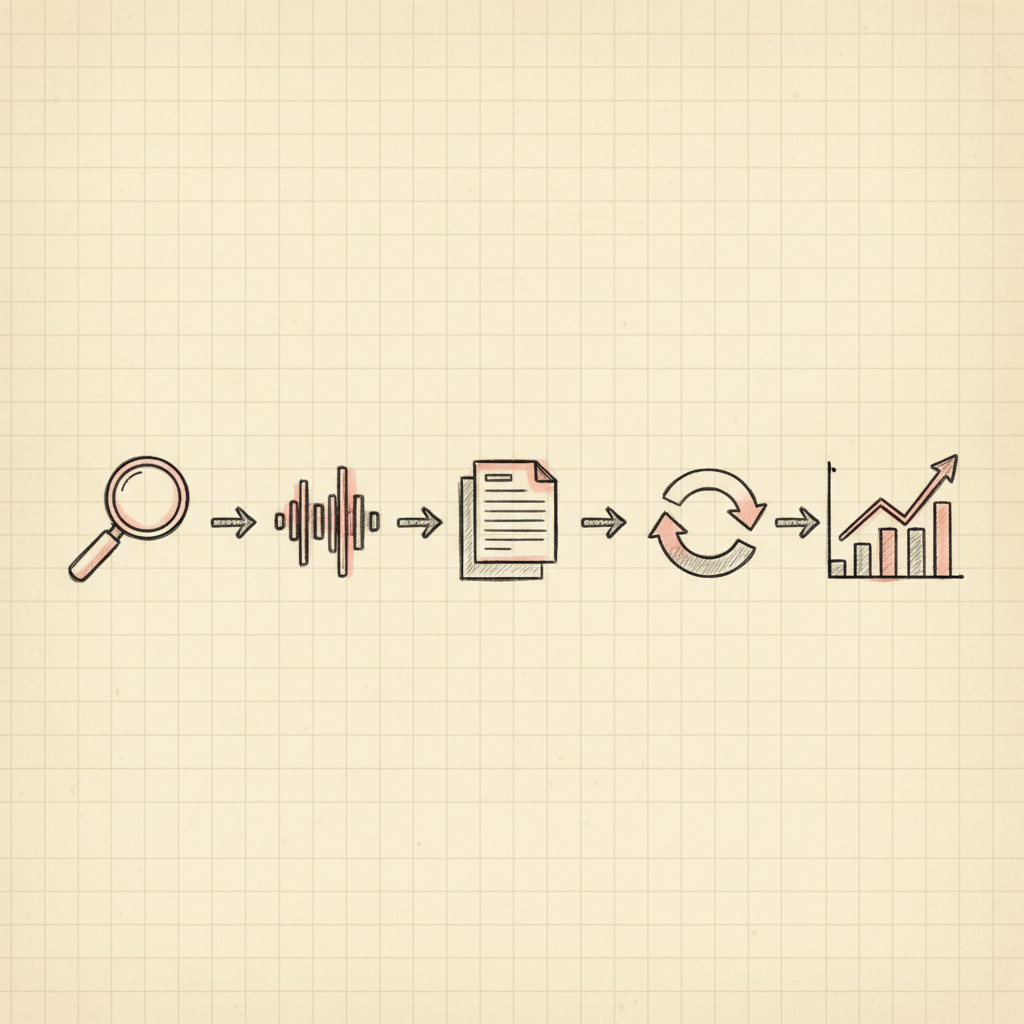
The 5-Step Agentic Marketing Playbook
Here is the complete framework. Each step builds on the previous one. Running them out of order produces fragmented results.
| Phase | Step | Owner | Output |
|---|---|---|---|
| Foundation | Step 1: Audit | Human + AI | Task map with readiness scores |
| Intelligence | Step 2: Signal | AI employees | Real-time intent feed |
| Execution | Step 3: Content at Scale | AI employees | Published content pipeline |
| Optimization | Step 4: AEO Loop | AI employees | Citation gap report + content queue |
| Compounding | Step 5: Measure and Close the Loop | Human + AI | Attribution dashboard, strategy updates |
Step 1: Audit Your Marketing Stack for AI Employee Readiness
The first step is clarity. Before deploying any AI employee, you need a complete map of every marketing task your team executes and an honest categorization of each one.
Two categories decide everything:
- High-judgment tasks require creative direction, client relationships, strategic pivots, or ethical decisions. These stay with humans.
- High-volume repeatable tasks follow predictable patterns, use existing data, and produce measurable outputs. These go to AI employees.
Across B2B SaaS companies we work with, the audit consistently reveals the same finding: 60-70% of active marketing tasks are high-volume and repeatable. This includes keyword research, content drafts, social post adaptation, internal linking, meta description writing, analytics reporting, lead scoring, and follow-up sequencing.
Run the audit by listing every recurring marketing activity for the past 90 days. Assign each a judgment score from one to five. Any task scoring three or below is an AI employee candidate.
The audit also reveals your biggest bottlenecks. Most B2B SaaS teams discover their highest-volume constraint is content production. That sets up Step 3 as the highest-leverage deployment.
Step 2: Build the Signal Layer
What Does the Signal Layer Actually Do?
The signal layer is the nervous system of your agentic marketing strategy. It connects real-world buyer behavior to AI employee actions. Without it, AI employees operate on schedules. With it, they operate on intent.
AI employees act on signals, not calendars. The distinction matters enormously for B2B SaaS. Your buyers are active on LinkedIn, reading competitor content, engaging with specific topics, and visiting pricing pages at unpredictable times. A schedule-based marketing system misses most of these windows. A signal-based system catches them.
Build the signal layer by connecting three data sources:
Website behavior signals. Page visits, scroll depth, return visits, and form interactions. A prospect who reads your integration documentation three times in a week is a different buyer than someone who bounced from your home page.
LinkedIn engagement signals. Comments, shares, and profile views from target account employees. These surface account-level intent before any direct outreach.
Content engagement signals. Newsletter opens, video completion rates, resource downloads, and topic-level engagement clusters. These tell you which pain points are active for which audience segments.
When these signals feed your AI employee layer, content creation, outreach timing, and follow-up sequencing all shift from reactive to proactive. McKinsey research on generative AI in B2B sales found a 50% increase in leads when AI-powered signal processing replaced manual prospecting workflows.
Step 3: Deploy Content AI Employees at Scale
How Do AI Employees Handle B2B SaaS Content Production?
This is where agentic marketing for B2B SaaS delivers the most immediate results. Content is the highest-volume, most repeatable, and most scalable marketing function in any B2B SaaS business.
A fully deployed content AI employee team handles the complete production pipeline: research, brief creation, first draft, SEO optimization, AEO formatting, internal linking, image sourcing, and publishing. Human marketers review, calibrate brand voice, and approve. Execution is entirely AI employee driven.
The output difference is not marginal. B2B SaaS teams running manual content operations produce four to eight pieces of content per month. Teams running AI employee content systems produce 40 to 80 pieces per month at equivalent or higher quality, calibrated to brand voice from day one.
Three AI employee roles power the content layer:
- Research analyst pulls keyword data, competitor coverage gaps, and trending topics in your category every week without prompting.
- Content strategist maps topics to funnel stages, assigns brief priorities, and maintains topical authority clusters.
- Content writer produces first drafts at brand voice using the brief, research inputs, and your internal knowledge base. Drafts go directly to review queues, not to empty documents.
At AI Topia, we connect AI employee teams to existing Claude Max or Claude Pro subscriptions, so the underlying intelligence powering your content team is the same Claude you may already use in your daily workflow.
One metric to track from day one: AI citation rate per topic cluster. This is the percentage of relevant ChatGPT, Perplexity, and Gemini answers that reference your content or brand when a buyer asks a question in your category. Most B2B SaaS teams start at zero. The goal in the first 90 days is measurable citation presence.
Step 4: Run the AEO Citation Loop
Answer Engine Optimization (AEO) is the most important new marketing capability in 2026. Every B2B SaaS company that fails to optimize for AI citation coverage is losing buyers at the very top of the funnel without knowing it.
The AEO loop works as a continuous four-step cycle:
Monitor. AI employees track what AI answer engines say about your category, your competitors, and the problems your product solves. This runs daily, not quarterly.
Identify gaps. When AI answers omit your brand or cite a competitor for a topic you should own, that is a gap. Across our client base, the average B2B SaaS company has 30-50 active citation gaps in their core category at any given time.
Generate targeted content. AI employees write content specifically designed to establish topical authority and citation-worthiness for each gap. This is not generic SEO content. It is structured for AI extraction: clear definitions, definitive statements, structured data, and quotable statistics.
Measure citation improvement. Track AI citation rate week over week per topic cluster. Gaps that close compound. Topics where you achieve citation presence become durable pipeline drivers as buyers discover your brand through AI-generated answers.
The AEO loop is the compounding flywheel of an agentic marketing strategy. Each content piece that wins AI citation coverage generates awareness with buyers you never reached through traditional SEO.
51% of B2B software buyers now start their product research with an AI chatbot. That number will only grow through 2026. The teams that build citation authority now will own those conversations in 2027 and beyond.
Step 5: Measure, Close the Loop, Compound
How Do You Know If Agentic Marketing Is Working?
Measurement in an agentic marketing strategy covers three layers that most B2B SaaS analytics setups ignore completely.
Layer 1: AI citation rate. Per topic cluster, track what percentage of relevant AI-generated answers include your brand or content. Use this to prioritize the AEO content queue. Topics with improving citation rates continue receiving content investment. Topics that stall get strategy adjustments.
Layer 2: Organic rank movement. Traditional SEO metrics still matter. Track keyword rankings for your target cluster, organic traffic by topic, and conversion rates from organic by landing page. These validate that content quality is high enough to rank in both traditional and AI search.
Layer 3: Pipeline influenced by content. Connect your content analytics to your CRM. Every qualified opportunity should be tagged with the content touchpoints that appeared in the buyer journey. This shows which topic clusters and which AI employee outputs are directly generating revenue.
Feed learnings back to the signal layer. This is the step most teams skip. When you discover that prospects who read three or more pieces of content in the "integration complexity" cluster convert at 2x the rate, that signal should trigger a content production increase in that cluster and a targeted outreach sequence for buyers showing that engagement pattern.
The loop closes: measurement informs signal calibration, signal calibration directs AI employee content production, content production drives citation and pipeline. Each cycle produces better data than the last.
An AI marketing platform built for this compounding model handles the feedback loop automatically. AI employees update their own priorities based on performance data without human intervention beyond strategy-level review.
What Results Can B2B SaaS Teams Expect from Agentic Marketing?
Definitive expectations, not marketing promises:
Content output increases 8-10x in the first 90 days when a content AI employee team replaces manual production. Quality improves as brand voice calibration improves over time.
AEO citation presence goes from zero to measurable within 60 days for most B2B SaaS categories. Niche categories with lower AI content competition see results faster.
Pipeline attribution from organic content increases as topic authority compounds. B2B SaaS companies in competitive categories typically see meaningful organic pipeline contribution within 6 months of running the full 5-step system.
Team capacity shifts. When AI employees handle 60-70% of marketing execution, human marketers shift to strategy, relationships, and creative direction. This is a structural efficiency gain, not a headcount reduction.
The goal is not to eliminate marketing effort. The goal is to redirect human effort to the 30-40% of marketing work that requires judgment, creativity, and relationships, while AI employees handle everything else at a scale no human team can match.
FAQ
Is agentic marketing strategy the same as marketing automation?
No. Marketing automation executes predefined rules on triggers. An agentic marketing strategy uses AI employees that apply judgment, adapt to new information, and initiate multi-step tasks autonomously. Automation follows instructions. AI employees make decisions within defined boundaries.
What size B2B SaaS team benefits most from agentic marketing?
Teams of two to fifteen benefit most because the leverage ratio is highest. A three-person team running AI employees can produce the marketing output of a fifteen-person department. Enterprise teams benefit too, but the constraint being solved is different: for enterprise, it is consistency and speed across complex content programs.
How long does it take to see results from the 5-step playbook?
Step 1 (Audit) completes in one week. Steps 2 and 3 (Signal and Content) are running within 30 days. AEO citation presence typically appears within 60 days. Pipeline attribution from organic content is measurable at 90 to 180 days depending on category competitiveness.
Do I need to replace my existing marketing team to run agentic marketing?
No. AI employees handle execution, not strategy. Your existing team owns brand direction, client relationships, editorial judgment, and measurement interpretation. The shift is from doing to directing. Most teams find the transition increases job satisfaction because repetitive tasks move to AI employees.
Can I use my existing Claude subscription to power AI employees?
Yes. AI Topia connects your existing Claude Max or Claude Pro subscription to your AI employee team. The same Claude powering your daily work powers your marketing execution at scale, with no additional model costs required.
What is the biggest mistake B2B SaaS teams make when starting agentic marketing?
Starting with tools instead of strategy. Teams that buy AI marketing software before completing the audit (Step 1) end up automating the wrong things. The audit identifies where AI employees create the highest leverage. Deploy there first. Expand from a position of proven ROI.
Want Weekly Founder Video Without Filming Weekly?
We run the Video Engine for you, or install it in your team. AI avatar, real footage, or both.