
How to Implement an AI CMO for Your Marketing Agency (Step-by-Step Guide)
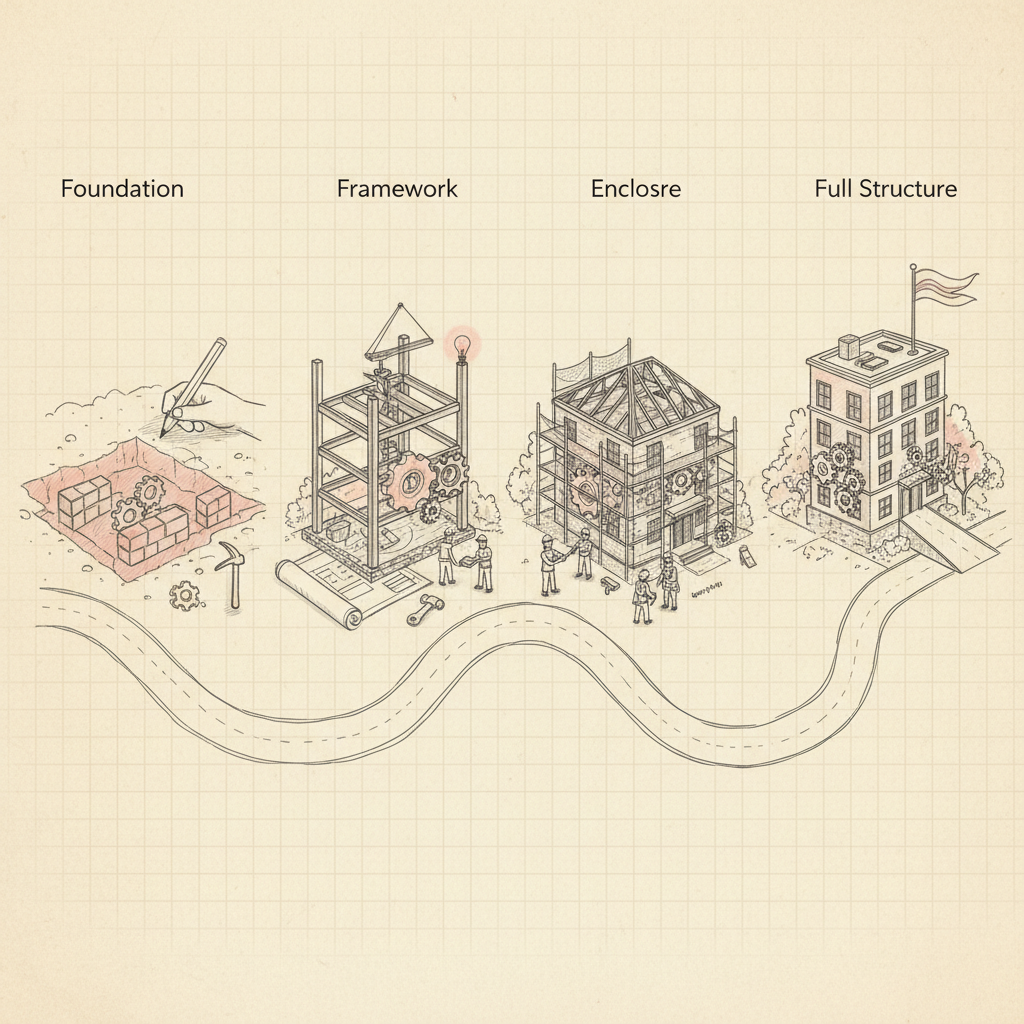
Implementing an AI CMO for your marketing agency takes 60 to 90 days across four phases: audit, stack, pilot, and scale. The agencies doing this in 2026 are not replacing their teams. They are restructuring them. Human operators move from execution to direction. An AI employee team handles the volume. This guide covers exactly how to make that transition without disrupting client accounts.
TL;DR Key Takeaways
- AI CMO implementation runs in four phases: Audit (weeks 1-2), Stack (weeks 3-4), Pilot (month 2), Scale (month 3+)
- Start by mapping deliverables into two buckets: high-judgment work versus high-volume repeatable work
- Run AI employees alongside your human team for 30 days before restructuring any roles
- One account manager can oversee 3 to 5x more client accounts after a full AI CMO rollout
- Claude Max or Pro subscribers can connect Claude directly as the foundation model for their AI employee team
- The biggest implementation mistake in 2026 is trying to automate everything at once — pick 2 to 3 workflows first
What Does Implementing an AI CMO Actually Mean for an Agency?
Implementing an AI CMO means replacing the role of marketing director with a coordinated team of AI employees that handle research, content production, distribution, and reporting autonomously. It does not mean buying a single software tool or adding an AI writing assistant to your stack. To understand what an AI CMO is at a structural level, the distinction matters: you are building a system, not subscribing to a feature.
For agencies, the implementation question is not "should we use AI?" It is "how do we reorganize our delivery model around AI employees so we can serve more clients at higher quality without proportionally growing headcount?"
Traditional marketing agencies spend 60 to 70% of billable time on repeatable execution tasks, according to Salesforce research on non-core work patterns. An AI CMO targets exactly that 60 to 70% so your human team can focus on strategy and relationships.
The difference from marketing automation is structural. Marketing automation follows predetermined rules. An AI CMO team makes judgment calls within defined parameters — choosing angles, adapting brand voice per client, flagging anomalies, and escalating when human input is required. That distinction changes how you implement it.
Is Your Agency Ready for an AI CMO?
Your agency is ready for an AI CMO in 2026 if you can answer yes to at least four of the following six criteria.
Readiness Checklist
| Criteria | Ready Signal | Not Ready Signal |
|---|---|---|
| Documented workflows | You have SOPs for at least 3 repeatable deliverables | Every client is handled ad hoc |
| Content volume | You produce 10+ pieces per month across clients | Output is sporadic, under 5 pieces/month |
| Brand voice assets | You have brand guides or tone docs per client | Clients have not articulated their voice |
| Human QA capacity | Someone on your team can review AI outputs daily | No one has bandwidth for a review step |
| Tech tolerance | Team has used AI tools (ChatGPT, Claude, Jasper) | Zero AI familiarity across the team |
| Stable client base | At least 2 active retainer clients | All project-based, no predictable volume |
If you scored 4 or above, you are ready to start Phase 1 today. If you scored 3 or below, spend two weeks standardizing your most repeated deliverable before beginning the implementation.
The 4-Phase AI CMO Implementation Framework
The framework below applies to agencies managing 2 to 20 client accounts. Larger agencies may run phases in parallel per client segment.
| Phase | Timeline | What You Build | Success Metric |
|---|---|---|---|
| Phase 1: Audit | Weeks 1-2 | Workflow map + AI readiness score per account | Every deliverable categorized by labor type |
| Phase 2: Stack | Weeks 3-4 | AI employee team for 2-3 pilot workflows | Pilot workflows producing first outputs |
| Phase 3: Pilot | Month 2 | AI employees running alongside human team | Output quality matches or exceeds baseline |
| Phase 4: Scale | Month 3+ | AI employees expanded across all accounts | Account manager capacity 3-5x pre-AI |
Agencies that follow this sequence see meaningful results by day 90. Those that skip the audit phase and jump straight to tooling typically spend months fixing misaligned outputs and rebuilding client trust.
Phase 1: Audit — Map Your Marketing Workflows
The first thing you do in Phase 1 is separate every client deliverable into two categories: high-judgment work and high-volume repeatable work.
High-judgment work includes strategy development, client relationships, creative direction, and QA sign-off. This work stays with your human team. High-volume repeatable work includes content production, social scheduling, SEO reporting, keyword research, and performance summaries. This is where your AI employee team will operate.
Run this audit for each active client account in 2026:
- List every deliverable you produced for the client in the last 90 days
- Classify each deliverable: high-judgment or high-volume repeatable
- Estimate the labor hours per deliverable type per month
- Score the account on AI readiness (1 to 5 scale): does the client have a documented brand voice? Is the output format consistent? Is the feedback loop short?)
- Identify the 3 highest-ROI automation targets across your book of business
The 3 highest-ROI automation targets for most agencies are content production, social scheduling, and SEO reporting. These three categories account for the majority of repeatable execution hours in a typical retainer account.
The output of Phase 1 is a documented workflow map for each client account plus an AI readiness score. A client with no brand guide and inconsistent deliverable formats scores a 2. A client with documented tone, a predictable content calendar, and a clear approval process scores a 4 or 5.
Start Phase 2 only with your highest-scoring accounts. Save the lower-scoring accounts for after you have built confidence in the system during the pilot.
Phase 2: Build Your AI Employee Stack
Phase 2 is about assembling the AI employee team that will handle your highest-ROI automation targets — not about automating your entire operation.
Pick 2 to 3 workflows from the audit. Build AI employees for those workflows. Leave everything else running manually while the pilot runs. The agencies that try to automate all 12 deliverable types in week 3 of 2026 rollouts typically stall by week 5.
Your AI employee stack in 2026 covers four functions:
Content production. A research-to-publish pipeline that moves from topic identification to first draft to SEO optimization to publishing queue. The AI employee team handles each handoff. A human reviews the draft and approves publication.
SEO and AEO monitoring. Continuous scanning of topic coverage gaps, keyword movements, and answer engine appearances. The AI employee surfaces these signals daily. A human decides which gaps to prioritize.
Social distribution. Platform-specific adaptation of approved content, formatted for LinkedIn, X, or Instagram with scheduling. The AI employee team knows each client's voice and adapts accordingly. No manual reformatting per platform.
Reporting. Weekly and monthly performance summaries generated from analytics integrations. The AI employee compiles the data, drafts the narrative, and flags anomalies. A human adds context before the client receives it.
If your team has existing Claude Max or Pro subscriptions, connect Claude as the foundation model for your AI employee team. Claude operates as the reasoning layer across research, writing, and synthesis tasks. Teams that already have Claude access at the individual level can extend it to power the entire AI employee workflow without additional model licensing.
Choosing the right platform for your stack matters more in 2026 than it did in 2024 because the gap between purpose-built agency platforms and general-purpose AI tools has widened significantly. Platforms built for AI CMO for marketing agencies include multi-client separation, white-label output, and role-based access out of the box.
By the end of Phase 2, your AI employees should be producing first outputs for the 2 to 3 pilot workflows. These outputs will not be ready for clients yet. That is what Phase 3 is for.
Phase 3: Run the 30-Day Pilot
Phase 3 is a 30-day parallel run where AI employees operate alongside your existing human workflows for the same deliverables.
Do not replace anything yet. Run both tracks simultaneously. Your human team produces the deliverable the way they always have. The AI employee team produces the same deliverable independently. Compare the outputs.
Track these four metrics during the pilot month:
- Content volume. How many pieces did each track produce? AI employees should produce at least 2x the volume in the same timeframe.
- Time-to-publish. From brief to live — how many days did each track require? Target a 50% reduction from AI employees.
- Revision rate. What percentage of AI employee outputs required substantial human edits? Start expecting 30 to 40% in week 1. By week 4, target below 15%.
- Client NPS proxy. For any client-facing outputs delivered during the pilot, track feedback. Quality should be indistinguishable from human-produced work by week 4.
The pilot is also where you define your human handoff triggers. These are the conditions under which the AI employee team escalates to a human. Examples: the client makes a major strategic pivot, the content touches a sensitive regulatory topic, the output falls below a quality threshold, or a new content format is introduced that the AI employees have not been calibrated for.
By the end of month 2, you should have a clear answer to three questions:
- Which workflows are ready to run on AI employees with light human review?
- Which workflows need more calibration time before they are client-ready?
- Which workflows should stay fully human-led for this client indefinitely?
McKinsey research on AI efficiency gains shows 10 to 15% improvement from AI on targeted marketing functions — but agencies running a structured pilot with clear handoff protocols see significantly higher gains because they are not deploying AI broadly. They are deploying it precisely.
Phase 4: Scale Across Client Accounts
Phase 4 begins in month 3 when you expand the validated AI employee workflows to all client accounts in your book of business.
This is where the compounding effect becomes visible. The AI employees you calibrated on your pilot accounts do not require full reconfiguration for each new client. They adapt to client-specific brand voice, topic areas, and formatting preferences through a calibration process that takes hours, not weeks.
The key structural advantage of scaling AI employees versus scaling human headcount:
- Adding a new client account to an AI employee team adds hours of configuration, not weeks of hiring and onboarding
- AI employees calibrate to each client's brand voice independently — no manual style guide enforcement per account
- Capacity scales horizontally: the same AI employee team can support 2 accounts or 20 accounts with incremental configuration, not proportional headcount growth
In 2026, agencies that complete the four-phase implementation report one account manager can oversee 3 to 5x more client accounts than before the rollout. That ratio is not about cutting staff. It is about reassigning human attention from execution to direction.
During Phase 4, restructure human roles explicitly. Your account managers are no longer producing content. They are reviewing it, setting strategic direction, and managing client relationships. Your content specialists are no longer writing first drafts. They are calibrating AI employee outputs and editing for nuance. Your SEO team is no longer pulling reports manually. They are interpreting AI-generated signals and making prioritization calls.
The human role shifts from executor to director. This is the model that sustainable agency growth in 2026 is built on.
How Do You Restructure Your Team Around an AI CMO?
Restructuring your team around an AI CMO means redefining every role as a review, direction-setting, or relationship function rather than an execution function.
This is the most sensitive part of the implementation and the most frequently avoided. Agencies that do the technical implementation without the organizational restructuring end up with two parallel systems: an AI employee team that produces outputs nobody reviews and a human team that continues doing the same work manually. Both tracks run, neither improves, and costs increase.
The restructuring works best when you:
- Announce the AI employee rollout as a capacity expansion, not a headcount reduction
- Rewrite job descriptions to reflect the new function — "AI Output Director" not "Content Writer"
- Create explicit KPIs for the review function: revision rate, approval cycle time, client satisfaction score
- Build in a 30-day adjustment period where team members are not penalized for slow adoption
Building and maintaining an AI employee stack is high-supervision work in the early months. Every new client scenario requires calibration. Every edge case surfaces a gap. Agentic marketing shifts the human role from builder to reviewer. You set objectives and review outputs. You do not design every execution path.
Team members who adapt fastest are those who already think in systems. They ask "how should the AI employee handle this?" before asking "how do I handle this?" That mindset shift is what separates agencies that scale in 2026 from those that plateau.
What Results Should Agencies Expect?
Agencies that complete all four implementation phases by month 3 of 2026 consistently report three measurable outcomes.
Output volume increase. Most agencies see a 3 to 4x increase in content production volume without adding headcount. This is the most immediate and measurable result, typically visible by the end of the pilot in month 2.
Delivery speed improvement. Time-to-publish for standard deliverables drops by 40 to 60% when AI employees handle research and first drafts. Client accounts that previously operated on a 10-day content cycle move to a 3 to 4-day cycle.
Margin expansion. When AI employees handle the high-volume repeatable work, agency margins on retainer accounts improve. The billable scope stays the same. The labor cost drops because human hours shift to higher-leverage activities.
45 distinct AI employee roles are active across a fully implemented AI CMO system — from keyword researcher to social scheduler to performance analyst. No agency starts with all 45. The four-phase framework ensures you activate them in the sequence that generates the fastest ROI for your specific client mix.
The agencies that see the strongest results by Q3 2026 are those that started Phase 1 before June. The implementation timeline is fixed. The compounding begins at the end of month 3. Starting in July means results arrive in October. Starting now means results arrive before summer.
FAQ
How long does it actually take to implement an AI CMO for a marketing agency?
The full implementation takes 60 to 90 days across four phases. Phase 1 audit takes 2 weeks. Phase 2 stack build takes 2 weeks. Phase 3 pilot runs for 30 days. Phase 4 scale begins in month 3. Agencies with documented workflows and existing AI familiarity on their team can compress the audit and stack phases to 2 to 3 weeks combined.
Do you need to hire a technical person to implement an AI CMO in 2026?
No. The platforms designed for agency AI CMO implementation in 2026 are configured through interfaces, not code. A technically comfortable account manager can handle the setup. The audit and workflow mapping in Phase 1 requires strategic thinking, not engineering skill. If your team can operate a project management tool and a CRM, they can configure an AI employee team.
What happens to content quality when AI employees write first drafts?
Quality in the first week of the pilot will be below your human baseline. By week 4 of the pilot, with calibration and feedback loops in place, AI employee first drafts should require fewer than 15% of edits to reach publishable quality. The calibration step in Phase 2 — where you feed the AI employee team your existing brand guides, tone samples, and approved content — is what closes that gap.
Can AI employees handle client communication directly?
No. Client communication stays with human account managers through all four phases. AI employees handle production workflows: research, writing, optimization, scheduling, and reporting. Human operators handle client calls, strategic conversations, feedback sessions, and relationship management. This boundary is a feature, not a limitation. It is what keeps the human role irreplaceable.
How do you measure ROI from an AI CMO implementation?
Track four metrics: content volume (pieces per month per account), time-to-publish (days from brief to live), revision rate (percentage of AI outputs requiring significant human edits), and account manager capacity (number of active client accounts per human FTE). A successful implementation shows volume up 3 to 4x, time-to-publish down 40 to 60%, revision rate below 15% by month 2, and account manager capacity expanded 3 to 5x by month 4.
Should agencies tell clients they are using AI employees?
Yes. Transparency builds trust and sets accurate expectations. Frame AI employees as infrastructure — the same way agencies disclose they use project management software or analytics platforms. Clients care about output quality and delivery consistency. When AI employees improve both, the disclosure becomes a competitive advantage, not a liability.
Want Weekly Founder Video Without Filming Weekly?
We run the Video Engine for you, or install it in your team. AI avatar, real footage, or both.