
The AI UGC Playbook: Creator-Style Product Videos Without Hiring Creators
An AI presenter holds your product, talks to the camera like a creator filming on their phone, and tells people why it's worth trying. Fifteen seconds. No creators to find, ship product to or wait on.
This page breaks down a 15-second skincare video we made with an AI creator and shows how to make the same format for your product.
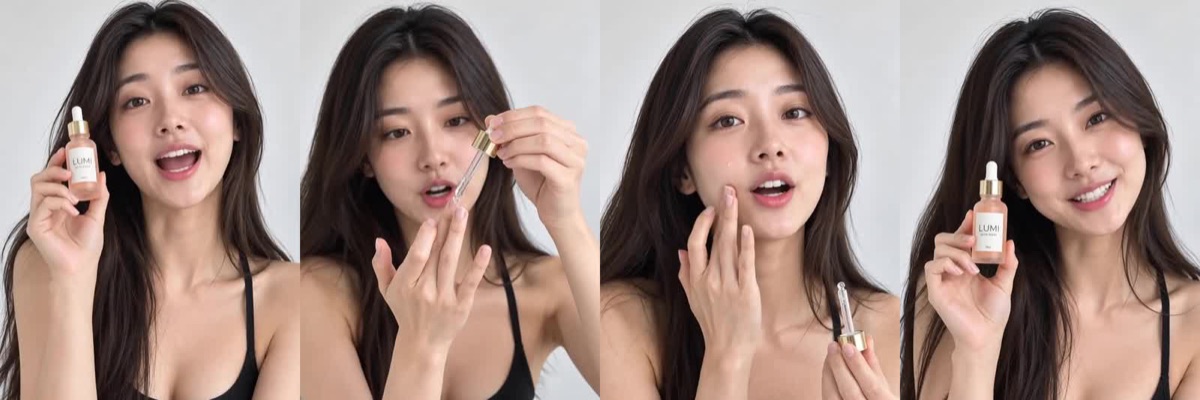
Hook, how to use it, the feel, the ask. Lumi is a made-up serum brand we created to show the format, not a client.
What AI UGC is good for
UGC (user-generated content) is the style of video where a normal-looking person talks about a product on their phone. It works because it doesn't look like an ad.
AI UGC keeps the style and swaps the creator for an AI presenter. That makes it good at three things:
- Testing angles fast. Ten hooks for one product in a day, instead of ten creator briefs.
- Product demos. Show how to use it, how it feels, what's in the box.
- Volume for ads and organic. The same presenter, every week, for every product.
What it's not good at: proving the product works. A real customer's result is still the strongest proof you have. Use AI UGC to get attention and explain. Use real customers to convince. More on that in AI UGC vs Real UGC.
Mascot, character or UGC?
- A mascot is your brand as a hero beating objections. See The AI Mascot Playbook.
- A character is a made-up person living your customer's problem. See The AI Character Brief.
- AI UGC is a presenter showing and explaining the product, the way a creator would.
How the 15-second video works
Our Lumi demo, made with AI. 15 seconds, four beats. Lumi is a made-up brand, not a client.
| Time | Beat | What Lumi says |
|---|---|---|
| 0-4s | Hook: why I'm talking to you | "Okay, I need to talk about this serum..." |
| 4-7s | The problem the buyer already has | "I've tried everything for dullness and nothing actually stuck." |
| 7-8s | How to use it, in one line | "Two drops every morning." |
| 8-12s | How it feels: texture, smell, speed | "It sinks in, it's not sticky, and it smells so good." |
| 12-15s | Name, repeat the routine, the ask | "It's Lumi. Two drops every morning. Links below." |
The product is in her hand almost the whole time, and she uses it on camera. The label faces the lens on the hook and on the ask, so the name sticks.
Step 1: Cast the presenter
Pick someone your buyer would take advice from. Usually that's someone who looks like them, a little further along.
- One look, kept forever: hair, outfit, setting. The same presenter across videos builds recognition.
- A real-feeling setting: a plain wall, a bathroom, a kitchen. Phone-camera framing, not a studio.
- Never a real person's likeness. Not a celebrity, not a creator you saw, not a customer.
Build one reference sheet and reuse it for every video. The method is in The AI Character Reference System.
Step 2: Get the product right
The presenter can be made up. The product can't.
- Use real photos of your product as the reference: front label, side, and in a hand.
- Check the label in every clip. AI loves to misspell logos and change the bottle shape.
- Keep the product big in frame on the hook and on the ask.
Step 3: Write the script
Use the five beats above. Paste this into Claude:
Write a 15-second UGC-style script for [product] for [buyer]. Beats: a casual hook that sounds like a creator talking to a friend (under 12 words), the problem the buyer already has, how to use the product in one line, how it feels or what happens when you use it, then the product name and one action. Only use these product facts: [list facts you can prove]. No medical or results claims. Give me 5 versions with different hooks.
Read every version out loud. Keep the ones that sound like a person, not a brochure.
Step 4: Make it
- Presenter still: an image model makes the presenter holding your product, from the reference sheet and your product photos.
- Talking video: a talking-video model animates the still with the script, lip-synced, with natural hand movement.
- Voice: one voice for this presenter, the same in every video.
- Edit: captions, a quick cut on the product close-up, and the link.
Check hands, the label and the lip-sync on every clip. Those are the three things that give AI away.
Step 5: Test hooks, keep the winner
Same presenter, same product, five hooks. Post them, see which one holds attention, and make the next ten from the winner. That's how one product becomes a month of videos. The full method is in The Videomaxxing Playbook.
Rules that keep it safe
- No fake testimonials. An AI presenter isn't a customer, so it shouldn't claim personal results ("my skin has never looked like this") as if it were real. In the US, the FTC's rule on fake reviews and testimonials covers AI-generated ones. Stick to what the product is, how to use it and how it feels, and keep real results for real customers.
- Say it's AI. Use the platform's AI-content label, and disclose in the caption.
- Only claims you can prove. Skincare, supplements, health and finance have strict advertising rules. "Brightening" and "cures acne" are not the same claim.
- Follow the ad platform's policies. Meta and TikTok both have rules for AI-generated people in ads.
- No real likenesses. Not a creator, a celebrity or a customer.
Our Lumi demo uses a first-person line to show the creator style. For a real brand, swap it for a product fact.
What AI UGC can't do
It can't replace a real customer saying "this worked for me." Use AI UGC for reach, demos and testing, and put real reviews, real customers and a real founder behind the link. If you don't have time to film the founder part every week, that's what a founder AI clone is for. See How Businesses Use AI Avatars to Scale Content.
Questions
Is AI UGC allowed in ads?
Generally yes, with disclosure and within each platform's rules. What gets brands in trouble is presenting an AI person as a real customer with real results.
How long should a video be?
Start at 15 seconds. It forces one hook, one product and one ask.
Do I need a different presenter for every product?
No. One presenter across products builds recognition. Use a second presenter only when you sell to a clearly different buyer.
Can I use it for a service business?
Yes. The "product in hand" becomes the deliverable: the report, the before-and-after room, the dashboard, the plan.
Want this set up for your business?
We turn these workflows into working marketing and sales systems.